How to Identify a Jeep Wrangler 4-Cylinder Engine
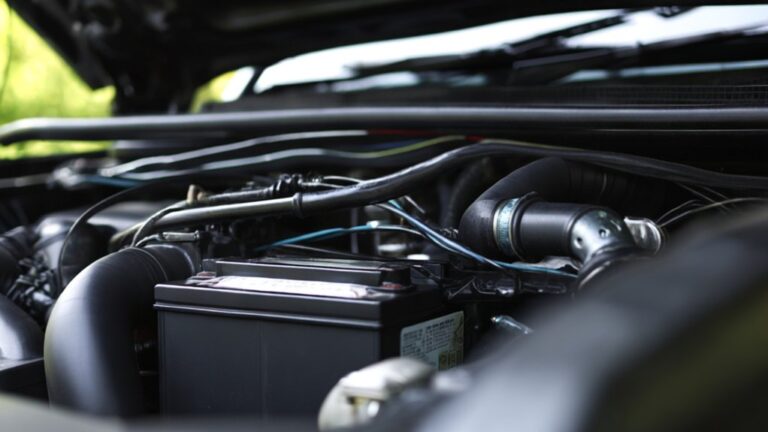
You can identify a Jeep Wrangler 4-cylinder engine by looking under the hood for a compact, narrower layout with fewer spark plug wires—typically four—and a smaller intake manifold. The valve cover on these engines is smaller compared to V6 models, which are larger and wider. You might also spot engine badges or check the VIN for confirmation. If you want to understand more about model-specific clues and maintenance tips, there’s plenty to explore ahead.
Key Takeaways
- Look for a narrow, compact engine with a smaller valve cover and intake manifold under the hood to identify a 4-cylinder Jeep Wrangler engine.
- Count four spark plug wires or ignition coils, which indicate a 4-cylinder configuration.
- Check engine labels or stickers under the hood showing displacement like “2.0L I4” or “2.5L 4-cylinder.”
- Decode the 8th character of the vehicle’s VIN using online tools to confirm the engine type.
- Listen for a higher-pitched, smoother hum at idle, typical of 4-cylinder engines compared to V6 or V8 sounds.
How to Tell If Your Jeep Wrangler Has a 4-Cylinder Engine

Although Jeep Wranglers come with various engine options, you can quickly tell if yours has a 4-cylinder engine by checking under the hood for specific engine markings or by referring to your vehicle’s specifications.
Open the hood and look for an engine badge or sticker that indicates the engine type, often found on the valve cover or air intake. You might see labels like “2.0L I4,” which signifies a 4-cylinder engine.
Additionally, consult your owner’s manual or the window sticker, usually located on the driver’s side door jamb, for detailed engine information.
If you have your vehicle identification number (VIN), you can decode it online to confirm the engine type.
These steps help you identify the 4-cylinder engine without any guesswork.
Which Jeep Wrangler Models Have 4-Cylinder Engines?
When you’re looking to find a Jeep Wrangler with a 4-cylinder engine, you’ll want to focus on specific models and trims that come equipped with these smaller powerplants.
The Jeep Wrangler JK (2007-2018) often features a 3.6L V6, but certain trims like the Sport and Sport S include a 2.5L 4-cylinder engine, especially in earlier years.
Moving to the JL generation (2018-present), the base trims usually come with a 2.0L turbocharged 4-cylinder engine, offering a good balance of power and efficiency.
The JL generation’s base trims feature a 2.0L turbocharged 4-cylinder for power and efficiency.
Additionally, the Wrangler 4xe plug-in hybrid pairs a 2.0L 4-cylinder with electric motors.
If you want a Wrangler with a 4-cylinder, focusing on these trims and model years will guide your search effectively.
Spotting Key Parts of a 4-Cylinder Engine in Your Jeep
Knowing which Jeep Wrangler models come with 4-cylinder engines helps narrow down your search, but identifying the engine itself requires a closer look under the hood.
To spot a 4-cylinder engine, focus on specific parts that set it apart from larger engines. First, check the number of spark plug wires or ignition coils—4-cylinder engines have just four.
Next, look at the intake manifold; a 4-cylinder’s is usually more compact and simpler.
Finally, examine the valve cover, which often has a smaller, less complex design compared to V6 or V8 engines.
Keep an eye out for these key indicators:
- Four spark plug wires or coils
- Compact intake manifold
- Smaller, simpler valve cover
These features will help you confidently identify a 4-cylinder engine in your Jeep Wrangler.
Finding Your Jeep’s Engine Displacement
To find your Jeep’s engine displacement, start by locating the engine identification label or stamping, which usually provides key details about the engine size.
This label is often found on the engine block itself, near the front or on the valve cover. Once you locate it, look for numbers indicating the displacement, typically in liters (L) or cubic centimeters (cc).
For example, a 2.0L engine means it has a 2-liter displacement. If you can’t find the label, check your Jeep’s owner’s manual or under the hood for a sticker with engine specs.
Knowing your engine’s displacement helps confirm if it’s a 4-cylinder and aids in maintenance or upgrades.
Keep this info handy whenever you work on your Jeep’s engine.
How to Read Your Jeep Wrangler’s Engine Codes and Labels
You can find your Jeep Wrangler’s engine code labels in a few key spots under the hood, like the valve cover or near the firewall. These codes hold valuable info about your engine’s specs and build date.
Once you know where to look, decoding these numbers will help you confirm if you have a 4-cylinder engine.
Locating Engine Code Labels
Where can you find the engine code labels on your Jeep Wrangler? Knowing where to look is key to identifying your 4-cylinder engine quickly and accurately. The labels are typically placed in a few specific spots that are easy to access once you know where to check.
Look in these common locations:
- On the valve cover or cylinder head, often near the front of the engine
- On a metal tag attached to the engine block, usually visible from above
- Near the radiator support or firewall, where a sticker or plate may list engine details
Decoding Jeep Engine Numbers
Although engine codes might look like a jumble of letters and numbers, they actually hold clear information about your Jeep Wrangler’s 4-cylinder engine. When you find the code on the engine label or stamped on the block, each section reveals specific details.
The first characters often indicate the engine family or series, while the following numbers can tell you the displacement or horsepower rating. You might also see a date code that shows when the engine was manufactured.
Checking the Vehicle Identification Number (VIN) for Engine Info
You can find your Jeep Wrangler’s VIN on the dashboard near the windshield or inside the driver’s door frame.
Once you locate it, focus on the specific characters that reveal engine details.
If you’re unsure, online VIN decoding tools can quickly help you identify whether your engine is a 4-cylinder.
Locating The VIN
Wondering how to confirm if your Jeep Wrangler has a 4-cylinder engine? The first step is locating the Vehicle Identification Number (VIN), which holds essential details about your vehicle, including the engine type.
Here’s where you can find the VIN on your Jeep:
- On the driver’s side dashboard, visible through the windshield
- Inside the driver’s side door jamb on a sticker or metal plate
- On your vehicle registration or insurance documents
Once you’ve found the VIN, you’re ready to check the engine information it encodes. Locating the VIN is quick and simple, and it’s your key to verifying your Wrangler’s engine type accurately.
Keep this number handy for any future references or checks.
Decoding Engine Characters
Once you have your Jeep Wrangler’s VIN, you can decode specific characters within it to identify the engine type. The 8th character in the VIN usually represents the engine code.
For example, a “G” might indicate a 4-cylinder engine, while other letters correspond to different engine types. You’ll want to refer to Jeep’s official engine code chart to match this character with the exact engine model.
Additionally, the 3rd character can sometimes hint at the vehicle’s series, which narrows down possible engine options.
By focusing on these key characters, you can quickly pinpoint whether your Wrangler has a 4-cylinder engine without opening the hood.
This method is reliable for most model years and saves time during identification.
Using Online VIN Tools
Several online VIN decoding tools can quickly reveal detailed engine information for your Jeep Wrangler. By entering your vehicle’s 17-character VIN, you can access accurate engine specs without guesswork. These tools pull data straight from manufacturer records, ensuring reliability.
When using online VIN tools, here’s what you can expect:
- Detailed engine type and displacement
- Manufacturing year and plant location
- Model-specific features and options
Just locate your VIN on the driver’s side dashboard or inside the driver’s door jamb, then input it into a trusted VIN decoder website. This method saves you time and helps confirm if your Jeep has the 4-cylinder engine you’re looking for.
It’s a straightforward and efficient way to identify engine details.
Using the Owner’s Manual to Confirm Your Jeep’s Engine Type
Although it might seem simple, checking your Jeep Wrangler’s owner’s manual is one of the most reliable ways to confirm whether it has a 4-cylinder engine. Inside, you’ll find detailed specifications about your vehicle, including engine type, displacement, and configuration.
Look for sections labeled “Engine Specifications” or “Vehicle Overview.” These will clearly state if your Wrangler has a 4-cylinder engine, often listing the engine code or size in liters. The manual may also include diagrams or descriptions that help you visually identify the engine.
Since the owner’s manual is tailored to your specific model and year, it eliminates guesswork. So, before you delve into more complicated methods, grab your manual and check—this straightforward step saves time and guarantees accuracy.
How to Identify a 4-Cylinder by Engine Sound
If you don’t have your owner’s manual handy, you can still identify a 4-cylinder engine by paying attention to how your Jeep Wrangler sounds when it’s running.
A 4-cylinder engine typically produces a distinct noise compared to larger engines. Here’s what you should listen for:
- A smoother, higher-pitched hum since 4-cylinder engines have fewer cylinders firing in sequence.
- Less deep rumbling or growling, which is more common in V6 or V8 engines.
- A quicker, more rhythmic firing pattern that you can sometimes hear at idle or low RPMs.
Maintenance Tasks Affected by Your Jeep’s Engine Type
Your Jeep’s engine type influences key maintenance tasks like oil change frequency, spark plug replacement, and coolant system care.
Knowing whether you have a 4-cylinder helps you follow the right schedule and use the correct parts.
Let’s explore how these tasks differ based on your engine.
Oil Change Frequency
How often should you change the oil in a Jeep Wrangler with a 4-cylinder engine? Typically, you’ll want to stick to an oil change interval of about every 5,000 to 7,500 miles, but this can vary based on your driving habits and conditions.
Keeping up with oil changes is essential to maintain engine health and performance. Here’s what to think about:
- Driving Environment: Frequent off-roading or dusty conditions may require more frequent changes.
- Oil Type: Synthetic oils often allow for longer intervals compared to conventional oils.
- Manufacturer Recommendations: Always check your owner’s manual for the specific interval suggested for your engine model.
Staying on top of oil changes guarantees your 4-cylinder Jeep Wrangler runs smoothly and avoids unnecessary wear.
Spark Plug Replacement
When should you replace the spark plugs in your Jeep Wrangler’s 4-cylinder engine? Typically, you’ll want to change them every 30,000 to 50,000 miles, but always check your owner’s manual for exact intervals.
Worn spark plugs can cause rough idling, misfires, and reduced fuel efficiency, so timely replacement guarantees your engine runs smoothly.
To replace them, first disconnect the battery, then remove the ignition coils covering the plugs. Use a spark plug socket and ratchet to carefully extract each plug.
Inspect new plugs for the correct gap and thread them in by hand before tightening with the ratchet. Reinstall the ignition coils and reconnect the battery.
Regular spark plug maintenance ensures your 4-cylinder engine performs efficiently and helps avoid costly repairs down the road.
Coolant System Care
Maintaining the spark plugs guarantees your engine runs smoothly, but keeping your Jeep Wrangler’s cooling system in check is just as important for overall performance.
The 4-cylinder engine generates heat differently, so you need to pay attention to coolant levels and system health regularly. Neglecting this can lead to overheating and costly repairs.
To care for your coolant system effectively, you should:
- Check coolant levels every month and top off with the recommended antifreeze mixture.
- Inspect hoses and radiator for leaks or cracks that could cause fluid loss.
- Flush the cooling system every 30,000 miles or as specified in your owner’s manual to remove buildup and maintain flow.
Staying on top of these tasks ensures your 4-cylinder engine stays cool and runs efficiently.
How Correctly Identifying Your Jeep’s 4-Cylinder Engine Helps Performance
Because each 4-cylinder engine model has unique features and requirements, correctly identifying yours guarantees you choose the right parts and maintenance procedures.
When you know exactly which engine you have, you avoid buying incompatible components that could harm performance or cause damage. Proper identification helps you follow manufacturer-recommended service intervals, ensuring your Jeep runs smoothly and efficiently.
It also enables you to optimize fuel economy and power by selecting the correct tuning or upgrades designed for your engine type. Additionally, accurate identification aids in troubleshooting issues faster since you can reference the right specifications and repair guides.
Ultimately, knowing your Jeep’s 4-cylinder engine inside and out helps you maintain peak performance and reliability, saving you time and money in the long run.
Myths About Jeep Wrangler 4-Cylinder Engines
Knowing your Jeep Wrangler’s 4-cylinder engine inside and out sets you up for better care and performance. It also helps clear up common misconceptions. You might hear myths that can mislead you about these engines. For example:
- They’re underpowered and can’t handle off-roading—false, as many 4-cylinder Wranglers are built for rugged terrain.
- They’re less reliable than V6 or V8 engines—which isn’t true; proper maintenance keeps them going strong.
- They’re always more fuel-efficient—while often true, driving habits and conditions greatly affect mileage.
Key Checks to Confirm Engine Type When Buying a Used Jeep Wrangler
Before you finalize a purchase, you’ll want to verify the engine type to avoid surprises down the road. Start by checking the vehicle identification number (VIN); it often provides engine details when decoded. Ask the seller for maintenance records or any documentation mentioning the engine specs. Don’t rely solely on badges or stickers—they can be misleading.
If possible, request a test drive to listen for engine sounds typical of a 4-cylinder, such as smoother, higher-pitched operation compared to a V6. You can also check the vehicle’s registration or title, which sometimes list engine information.
Ultimately, consider getting a professional inspection or running a diagnostic scan to confirm the engine type confidently before committing to buy.
Visual Differences Between 4-Cylinder and V6 Engines Under the Hood
When you pop the hood, you’ll notice the 4-cylinder engine is more compact compared to the V6’s larger size.
The cylinder arrangement is also different, with the 4-cylinder aligned in a straight line while the V6 has two banks forming a V shape.
You’ll spot distinct visual components too, like fewer exhaust manifolds and simpler intake systems on the 4-cylinder.
Engine Size Comparison
How can you tell a 4-cylinder engine apart from a V6 just by looking under the hood? The size difference is noticeable once you know what to look for.
A 4-cylinder engine is more compact, taking up less space, while a V6 is bulkier and wider. Here’s how you can spot the difference:
- Width: The 4-cylinder is narrower, fitting more snugly in the engine bay.
- Height: The V6 tends to be taller due to its extra cylinders and components.
- Overall footprint: The 4-cylinder leaves more visible space around it, whereas the V6 fills the area more completely.
Cylinder Arrangement Layout
Noticing the size difference under the hood is just the start; understanding how the cylinders are arranged helps you identify the engine type more accurately.
In a Jeep Wrangler 4-cylinder engine, the cylinders line up in a single row, forming an inline layout. This means you’ll see one long, straight engine block with four evenly spaced cylinders.
In contrast, the V6 engine has two banks of cylinders arranged in a “V” shape, creating a wider and more compact appearance. When you look under the hood, the inline 4-cylinder engine appears narrower and longer, while the V6 looks bulkier and shorter.
Visual Engine Components
Although both engines power your Jeep Wrangler efficiently, you can spot key visual differences under the hood that reveal whether you’re looking at a 4-cylinder or a V6. When you open the hood, the engine’s layout and components stand out clearly.
The 4-cylinder engine is more compact, with fewer visible parts cluttering the space. Here are some quick visual clues:
- The 4-cylinder has a smaller intake manifold compared to the bulkier V6.
- You’ll notice fewer spark plug wires on the 4-cylinder, as it only has four cylinders to serve.
- The V6 engine often has a wider valve cover, sitting higher and showing more complexity in design.
Recognizing Jeep Wrangler 4-Cylinder Engine Components and Layout
When you open the hood of a Jeep Wrangler with a 4-cylinder engine, you’ll quickly spot key components arranged in a compact, efficient layout. The engine block sits centrally, with the intake manifold and spark plugs easily visible. You’ll also see the air filter housing and battery positioned for easy access, making maintenance straightforward. Recognizing these parts helps you confirm the engine type.
| Component | Location |
|---|---|
| Engine Block | Center of engine bay |
| Air Filter Housing | Upper left side, near fender |
| Battery | Upper right side, near fender |
This layout prioritizes space-saving and functionality, typical of the Jeep Wrangler’s 4-cylinder setup, making it distinct from larger engines.
Why Knowing Your Jeep Wrangler’s 4-Cylinder Engine Matters
Understanding your Jeep Wrangler’s 4-cylinder engine lets you perform basic maintenance and troubleshoot issues more confidently. When you know your engine inside and out, you save time and money by handling simple fixes yourself and avoiding unnecessary mechanic visits. Plus, you’ll get better performance and efficiency from your Jeep.
Here’s why it matters:
- You can spot early warning signs of engine trouble before they escalate.
- Routine maintenance like oil changes and spark plug replacements become straightforward.
- Understanding your engine helps you make informed choices about upgrades and repairs.
Knowing your Jeep’s 4-cylinder engine isn’t just about mechanics; it’s about keeping your vehicle reliable and ready for any adventure.
Frequently Asked Questions
What Is the Average Fuel Economy of a Jeep Wrangler 4-Cylinder?
You can expect around 20-25 miles per gallon with a Jeep Wrangler 4-cylinder, depending on the model year and driving conditions. It’s decent for off-roading but not the most fuel-efficient SUV out there.
Can a 4-Cylinder Engine Handle Off-Road Towing?
Absolutely, a 4-cylinder can handle light off-road towing, but don’t expect dominant drags with heavy loads. You’ll want to watch weight limits and terrain, ensuring your Jeep’s power performs properly without pushing past its potential.
How Does a 4-Cylinder Engine Affect Jeep Wrangler Resale Value?
A 4-cylinder engine usually lowers your Jeep Wrangler’s resale value since buyers often prefer the power of a V6. However, you’ll attract fuel-conscious buyers who appreciate better gas mileage and lower maintenance costs.
Are 4-Cylinder Jeep Wranglers Better for City Driving?
Yes, 4-cylinder Jeep Wranglers are better for city driving because they’re more fuel-efficient and easier to maneuver in tight spaces. You’ll save on gas and enjoy a smoother, more responsive ride around town.
What Are Common Modifications for Jeep Wrangler 4-Cylinder Engines?
You’ll often upgrade your Jeep Wrangler 4-cylinder with cold air intakes, performance exhausts, and ECU tunes to boost power. Suspension lifts and bigger tires are popular too, enhancing off-road capability and overall appearance.
Conclusion
Think of identifying your Jeep Wrangler’s 4-cylinder engine like reading a map on a trail—you need the right clues to find your way. Just like one hiker once found a hidden shortcut by recognizing subtle landmarks, spotting engine codes and key parts helps you avoid costly mistakes. Knowing exactly what’s under your hood not only saves money but gives you confidence, turning every drive into a smoother, smarter adventure.