How to Lease a Jeep Wrangler Step by Step
To lease a Jeep Wrangler, first set your budget and check your credit score to secure better terms. Choose a model and trim that fits your lifestyle, then find nearby dealerships to compare inventory and negotiate lease details like monthly payments, mileage, and fees. Review the lease agreement carefully, gather required documents, and inspect the vehicle before signing. Finally, plan how you’ll handle lease-end options. Following these steps lets you smoothly navigate the leasing process and get the most from your Jeep experience.
Key Takeaways
- Determine your budget and select a Jeep Wrangler model and trim that fits your lifestyle and driving needs.
- Check and improve your credit score to qualify for better lease terms and lower monthly payments.
- Research and visit multiple dealerships to compare inventory, lease offers, and negotiate payment, mileage, and lease duration.
- Carefully review the lease agreement for accurate terms, fees, mileage limits, and maintenance responsibilities before signing.
- Prepare necessary documents like ID, proof of income, and credit reports to streamline lease approval and vehicle pickup.
How Does Jeep Wrangler Leasing Work?
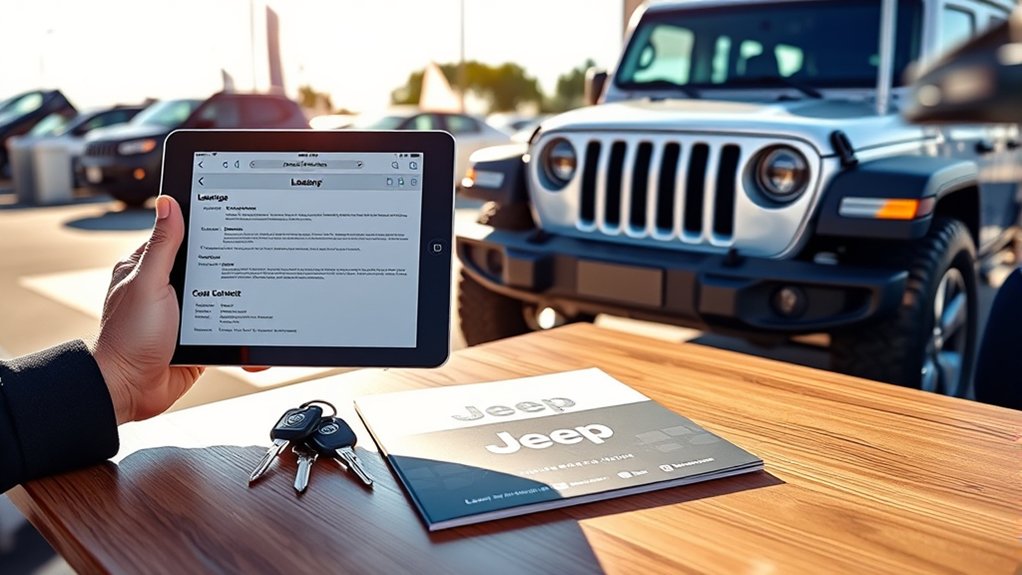
Although leasing a Jeep Wrangler might seem complex at first, it’s actually a straightforward process once you understand the basics. When you lease, you’re fundamentally renting the vehicle for a set period, typically two to three years, with monthly payments based on the Wrangler’s depreciation during that time.
You don’t own the Jeep; instead, you agree to return it at lease end, usually with mileage limits and wear guidelines to follow. You’ll pay an initial fee, monthly payments, and possibly costs for excess mileage or damage.
Leasing lets you drive a newer Wrangler with lower payments than buying. Just remember, you’re responsible for maintaining the vehicle and adhering to the lease terms to avoid extra fees at the end.
Lease vs. Buy: Jeep Wrangler Comparison
When deciding between leasing and buying a Jeep Wrangler, you’ll want to weigh the cost differences and how each option fits your budget.
Consider how much flexibility you need with ownership and what works best for your lifestyle.
Also, think about the long-term financial impact before making your choice.
Cost Differences Overview
How much will you really spend when leasing versus buying a Jeep Wrangler? Leasing typically means lower monthly payments since you’re paying for depreciation, not the full value. Buying requires a bigger upfront cost but builds equity over time. Keep these cost differences in mind:
- Leasing often needs a smaller down payment than buying.
- Buying may involve higher monthly payments but no mileage limits.
- Leasing can include additional fees for excess wear and mileage.
- When buying, you’ll face maintenance costs as the vehicle ages.
Understanding these points helps you weigh short-term affordability against long-term value. Your choice depends on whether you want lower immediate costs or eventual ownership without restrictions.
Ownership Flexibility Options
Since leasing a Jeep Wrangler typically limits your ownership duration, you’ll need to take into account how much flexibility you want in keeping or changing your vehicle.
Leasing usually locks you in for a fixed term—commonly two to three years—after which you return the Wrangler and can lease a new one. This works well if you enjoy driving the latest model without the hassle of selling a car.
On the other hand, buying gives you full ownership, letting you keep your Jeep as long as you want and modify it however you like. If you prefer long-term commitment and customization freedom, buying might suit you better.
But if you want to switch vehicles regularly without ownership responsibilities, leasing offers more flexibility.
Consider your lifestyle and preferences carefully before deciding.
Long-Term Financial Impact
What financial impact will leasing versus buying a Jeep Wrangler have on you in the long run? Leasing often means lower monthly payments and less upfront cash, but you won’t build equity.
Buying requires a bigger initial investment, but you’ll own the vehicle outright once the loan’s paid off.
Consider these points:
- Leasing usually limits mileage, potentially leading to extra fees.
- Buying lets you customize your Jeep without restrictions.
- Long-term costs of ownership include maintenance, which you might avoid during a lease.
- When you buy, your Jeep can retain resale value or trade-in worth.
Weigh these factors carefully to decide if leasing saves you money short-term or if buying is smarter financially over the years.
Set a Realistic Budget and Monthly Payment
Before you explore lease options, you need to determine a budget that fits your financial situation comfortably. Start by reviewing your monthly income and expenses to see what you can realistically allocate for your Jeep Wrangler lease payment.
Don’t forget to factor in additional costs like insurance, maintenance, and taxes. Aim for a monthly payment that won’t stretch your finances or compromise other essential expenses.
Setting this budget early helps you avoid surprises and keeps your lease manageable. Remember, leasing isn’t just about the monthly payment; it’s about the total cost of driving the vehicle.
Choose the Right Jeep Wrangler Model and Trim
Once you’ve set a realistic budget, it’s time to focus on selecting the Jeep Wrangler model and trim that best fits your needs and lifestyle. Jeep offers several models, each with unique features and capabilities. Consider how you’ll use the vehicle—daily driving, off-roading, or weekend adventures.
Choose the Jeep Wrangler model and trim that perfectly matches your lifestyle and driving needs.
Popular trims like Sport, Sahara, Rubicon, and Willys each offer different performance levels and amenities.
Here’s what to keep in mind when choosing:
- Off-road capability: Rubicon excels here
- Comfort and tech: Sahara offers more luxury features
- Budget-friendly options: Sport trim is more affordable
- Style and exclusivity: Willys trim has unique design touches
Selecting the right model and trim guarantees you enjoy your Jeep Wrangler lease to the fullest.
Check Your Credit Score Before Leasing
Before you lease your Jeep Wrangler, check your credit score to understand where you stand. Your credit report impacts the lease terms and interest rates you’ll qualify for.
If your score needs a boost, take steps to improve it before you apply.
Understand Your Credit Report
Since your credit score plays a crucial role in determining the lease terms and interest rates, you should check it carefully before applying. Understanding your credit report helps you identify any errors or negative items that might affect your score. You can request a free report from major credit bureaus once a year.
When reviewing your report, focus on:
- Personal information accuracy (name, address, etc.)
- Account status and payment history
- Any outstanding debts or collections
- Recent credit inquiries
Spotting inaccuracies or fraudulent activity early allows you to dispute them and potentially improve your credit profile.
Impact of Credit Scores
Checking your credit report is just the first step; understanding how your credit score affects your lease can make a big difference. Your credit score influences the interest rate, monthly payment, and even approval chances for leasing a Jeep Wrangler. A higher score means better lease terms, while a lower score might lead to higher costs or denial. Here’s a quick look:
| Credit Score Range | Lease Impact |
|---|---|
| 750 and above | Low interest, easy approval |
| 650 – 749 | Moderate interest, possible conditions |
| Below 650 | High interest, likely denial or large down payment |
Knowing where you stand helps you set realistic expectations and negotiate better lease deals.
Improve Credit Before Leasing
If you want to secure the best lease terms for your Jeep Wrangler, you’ll need to improve your credit score first. A higher score means lower interest rates and better monthly payments.
Start by checking your credit report for errors and disputing any inaccuracies.
Next, focus on paying down existing debts and keeping credit card balances low.
Avoid opening new credit accounts right before applying for a lease, as hard inquiries can temporarily lower your score.
Finally, make all your payments on time to build a positive history.
Here’s how to improve your credit before leasing:
- Review your credit report thoroughly
- Pay off or reduce outstanding debts
- Avoid new credit applications
- Make timely payments consistently
Taking these steps boosts your chances of getting a favorable Jeep Wrangler lease.
Find Local Jeep Wrangler Dealerships
Start by identifying at least three local Jeep Wrangler dealerships to compare their offers and inventory. Use online tools like Google Maps or the Jeep official website to locate dealerships near you.
Check each dealership’s website for their available Wrangler models, trims, and any current leasing promotions. You can also call or visit in person to verify inventory and ask about upcoming shipments if stock is low.
Visiting multiple dealerships helps you understand pricing differences and available features. Don’t forget to read customer reviews to gauge dealership reputation and service quality.
Negotiate Lease Terms and Mileage
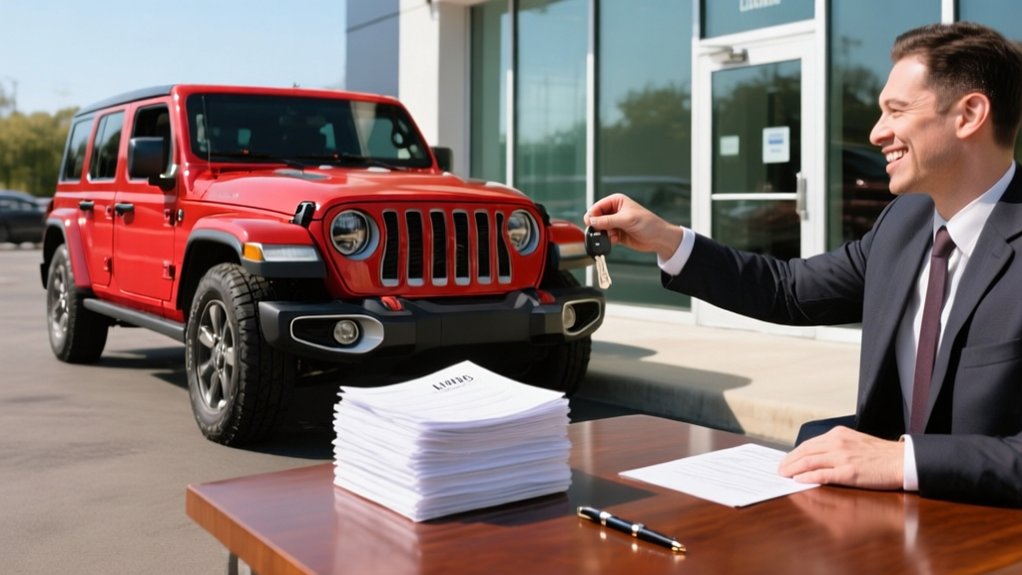
Once you’ve identified potential dealerships, it’s time to focus on negotiating the lease terms and mileage limits. Make sure you clearly understand the lease duration, monthly payments, and allowed mileage before signing.
Before signing, ensure you fully understand lease duration, monthly payments, and mileage limits.
Be ready to negotiate for terms that fit your driving habits and budget.
Keep these key points in mind when negotiating:
- Ask about the standard mileage allowance and the cost per mile for extra miles.
- Consider negotiating a higher mileage limit if you drive a lot.
- Discuss the lease term length to balance monthly payments and total cost.
- Clarify any upfront fees, down payments, or security deposits required.
How to Review Your Jeep Wrangler Lease
Before signing your Jeep Wrangler lease, you’ll want to carefully review every detail to guarantee the terms match what you negotiated and your expectations. Check the monthly payment amount, lease duration, and mileage limits against your agreed terms.
Confirm any upfront costs, such as security deposits or fees, are accurate. Look over the lease-end conditions, including wear-and-tear policies and potential charges.
Make sure the included warranty and maintenance responsibilities are clearly stated. Verify the buyout price if you’re considering purchasing the Jeep at lease end.
Don’t forget to review penalties for early termination or excess mileage. Taking the time to thoroughly examine your lease helps avoid surprises and ensures you’re fully informed before committing to the contract.
If anything seems unclear, ask the dealer for clarification before signing.
Prepare Documents for Your Jeep Lease
Before you lease your Jeep Wrangler, gather essential documents like your personal ID, proof of income, and credit history. These papers help the dealership verify your eligibility and financial stability.
Having them ready speeds up the approval process and gets you on the road faster.
Essential Personal Identification
Why do you need to gather specific personal identification documents when leasing a Jeep Wrangler? Leasing companies require these documents to verify your identity, protect against fraud, and comply with legal regulations.
Having the right identification ready speeds up the approval process and ensures a smooth lease experience.
Make sure to have these essential personal identification documents on hand:
- Valid government-issued photo ID (driver’s license or passport)
- Social Security number or card
- Proof of residency (utility bill or lease agreement)
- Any additional ID requested by the dealership or leasing company
Collecting these upfront avoids unnecessary delays and shows you’re prepared and serious about leasing your Jeep Wrangler.
Keep your documents organized and easily accessible for a hassle-free process.
Proof Of Income
Since leasing companies need to confirm you can make your monthly payments, you’ll have to provide proof of income when applying for your Jeep Wrangler lease.
Common documents include recent pay stubs, typically from the last 30 days, which show your earnings and employer details.
If you’re self-employed, prepare your latest tax returns or bank statements to demonstrate consistent income.
Some lessors may also ask for a letter from your employer verifying your position and salary.
Make sure these documents are current, accurate, and clearly show your ability to cover the lease payments.
Having your proof of income ready speeds up the approval process and shows lenders you’re financially responsible, helping you secure the best lease terms for your Jeep Wrangler.
Credit History Documents
How can you prove your creditworthiness when leasing a Jeep Wrangler? Lenders need to see your credit history documents to assess your reliability. Make sure you gather and organize these key documents before applying. These will demonstrate your financial responsibility and help speed up the approval process.
Here’s what you should prepare:
- A recent credit report from major bureaus (Experian, Equifax, TransUnion)
- Statements showing your current debts and payment history
- Documentation of any open loans or credit cards
- Letters explaining any past credit issues or disputes
Having these ready shows you’re serious and transparent, increasing your chances of a smooth lease approval.
Don’t wait until the last minute—getting your credit history documents in order is essential.
Inspect Your Jeep Wrangler Before Signing
Before you sign any lease agreement, make sure you thoroughly inspect the Jeep Wrangler to avoid unexpected issues later on. Check both the exterior and interior carefully for any damage or wear that might be noted in the lease. Confirm all features and electronics work properly. Don’t forget to test drive to spot any mechanical concerns.
| Inspection Area | What to Look For |
|---|---|
| Exterior | Scratches, dents, rust |
| Tires | Tread depth, even wear |
| Interior | Seats, dashboard, controls |
| Engine | Leaks, unusual sounds |
| Electronics | Lights, radio, navigation |
Plan Your Jeep Lease-End Options
You have three main options when your Jeep Wrangler lease ends: return the vehicle, buy it, or lease a new one. Each choice depends on your budget, driving needs, and how much you’ve enjoyed the Jeep. Before the lease ends, plan carefully to avoid surprises.
Consider these key points when deciding:
- Check for excess mileage and wear charges
- Compare the buyout price to market value
- Explore incentives for leasing a new Jeep
- Schedule your lease-end inspection early
If you choose to return the Wrangler, guarantee it’s in good condition to avoid fees. Buying it lets you keep a vehicle you love without starting fresh. Leasing new means getting the latest model with updated features.
Plan ahead to make the best decision for your situation.
Frequently Asked Questions
Can I Customize My Jeep Wrangler During the Lease?
You generally can’t customize your Jeep Wrangler during the lease without permission. Most leases restrict modifications, so you’ll need to check with the leasing company first to avoid fees or penalties when returning the vehicle.
What Insurance Coverage Is Required for a Leased Jeep Wrangler?
You’ll need full coverage insurance—liability, collision, and all-encompassing—to keep your Jeep Wrangler protected like armor on a knight. This guarantees the leasing company’s investment stays safe while you enjoy your adventure worry-free.
Are There Any Penalties for Early Lease Termination?
Yes, you’ll usually face early termination penalties if you end your lease early. These fees can be costly, including remaining payments or a lump sum. Always check your lease terms to understand potential charges before deciding.
How Does Leasing a Jeep Wrangler Affect My Taxes?
Leasing a Jeep Wrangler can lighten your tax load like a cool breeze on a hot day. You might deduct lease payments if you use it for business, but personal leases usually don’t offer tax breaks, so check carefully!
Can I Transfer My Jeep Wrangler Lease to Someone Else?
You can usually transfer your Jeep Wrangler lease, but it depends on your leasing company’s policies. You’ll need their approval, and the new lessee must qualify. Check your lease agreement and contact the leasing company first.
Conclusion
You might think leasing a Jeep Wrangler is just about paperwork and payments, but it’s also about the thrill of adventure waiting just around the corner. As you set your budget, check your credit, and pick the perfect model, you’re not just signing a lease—you’re opening the door to unforgettable journeys. Funny how a simple decision can lead to so many new memories. Ready to hit the road? Your Wrangler’s waiting.