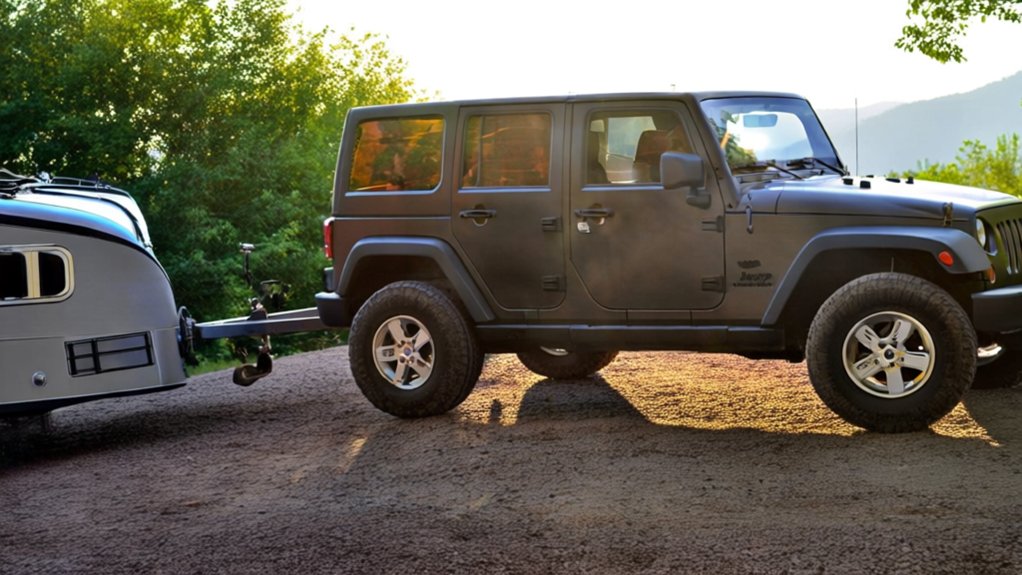
How to Determine What Size Camper a Jeep Wrangler Can Pull
To find the right camper size for your Jeep Wrangler, start by checking your owner’s manual or the door jamb label for its towing capacity based on your model, engine, and any towing packages. Make sure the camper’s weight, plus passengers and cargo, stays within your Jeep’s Gross Combined Weight Rating (GCWR). Consider your engine size and upgrades, since they affect towing limits. Knowing this helps you tow safely and confidently—there’s more to learn about optimizing your setup and handling different terrains.
Key Takeaways
- Check your Jeep Wrangler’s owner’s manual or door jamb label for exact towing capacity and weight ratings per model and trim.
- Match camper weight with your Jeep’s towing capacity, considering engine size, transmission, and any factory towing packages.
- Calculate Gross Combined Weight Rating (GCWR) to ensure total vehicle, camper, cargo, and passengers stay within safe limits.
- Factor in terrain and driving conditions, reducing towing load on steep or off-road routes for safety and vehicle protection.
- Use proper hitching techniques, secure safety chains, and perform pre-trip checks on tires, brakes, and connections before towing.
How to Quickly Find Your Jeep Wrangler’s Towing Capacity
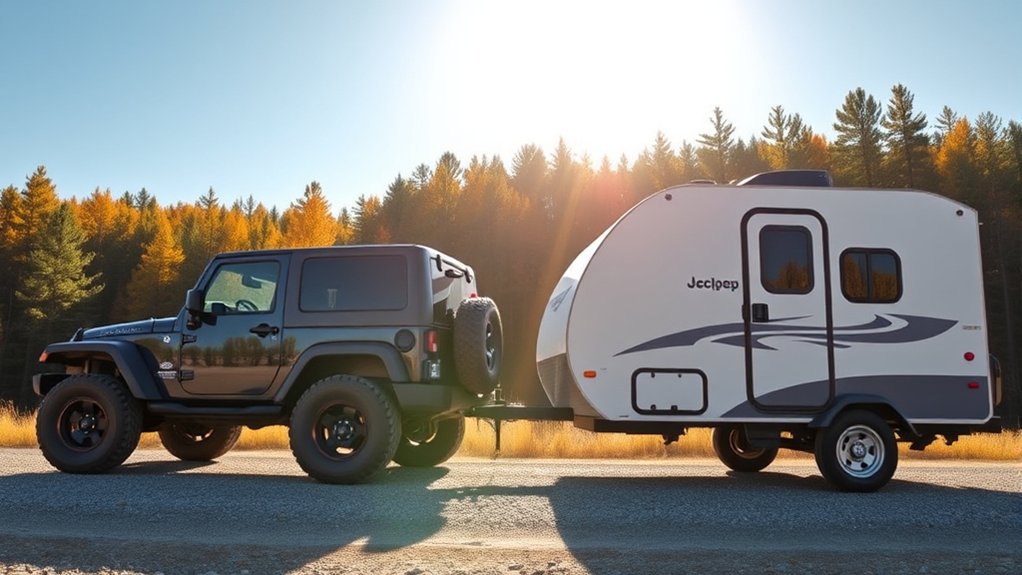
Wondering how to quickly find your Jeep Wrangler’s towing capacity? Start by checking your owner’s manual—it has the exact specs for your model year and trim.
Quickly find your Jeep Wrangler’s towing capacity by checking your owner’s manual for exact specs.
If you don’t have the manual handy, visit Jeep’s official website or use online resources by entering your Wrangler’s year and model.
You can also find a label inside the driver’s door jamb; it usually lists towing limits.
Keep in mind, towing capacity varies depending on engine type, transmission, and whether your Jeep has a factory towing package.
Knowing this number is essential because it tells you the maximum weight your Wrangler can safely pull without risking damage or compromising safety.
Once you know your towing capacity, you’re ready to pick a camper that fits within those limits.
Understanding Gross Combined Weight Rating (GCWR) for Your Jeep
To tow safely, you need to understand your Jeep’s Gross Combined Weight Rating (GCWR), which is the total weight of your vehicle, camper, and cargo.
Staying within this limit is essential to prevent damage and guarantee control on the road.
Defining Gross Combined Weight
Although you might be keen to hit the road with your camper, understanding your Jeep Wrangler’s Gross Combined Weight Rating (GCWR) is essential to guarantee safe towing. Gross Combined Weight (GCW) is the total weight of your Jeep, the camper, passengers, cargo, and fuel—all combined. Staying within your Jeep’s GCWR ensures your vehicle handles well and brakes effectively.
| Component | Description | Example Weight (lbs) |
|---|---|---|
| Jeep Wrangler | Vehicle weight + passengers | 4,500 |
| Camper | Trailer weight fully loaded | 2,000 |
| Cargo & Fuel | Gear, supplies, and fuel | 500 |
| Total GCW | Sum of all combined weights | 7,000 |
| Jeep’s GCWR Limit | Maximum safe combined weight | 7,500 |
Knowing these numbers helps you avoid exceeding your Jeep’s limits.
Importance of GCWR Limits
When you tow a camper with your Jeep Wrangler, staying within the GCWR limits safeguards your vehicle’s performance and your safety on the road. The Gross Combined Weight Rating (GCWR) is the maximum total weight your Jeep and camper can safely handle together. Ignoring this limit can cause serious mechanical strain and increase accident risk.
Here’s why GCWR matters:
- Protects your Jeep’s engine and transmission from overheating and premature wear.
- Ensures stable handling and braking, letting you control your vehicle safely.
- Prevents legal issues and insurance complications by adhering to manufacturer guidelines.
Knowing and respecting your Jeep’s GCWR helps you enjoy towing without compromising reliability or safety.
Calculating Jeep’s Towing Capacity
Calculating your Jeep’s towing capacity starts with understanding the Gross Combined Weight Rating (GCWR), which tells you the maximum weight your Jeep and camper can safely handle together. To find your GCWR, check your owner’s manual or the manufacturer’s website.
Once you know your Jeep’s GCWR, subtract your Jeep’s curb weight—the weight of your Jeep without any cargo or passengers—to determine the maximum weight your camper can be.
Why Engine Size Limits Your Jeep Wrangler’s Camper Weight
Since your Jeep Wrangler’s engine size directly affects its performance capabilities, it also determines how much camper weight it can safely handle. A bigger engine generally means more power and torque, which are essential for towing heavy campers.
Here’s why engine size limits your camper weight:
- Power Output: Larger engines produce more horsepower, helping your Wrangler accelerate and maintain speed when towing.
- Torque: Engines with higher torque provide better pulling force, especially important for climbing hills or towing on uneven terrain.
- Cooling and Durability: Bigger engines handle the stress of towing better, reducing the risk of overheating or mechanical wear.
Understanding these factors helps you match your camper size to your Jeep’s engine, ensuring safe and efficient towing without overstressing your vehicle.
How Wrangler Models (JK, JL, Etc.) Impact Towing Capacity
Although all Jeep Wranglers share a rugged design, their towing capacities vary considerably across models like the JK and JL.
When choosing a camper, you need to know that JK models (produced from 2007 to 2018) generally tow up to 3,500 pounds.
In contrast, the newer JL models (from 2018 onward) have improved engineering and can tow up to 3,500 or 3,500+ pounds, depending on the engine and configuration.
The differences come down to frame strength, suspension, and drivetrain enhancements.
If you have a two-door or four-door version, towing capacity might also shift slightly.
Knowing your specific Wrangler model helps you pick a camper size that won’t strain your vehicle or compromise safety on the road.
Always check the manufacturer’s towing specs for your exact trim.
How Towing Packages and Upgrades Boost Your Jeep’s Towing Ability
Knowing your Jeep Wrangler’s base towing capacity is just the start. You can enhance its towing ability with the right packages and upgrades. Here’s how:
Understanding your Jeep Wrangler’s base towing capacity is essential before exploring upgrades to boost its performance.
- Factory Towing Package – This often adds a heavy-duty hitch receiver, upgraded wiring harness, and transmission cooler. All of these are designed to handle extra towing stress.
- Suspension Upgrades – Installing stronger springs or adding helper air springs improves load support and stability when pulling heavier campers.
- Brake Enhancements – Upgrading to more robust brakes or adding a trailer brake controller ensures safer stopping power under increased load.
Why Trailer Weight and Tongue Weight Matter for Jeep Towing
When you tow a camper with your Jeep Wrangler, trailer weight and tongue weight directly affect your vehicle’s performance and safety. Trailer weight is the total weight of the camper, while tongue weight is the downward force on the hitch. Both impact handling, braking, and fuel efficiency, so you need to keep them within your Jeep’s limits.
| Weight Type | Effect on Jeep | Recommended Limit |
|---|---|---|
| Trailer Weight | Affects engine strain, braking | Max towing capacity |
| Tongue Weight | Influences rear axle load, sway | 10-15% of trailer weight |
| Excess Weight | Risks damage, unsafe driving | Avoid exceeding specs |
Monitoring these weights ensures a safer, smoother towing experience with your Wrangler.
Choosing the Right Camper Size for Your Jeep Wrangler
Keeping your Jeep Wrangler’s towing limits in mind, selecting the right camper size becomes essential for safe and efficient travel. To choose wisely, consider these key factors:
1. Check Your Jeep’s Towing Capacity****
Know your Wrangler’s maximum towing weight, including the tongue weight, to avoid overloading.
2. Assess Camper Weight and Size****
Pick a camper whose dry weight fits comfortably within your Jeep’s limits. Smaller models or teardrop trailers often work best.
3. Consider Driving Conditions and Terrain****
If you plan off-road trips, lighter and more compact campers improve maneuverability and safety.
Tips for Hooking Up Your Camper Safely With Your Jeep
Although hooking up your camper might seem straightforward, taking the right safety precautions guarantees a secure connection and smooth towing experience.
Start by aligning your Jeep and camper carefully, ensuring the hitch ball and coupler are properly positioned. Lower the camper onto the hitch ball slowly, then lock the coupler tightly to avoid any movement.
Align your Jeep and camper precisely, lower the camper slowly, and securely lock the coupler to prevent movement.
Always attach safety chains in a crisscross pattern under the hitch; this backup prevents the camper from dropping if the hitch fails.
Connect the electrical plug to synchronize brake lights and turn signals.
Finally, check the tire pressure on both vehicles and test the brakes before hitting the road.
Double-check all connections before driving to keep your journey safe and stress-free.
Common Jeep Wrangler Towing Mistakes to Avoid
When towing with your Jeep Wrangler, don’t ignore its towing capacity limits or you risk serious damage.
You’ll also want to pay close attention to tongue weight to keep your camper stable on the road.
Finally, make sure you use proper braking techniques to stay safe during your trip.
Ignoring Towing Capacity Limits
If you ignore your Jeep Wrangler’s towing capacity limits, you risk damaging your vehicle and compromising safety. Exceeding these limits strains the engine, transmission, and brakes, leading to costly repairs and decreased performance.
Plus, it increases the chance of accidents on the road. To avoid these issues, keep these points in mind:
- Know your Wrangler’s exact towing capacity by checking the owner’s manual or manufacturer specs.
- Calculate the total trailer weight, including cargo, to ensure it stays within limits.
- Don’t assume all Jeep Wranglers have the same towing capacity—variations exist based on model, engine, and year.
Sticking to your Wrangler’s towing limits keeps you safe and preserves your vehicle’s longevity.
Overlooking Tongue Weight Importance
Knowing your Jeep Wrangler’s towing capacity is just one part of safe towing; paying attention to tongue weight is equally important.
Tongue weight is the downward force your camper’s hitch exerts on your Jeep’s hitch receiver. If it’s too light, your trailer can sway dangerously. Too heavy, and it strains your suspension and reduces steering control.
You’ll want tongue weight to be about 10-15% of the camper’s total loaded weight. Overlooking this can lead to poor handling, increased wear, and unsafe driving conditions.
Always use a tongue weight scale to measure before hitting the road. Balancing the load inside your camper and ensuring proper hitch setup prevents these issues, helping you tow safely and confidently with your Jeep Wrangler.
Neglecting Proper Brake Usage
Even experienced Jeep Wrangler owners can overlook the importance of proper brake usage while towing, which can lead to dangerous situations on the road. When you neglect your camper’s brake system, you risk longer stopping distances and reduced control.
To prevent this:
- Check brake compatibility – Ensure your camper’s brakes are compatible with your Wrangler’s towing setup.
- Test brake responsiveness – Before hitting the road, test that your trailer brakes engage smoothly with your Jeep’s brakes.
- Maintain brake components – Regularly inspect and maintain brake pads, wiring, and controllers to avoid failure.
How Terrain and Driving Conditions Affect Jeep Towing Capacity
How do different terrains and driving conditions impact your Jeep Wrangler’s towing capacity? When you tow on flat, smooth roads, your Jeep performs near its maximum capacity. But once you hit hills, rough trails, or slippery surfaces, the strain increases, decreasing the effective towing limit. You need to adjust your expectations and driving approach accordingly.
| Terrain Type | Impact on Towing Capacity | Driving Tips |
|---|---|---|
| Flat Pavement | Full capacity | Maintain steady speed |
| Steep Inclines | Reduced capacity (up to 25%) | Use lower gears, slow down |
| Off-road/Mud | Notably reduced | Engage 4WD, drive cautiously |
Keep these factors in mind to avoid overloading and ensure safe towing on any adventure.
Maintenance Tips to Keep Your Jeep Wrangler Towing Safely
Because towing puts extra stress on your Jeep Wrangler, you need to stay on top of regular maintenance to keep it running safely. Neglecting this can lead to costly repairs or dangerous breakdowns while on the road. Focus on these key areas:
- Check Fluids Regularly – Monitor engine oil, transmission fluid, and coolant levels to prevent overheating and wear.
- Inspect Brakes and Tires – Ensure your brakes are responsive and tires have proper tread and pressure to handle extra weight.
- Maintain the Hitch and Wiring – Secure the hitch, check for rust, and verify trailer lights and signals work correctly.
Frequently Asked Questions
What Type of Hitch Is Best for Towing With a Jeep Wrangler?
You’ll want a Class III or IV hitch for towing with your Jeep Wrangler. These hitches provide the right strength and stability for most campers, ensuring safe and secure towing without overloading your vehicle.
Can a Jeep Wrangler Tow a Camper With a Rear-Mounted Spare Tire?
Don’t let that rear-mounted spare tire scare you—you can tow a camper with it! Just make certain the hitch is properly installed and the tire doesn’t interfere with clearance. Safety and balance keep your adventure rolling smoothly.
How Does Adding a Trailer Brake Controller Improve Towing Safety?
Adding a trailer brake controller improves towing safety by syncing your Jeep’s brakes with the trailer’s, giving you better control, reducing stopping distance, and preventing trailer sway. You’ll feel safer and handle emergencies more effectively.
Are There Legal Towing Restrictions for Jeep Wranglers in Different States?
Yes, towing laws vary by state, but don’t worry—you can easily check local restrictions online or with DMV. Staying informed helps you tow safely and legally, letting you enjoy your adventures without hassle or fines.
What Are the Fuel Economy Impacts When Towing a Camper With a Jeep?
Towing a camper with your Jeep drastically lowers fuel economy, often by 20-40%. You’ll notice increased engine strain and reduced MPG, so plan for more frequent stops and higher fuel costs during your trips.
Conclusion
Now that you know how to size your camper for your Jeep Wrangler, you’re ready to hit the road without a hitch—literally! Remember, ignoring towing limits is like trying to fit an elephant in a suitcase—it just won’t work. Keep your Jeep’s capacity, upgrades, and terrain in mind, and always follow safety tips. With proper care and attention, your Wrangler will tow smoothly and confidently, turning every trip into an unforgettable adventure.