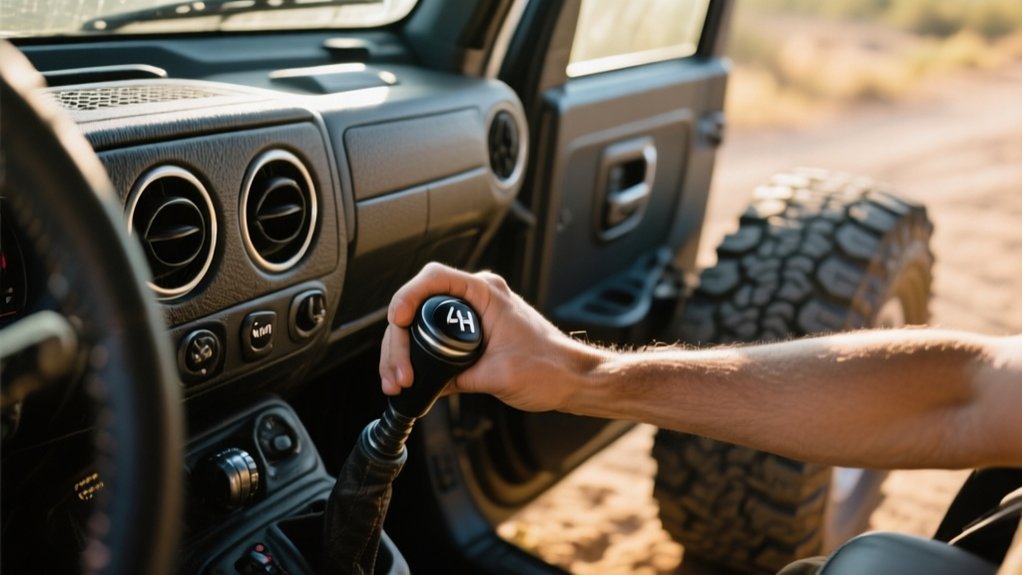
How to Use 4H Auto on a Jeep Wrangler
To use 4H Auto on your Jeep Wrangler, locate the 4WD control knob or switch and turn it to the 4H Auto position while driving at low speed without stopping. The system will automatically distribute power between front and rear wheels for better traction on slippery or uneven surfaces. Keep an eye on the indicator lights to confirm activation and switch back to 2H when roads dry to avoid wear. Explore further to understand when and why to choose this mode.
Key Takeaways
- Locate the 4WD control knob or switch and turn it to the 4H Auto position without stopping or shifting into neutral.
- The 4H Auto indicator light confirms activation, showing the system is adjusting power between front and rear wheels automatically.
- Use 4H Auto on slippery or uneven terrain to enhance traction and stability at normal driving speeds.
- Shift back to 2H on dry pavement and reduce speed to about 25 mph or less before switching to avoid drivetrain wear.
- Monitor warning and traction control lights for system status and maintain safe driving practices while using 4H Auto.
What Is 4H Auto on a Jeep Wrangler?

Although it might seem confusing at first, 4H Auto on a Jeep Wrangler automatically adjusts power between the front and rear wheels as needed. You don’t have to manually switch or worry about losing traction because the system senses wheel slip and redistributes torque instantly.
This mode lets you drive at higher speeds on paved or lightly slippery roads without sacrificing control. It’s perfect when conditions change suddenly, like encountering wet pavement or light gravel.
You’ll notice smoother handling since 4H Auto balances power for ideal grip without you needing to intervene. Using this mode means you get the benefits of four-wheel drive without the hassle of constant adjustments, making your driving experience safer and more convenient in varying road conditions.
How 4H Auto Improves Off-Road Traction
A key advantage of 4H Auto is how it boosts your Jeep Wrangler’s off-road traction by automatically adjusting power distribution to the wheels with the most grip. This system senses wheel slippage and reallocates torque, helping you maintain steady control on uneven or slippery terrain. You don’t have to manually switch modes to adapt, which keeps your focus on driving.
| Terrain Type | Traction Challenge | 4H Auto Benefit |
|---|---|---|
| Mud | Wheels slip easily | Sends power to gripping wheels |
| Gravel | Loose surface | Balances torque for stability |
| Snow | Reduced grip | Improves wheel engagement |
| Rocky Trails | Uneven traction | Adjusts power to stable wheels |
| Wet Grass | Slick surface | Prevents wheel spin |
With 4H Auto, your Jeep handles varied off-road conditions smoothly.
When to Use 4H Auto vs. 4L or 2H
You’ll want to use 4H Auto on slippery or uneven terrain where extra traction helps but you still need to maintain normal driving speeds.
Switch to 4L when you face steep climbs, deep mud, or rock crawling that requires maximum torque and slower speeds.
Use 2H for regular driving on dry, smooth roads to save fuel and reduce wear on your drivetrain.
Terrain Types for 4H
When driving on moderately challenging terrain, 4H Auto lets your Jeep Wrangler adjust power between the front and rear wheels automatically, providing better traction without sacrificing speed. You’ll find 4H Auto perfect for wet roads, gravel, light mud, and snowy conditions where you need extra grip but still want to maintain highway speeds.
It’s ideal when traction varies, like on mixed pavement and dirt trails. Avoid using 4H Auto on extremely rough or steep terrain—that’s when 4L is better suited.
On dry pavement or simple highways, stick to 2H for efficiency. Using 4H Auto in the right terrain guarantees your Jeep handles smoothly, giving you confidence without the hassle of manually switching modes.
Differences Between 4H and 4L
Although 4H Auto and 4L both provide four-wheel drive, they serve different purposes depending on the terrain and driving conditions. You’ll use 4H Auto for everyday off-road adventures and slippery roads, delivering power to all wheels while maintaining higher speeds.
In contrast, 4L is designed for extreme conditions like steep climbs, deep mud, or rock crawling, where you need maximum torque at low speeds.
Choosing the right mode matters because:
- 4H Auto keeps you safe and efficient on unpredictable surfaces.
- 4L gives you control when the terrain demands power over speed.
- Using 4L on dry pavement risks damage and loss of control.
- Switching between modes at the right time feels empowering and smart.
Pick wisely to enjoy your Jeep’s full potential.
How to Activate 4H Auto on Your Jeep Wrangler
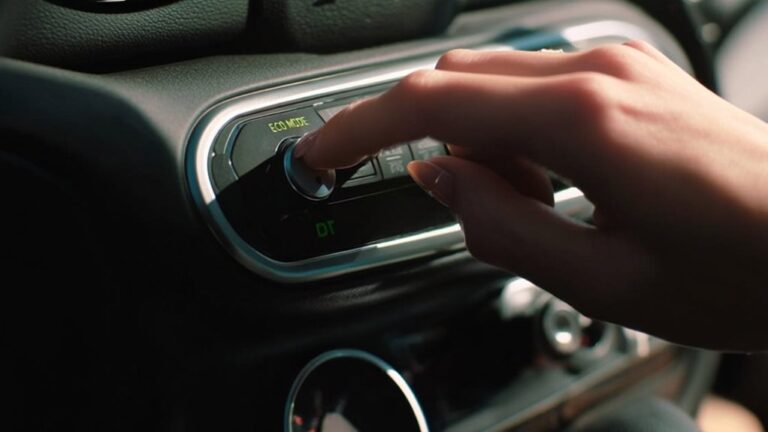
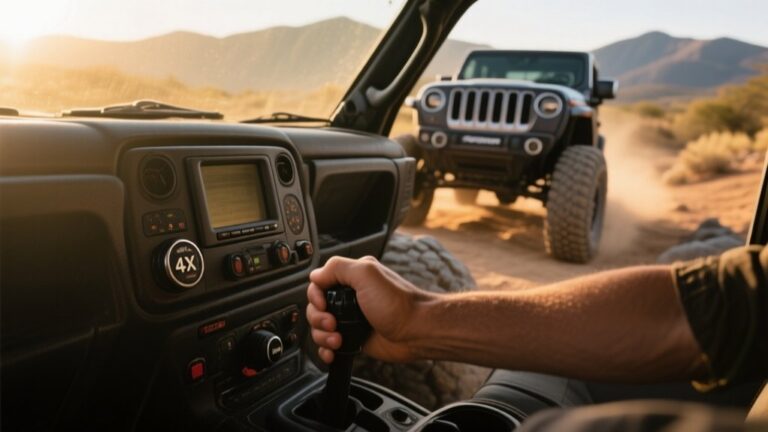
To activate 4H Auto on your Jeep Wrangler, start by locating the 4WD control knob or switch on your dashboard.
Once you find it, simply turn or press it to the 4H Auto position. This engages the drive mode, allowing your Jeep to automatically distribute power as needed.
Locating The 4H Auto
Before activating 4H Auto on your Jeep Wrangler, you’ll need to locate the control switch, which is typically found on the dashboard or center console. This switch is your gateway to enhanced traction and control in varying road conditions.
Look for a dial or button labeled “4H Auto” or a similar icon representing four-wheel drive.
Finding this switch quickly can boost your confidence and safety when the terrain changes unexpectedly. Here’s what to keep in mind:
- It’s often near the gear shifter for easy reach
- Illuminated indicators help confirm your selection
- Familiarity reduces hesitation in tricky situations
- The tactile feel of the switch makes it intuitive to use
Knowing exactly where this control lies puts you in command of your Jeep’s capabilities.
Engaging The Drive Mode
Once you’ve located the 4H Auto switch, engaging the drive mode is quick and straightforward, allowing you to adapt to changing road conditions without stopping.
To activate 4H Auto, simply turn the dial or press the button marked “4H Auto” on your Jeep Wrangler’s center console. You don’t need to shift into neutral or stop the vehicle, making it convenient for sudden changes in terrain.
The system will automatically distribute power between the front and rear wheels, improving traction on slippery or uneven surfaces. You’ll usually see an indicator light on the dashboard confirming that 4H Auto is engaged.
When you’re back on dry pavement, just switch back to 2H for normal driving to avoid unnecessary wear on the drivetrain.
How to Read Jeep Wrangler 4WD Indicators
Although the Jeep Wrangler’s 4WD system offers excellent control, you’ll need to understand its dashboard indicators to use it effectively. These lights help you know when 4H Auto is active and if the system detects any issues.
Look for these key indicators:
- 4WD Indicator Light: Confirms when 4H Auto is engaged, giving you confidence on rough terrain.
- Warning Light: Alerts you to potential problems, so you can act before trouble escalates.
- Traction Control Light: Shows when traction control is working, enhancing your grip and safety.
- Transfer Case Indicator: Tells you which drive mode the vehicle is in, preventing accidental misuse.
How 4H Auto Switches Between 2WD and 4WD Automatically
When you drive with 4H Auto engaged, your Jeep Wrangler seamlessly switches between 2WD and 4WD based on road conditions, so you don’t have to manually adjust the system. Sensors constantly monitor wheel slippage, road traction, and vehicle speed.
When the system detects loss of traction, it automatically engages 4WD to provide better grip and control. Once traction improves, it reverts to 2WD to optimize fuel efficiency and reduce drivetrain wear.
This automatic changeover happens smoothly, without you needing to intervene or stop the vehicle. This means you can focus on driving, confident that your Wrangler is adapting in real-time to changing surfaces, whether you’re cruising on pavement or encountering slippery patches.
The 4H Auto system balances performance and convenience effortlessly.
Driving Conditions That Benefit Most From Jeep Wrangler 4H Auto
You’ll find 4H Auto especially useful on wet and slippery roads where traction changes constantly.
It also handles mixed terrain conditions smoothly by adjusting power as needed.
Plus, it’s perfect for light off-road trails where you want extra grip without switching modes manually.
Wet And Slippery Roads
Since wet and slippery roads reduce traction, engaging 4H Auto on your Jeep Wrangler helps maintain stability by automatically adjusting power between the front and rear wheels. This feature lets you focus on driving confidently, knowing your vehicle adapts instantly to changing conditions.
You’ll feel more secure steering through rain-soaked streets or slick patches without constantly worrying about losing control.
With 4H Auto activated, you get:
- Enhanced grip that keeps your Jeep glued to the road
- Reduced risk of skidding or fishtailing
- Smooth power distribution for safer cornering
- Peace of mind during sudden downpours or early morning frost
Trusting 4H Auto in these conditions means you can drive smarter, not harder, no matter how slippery the road gets.
Mixed Terrain Conditions
Controlling wet and slippery roads showcases how 4H Auto adjusts power to keep your Jeep stable, but its benefits extend far beyond just slick pavement. When you’re orchestrating mixed terrain—think patches of gravel, mud, and uneven surfaces—4H Auto seamlessly adapts, delivering power where it’s needed most.
You don’t have to constantly switch modes; the system senses traction changes and redistributes torque between front and rear wheels for ideal grip. This means you can focus on steering and maintaining momentum without worrying about sudden loss of control.
Whether you’re crossing a muddy field or a rocky dirt path combined with loose sand, 4H Auto helps your Wrangler maintain stability and traction, making your drive safer and more confident on unpredictable surfaces.
Light Off-Road Trails
When steering light off-road trails, your Jeep Wrangler’s 4H Auto mode shines by automatically adjusting power distribution to handle uneven dirt paths, shallow ruts, and loose gravel. This means you can focus on the adventure instead of constantly switching modes.
The system enhances traction without sacrificing fuel efficiency, giving you confidence on less demanding terrain. Whether you’re exploring forest tracks or sandy backroads, 4H Auto keeps your Wrangler ready for unexpected changes.
- Feel the thrill of smooth, controlled handling on tricky surfaces
- Trust your Jeep to tackle surprises without stopping
- Enjoy the freedom to explore new paths with less worry
- Stay connected to nature while your vehicle handles the rough spots effortlessly
4H Auto vs. Other 4WD Modes Explained
How does 4H Auto differ from other 4WD modes on your Jeep Wrangler? Unlike 4H Part-Time, which locks power evenly between front and rear axles and is best for consistent off-road or slippery surfaces, 4H Auto automatically adjusts power distribution based on traction needs.
This means it primarily drives the rear wheels but shifts torque to the front when slippage occurs, giving you better fuel efficiency and smoother on-road handling.
In contrast, 4L (Low Range) provides maximum torque for tough, slow-speed off-roading, while 2H (Two-Wheel Drive High) powers only the rear wheels for normal driving conditions.
When and How to Shift Out of 4H Auto Safely
Understanding the differences between 4H Auto and other 4WD modes helps you know the best times to switch out of 4H Auto. You should shift out when road conditions improve and you’re back on dry pavement. This keeps your Jeep running efficiently and prevents unnecessary wear.
To shift out safely, slow down to about 25 mph or less, then simply move the transfer case lever or dial back to 2H while driving. Avoid sudden turns or hard acceleration during the shift.
Remember these key points:
- Feel confident knowing you’re protecting your drivetrain.
- Enjoy smoother handling on dry roads.
- Save money by preventing premature component damage.
- Experience peace of mind with proper vehicle care.
Common 4H Auto Mistakes to Avoid
You might run into trouble if you misunderstand how 4H Auto actually works or rely on it too much. It’s easy to forget that different terrains need different approaches.
Ignoring that can cause problems. Let’s look at these common mistakes so you can avoid them.
Misunderstanding 4H Auto Function
Although 4H Auto is designed to simplify driving on varying terrains, many Jeep Wrangler owners often misuse it by assuming it works like traditional 4WD modes. You might expect it to lock power evenly to all wheels all the time, but 4H Auto actually adjusts torque automatically based on traction. Misunderstanding this can lead to frustration and even unsafe driving conditions.
Avoid these common pitfalls:
- Assuming 4H Auto is always as capable as 4H Part-Time
- Expecting constant power distribution regardless of road conditions
- Using 4H Auto for extreme off-roading without switching modes
- Neglecting to check your owner’s manual for proper usage
Knowing how 4H Auto truly works helps you use it confidently and safely.
Overusing 4H Auto Mode
Many Jeep Wrangler owners make the mistake of relying too heavily on 4H Auto, thinking it’s a catch-all solution for any driving condition. While 4H Auto offers great convenience by automatically adjusting power between front and rear wheels, overusing it can lead to unnecessary wear on your drivetrain.
You don’t want to keep it engaged on dry pavement for extended periods since it’s designed to activate four-wheel drive only when needed. Using 4H Auto constantly might also reduce fuel efficiency and cause premature tire wear.
Instead, switch to 2H mode when you’re mainly driving on regular roads with good traction. Save 4H Auto for situations where you expect changing traction conditions, so your Jeep performs at its most effective without putting extra strain on its components.
Ignoring Terrain Conditions
When terrain conditions vary, relying solely on 4H Auto without evaluating the environment can lead to poor performance and potential safety risks. You might think 4H Auto handles every off-road situation seamlessly, but ignoring the specific terrain can cause your Jeep to lose traction or even get stuck.
Always assess the surface before engaging 4H Auto. Mud, sand, rocks, and snow each demand different approaches. Don’t let overconfidence or inattention put you in a tough spot.
Avoid these pitfalls:
- Feeling invincible on unpredictable terrain
- Overestimating 4H Auto’s adaptability
- Neglecting to switch modes when conditions change
- Ignoring warning signs like slipping or unusual noises
Stay alert, and use 4H Auto wisely for safer, smoother adventures.
How to Troubleshoot 4H Auto Engagement Issues
If your Jeep Wrangler’s 4H Auto mode isn’t engaging as expected, you’ll want to start by checking the basics like the transfer case position and vehicle speed. Make sure the transfer case lever or dial is correctly set to 4H Auto.
Begin troubleshooting your Jeep Wrangler’s 4H Auto mode by verifying the transfer case setting and vehicle speed.
Also, confirm you’re driving within the recommended speed range for engagement, usually under 55 mph.
If it still won’t engage, inspect the 4WD indicator light—if it’s off or flickering, there might be an electrical issue.
Next, check the fuses related to the 4WD system and look for damaged wiring connections near the transfer case.
If everything seems fine but problems persist, your Jeep might need a diagnostic scan to identify sensor or actuator faults.
Addressing these steps helps pinpoint and often resolve 4H Auto engagement issues effectively.
Maintaining Your Jeep’s 4WD System
After troubleshooting 4H Auto engagement issues, keeping your Jeep’s 4WD system in good shape will help prevent future problems. Regular maintenance ensures your Wrangler performs reliably when you need it most.
You should:
- Check and change the transfer case fluid according to your owner’s manual to avoid wear and tear.
- Inspect drive shafts and universal joints for damage or excessive play, preventing unexpected breakdowns.
- Clean and lubricate 4WD components to keep them moving smoothly and reduce friction.
- Test the 4H Auto mode periodically on safe terrain to confirm it engages properly and catches any early issues.
How Weather Affects 4H Auto Use
Because weather conditions directly impact traction and vehicle control, understanding how different climates affect your Jeep Wrangler’s 4H Auto mode is essential.
In wet or rainy conditions, 4H Auto helps by automatically adjusting power to the wheels with the best grip, improving stability without you needing to switch modes manually.
When driving on snow or ice, it provides better traction than 2WD, but you should still drive cautiously since slippery surfaces can challenge even 4WD systems.
In dry, clear weather, 4H Auto can engage unnecessarily, causing slight tire wear and reduced fuel efficiency, so you might prefer 2WD in those cases.
Tips to Maximize Fuel Efficiency With 4H Auto
While 4H Auto enhances your Jeep Wrangler’s traction, it can also impact fuel efficiency if not used wisely. To get the most out of every gallon, you’ll want to manage how and when you engage 4H Auto. Using it only when necessary prevents unnecessary energy loss.
4H Auto boosts traction but should be used selectively to optimize your Jeep Wrangler’s fuel efficiency.
Here are some tips to keep your fuel economy in check:
- Shift to 2H on dry, paved roads to avoid wasting fuel.
- Maintain steady speeds; sudden acceleration wastes fuel.
- Keep your tires properly inflated for ideal rolling resistance.
- Remove excess weight and unnecessary accessories that increase drag.
Upgrading or Customizing Your Jeep Wrangler’s 4H Auto Features
If you want to enhance your Jeep Wrangler’s 4H Auto capabilities, several upgrades and customizations can help you tailor its performance to your driving style and terrain needs.
Installing a high-quality limited-slip or locking differential improves traction on slippery surfaces, giving you better control in 4H Auto mode.
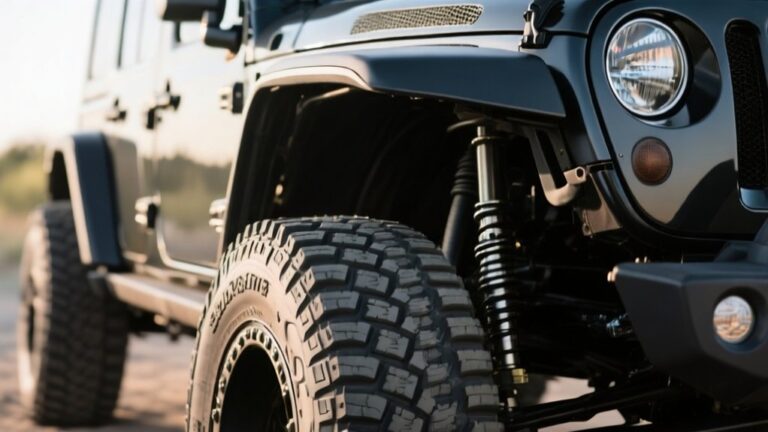
Upgrading to all-terrain or mud-terrain tires also enhances grip and durability.
You might consider adding a performance tuner or programmer to adjust the transfer case settings for quicker engagement or smoother shift.
Additionally, installing skid plates protects essential components when off-roading.
These modifications not only boost 4H Auto functionality but also increase your Jeep’s overall off-road readiness, making your driving experience safer and more enjoyable wherever you go.
Frequently Asked Questions
Can 4H Auto Be Used on Paved Roads Without Damaging the Drivetrain?
Yes, you can use 4H Auto on paved roads without damaging the drivetrain. It’s designed to automatically adjust power between wheels, providing better traction without causing drivetrain bind or excessive wear during normal driving conditions.
Does 4H Auto Affect Tire Wear Compared to Other 4WD Modes?
Like a telegram from the past, here’s the scoop: 4H Auto generally causes less tire wear than 4H Part-Time because it automatically adjusts power distribution, reducing drivetrain binding and uneven tire wear when driving on mixed surfaces.
How Does 4H Auto Interact With Jeep’s Traction Control System?
4H Auto works seamlessly with your Jeep’s traction control system, automatically adjusting power to wheels for ideal grip. You’ll notice improved stability on slippery surfaces without manually switching modes or disabling traction control.
Can I Engage 4H Auto While Towing a Trailer?
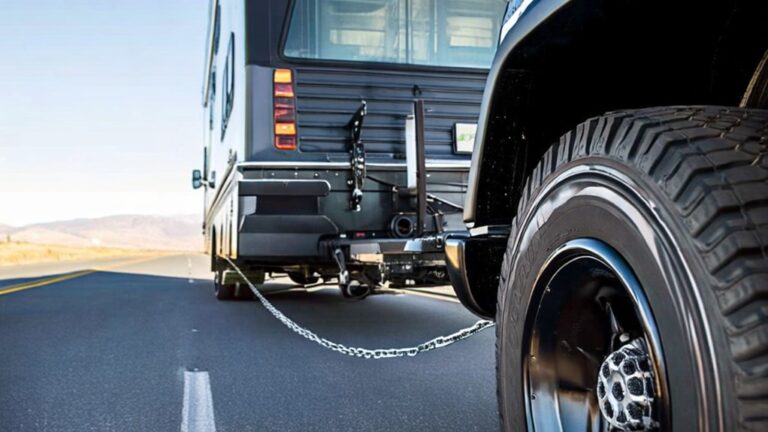
Towing trailers? Totally! You can confidently click into 4H Auto while towing a trailer. It’s crafted to control traction smoothly, so your Jeep maintains stability and safety without sacrificing performance on varied terrains.
Is 4H Auto Compatible With All Jeep Wrangler Model Years?
No, 4H Auto isn’t compatible with all Jeep Wrangler model years. You’ll mostly find it on newer models with advanced 4WD systems. Always check your owner’s manual to confirm if your specific Wrangler supports 4H Auto.
Conclusion
Using 4H Auto on your Jeep Wrangler can boost off-road traction by up to 30%, making your adventures smoother and safer. Knowing when and how to engage it guarantees you get the best performance without sacrificing fuel efficiency. Remember, maintaining your 4WD system is key to reliability. By mastering 4H Auto, you’re ready to tackle diverse terrains confidently—turning every drive into an exciting journey with your Wrangler.