7 Easy Steps to Switch to 4WD in Your Jeep Wrangler
To switch to 4WD in your Jeep Wrangler, first identify your 4WD system type and verify your vehicle is on a suitable surface, avoiding dry pavement. Check tire condition and make sure 4WD is disengaged. For 4WD High, shift from 2H to 4H while moving below 55 mph; for 4WD Low, stop and shift to neutral before selecting 4L. Confirm engagement via the indicator light and test traction at low speed. Follow these steps for a smooth, safe changeover—and learn how to optimize your system for any terrain.
How to Identify Your Jeep Wrangler’s 4WD System
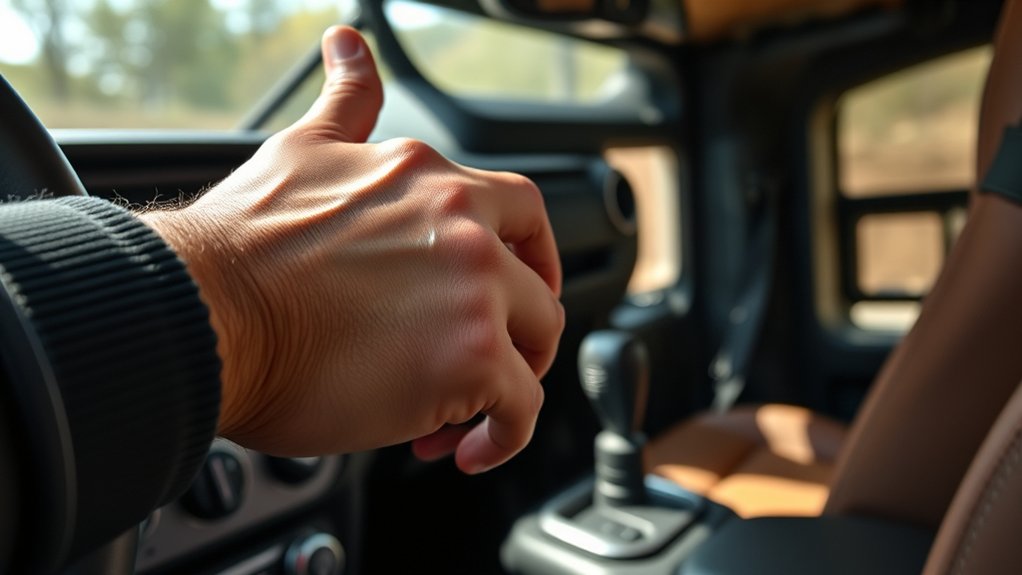
Before you switch to 4WD, you need to know which system your Jeep Wrangler uses. Most Wranglers come with either a part-time or full-time 4WD system.
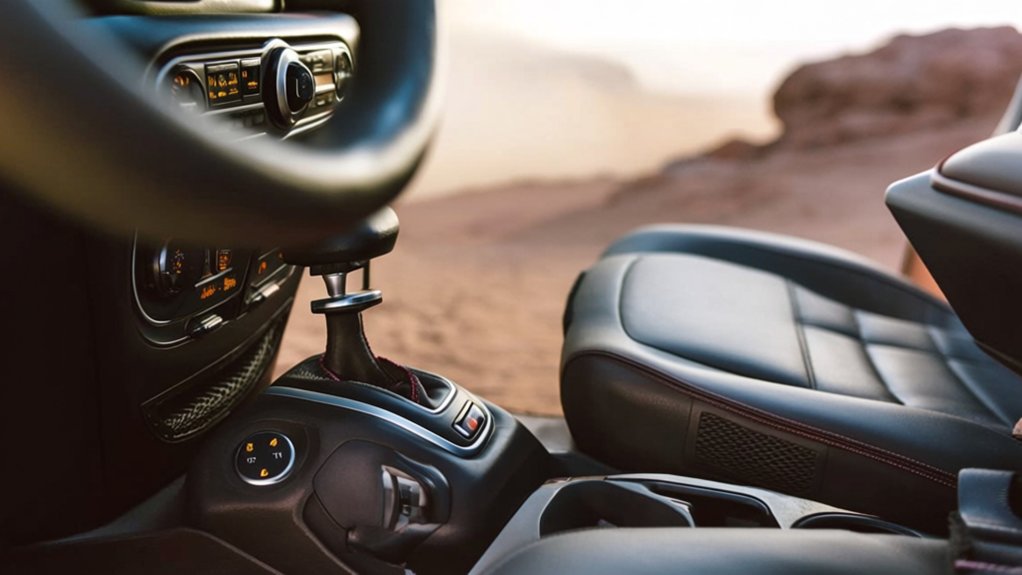
To identify yours, check your owner’s manual or look for the transfer case shifter inside your Jeep. If you see options like 2H, 4H, N, and 4L, you’re dealing with a part-time system that requires manual shifting between modes.
On the other hand, if your Jeep has a dial or button labeled “4WD Auto,” it likely features a full-time system that adjusts automatically.
Knowing your system helps you engage 4WD correctly and avoid damage. Take a moment to familiarize yourself with these controls before hitting the trail.
Check Your Jeep Before Engaging 4WD
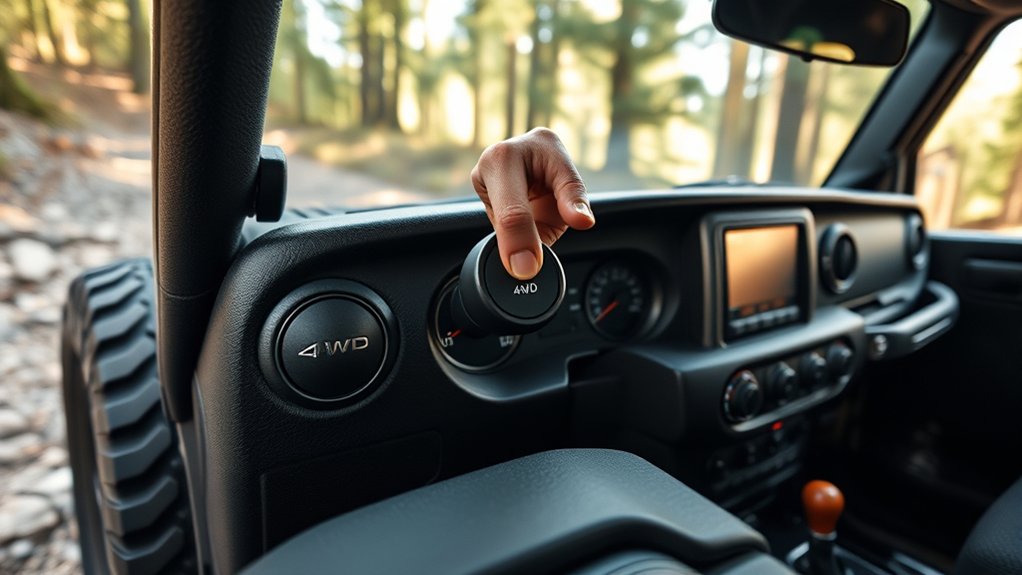
Before switching to 4WD, check your tire conditions to make sure they’re in good shape for traction.
Confirm your 4WD system is disengaged and ready to activate.
Finally, assess whether the terrain calls for 4WD to avoid unnecessary wear on your Jeep.
Inspect Tire Conditions
Although engaging 4WD enhances your Jeep Wrangler’s capability, you should first inspect your tires to certify they’re in good condition. Check for uneven wear, cracks, or punctures that could affect traction or lead to tire failure.
Make sure the tread depth is sufficient for off-road conditions—low tread reduces grip and can cause slipping. Also, verify that all four tires are the same size and type; mismatched tires can strain the 4WD system and reduce its effectiveness.
Don’t forget to assess the tire pressure, as correct inflation improves handling and prevents damage. Taking these simple steps ensures your tires can handle the increased demands of 4WD, keeping you safe and maintaining your Jeep’s performance on any terrain.
Verify 4WD System Status
Since engaging 4WD puts extra strain on your Jeep’s drivetrain, you’ll want to verify the system’s status before switching modes. Start by checking the 4WD indicator light on your dashboard; it confirms whether the system is ready to engage.
Make sure your Jeep is at a complete stop or moving slowly, depending on your model’s requirements. Inspect your transfer case lever or electronic switch to ensure it’s in the correct position for shifting.
Listen for any unusual sounds, like grinding or clicking, which could signal mechanical issues. Also, check for any warning lights or error messages related to the drivetrain.
Taking these steps helps prevent damage and guarantees your 4WD system engages smoothly when you need it most.
Assess Terrain Suitability
How do you know if the terrain is suitable for engaging 4WD in your Jeep Wrangler? First, check if the ground is slippery, uneven, or loose—like mud, snow, sand, or rocky paths. These conditions call for 4WD to improve traction and control.
Avoid using 4WD on dry, paved roads since it can cause unnecessary wear and reduce fuel efficiency.
Also, consider the severity of the terrain; steep inclines or deep ruts often require 4WD to prevent getting stuck.
Before engaging, look for obstacles such as large rocks or deep water, which could damage your Jeep if not handled with 4WD.
How to Shift Into 4WD Low and High

Now that you’ve checked your Jeep, it’s time to shift into 4WD High or Low depending on the terrain. You’ll want to follow proper shifting techniques to avoid damaging your drivetrain.
Let’s go over how to engage both modes smoothly and safely.
Engaging 4WD High
When you need extra traction on slippery or uneven terrain, engaging 4WD High is your go-to option. To activate it, start by driving at a low speed—usually under 55 mph.
Simply shift the transfer case lever from 2H (two-wheel drive high) to 4H (four-wheel drive high). Your Jeep Wrangler’s system allows you to do this while moving, so you don’t have to stop.
You’ll feel the difference immediately as power distributes to all four wheels, improving grip and stability on dirt, snow, or wet roads.
Remember, 4WD High is perfect for moderate off-road conditions or slick pavement but not for dry pavement to avoid drivetrain damage.
Once you’re back on solid ground, shift back to 2H for normal driving.
Activating 4WD Low
Wondering when to switch to 4WD Low? Use it when you need maximum torque and control, like climbing steep hills or crawling over rocks. Here’s how to activate it:
- Stop Your Jeep: Bring your Wrangler to a complete stop. Engaging 4WD Low while moving can damage the transfer case.
- Shift to Neutral: Put your transmission in neutral. This step is crucial for a smooth transition.
- Engage 4WD Low: Move the transfer case lever from 4WD High to 4WD Low. You’ll feel it lock into place, giving you the low-range gearing for tough terrain.
Once activated, your Jeep will deliver more power at lower speeds, perfect for off-road challenges.
Shifting Techniques Tips
Switching between 4WD High and 4WD Low requires smooth shifting to protect your Jeep’s drivetrain. Begin by slowing your Jeep to a complete stop before shifting into 4WD Low to avoid damage.
Keep your foot on the brake, shift the transfer case lever from 2H or 4H into 4L firmly but gently. You’ll feel it engage with a slight resistance—don’t force it.
When shifting from 4WD Low back to 4WD High or 2WD, put your Jeep in neutral and then move the lever smoothly. Avoid shifting on rough terrain or at high speeds to prevent strain.
Practicing these techniques guarantees your Jeep’s components stay in top shape, giving you reliable performance off-road and on.
Make Sure Your 4WD Is Engaged Before You Drive

Before you hit the road, double-check that your 4WD is properly engaged to guarantee maximum traction and control. Failing to confirm this can lead to poor handling and potential damage to your Jeep’s drivetrain.
Follow these steps to ensure engagement:
- Check the Indicator Light – Verify that the 4WD indicator on your dashboard is illuminated, confirming the system is active.
- Feel the Resistance – When shifting, you should feel a slight resistance or click as the drivetrain locks in.
- Test by Driving Slowly – Move forward at low speed and notice if the vehicle grips the road or terrain better than in 2WD.
Taking these precautions protects your Jeep and enhances your off-road confidence.
Choose the Right 4WD Mode for Different Terrains
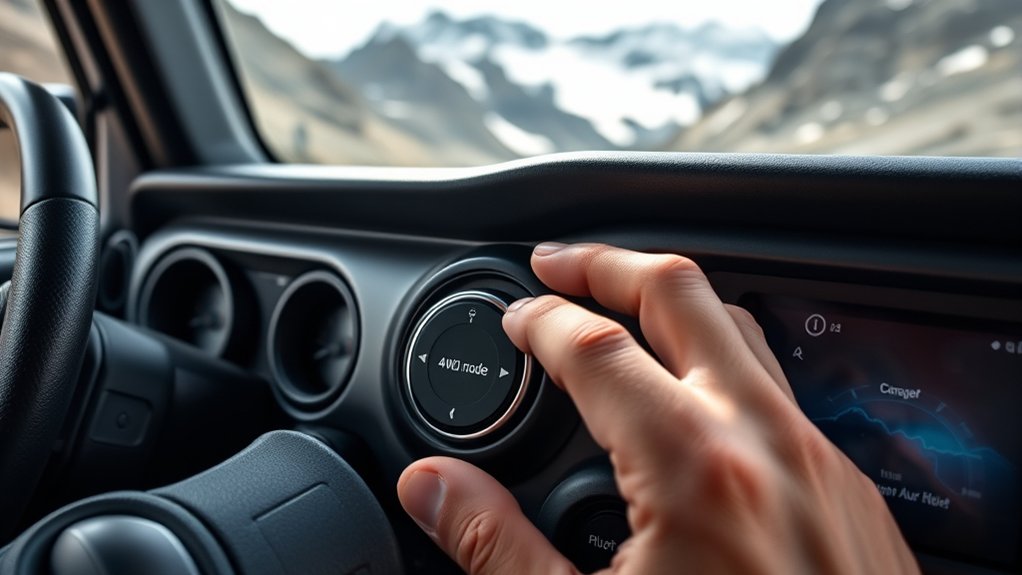
When you face different terrains, selecting the right 4WD mode guarantees your Jeep Wrangler handles effectively and stays safe. You’ll want to switch modes based on the surface to optimize traction and control. Here’s a quick guide to help you pick the best setting:
| Terrain Type | Recommended 4WD Mode |
|---|---|
| Dry pavement | 2WD or 4WD Auto |
| Muddy or wet trails | 4WD High (4H) |
| Rocky or uneven | 4WD High (4H) |
| Deep sand or snow | 4WD Low (4L) |
| Steep inclines | 4WD Low (4L) |
Use 4L for slow, powerful crawling, and 4H for faster, moderate off-road conditions. Adjust modes before you start moving for smooth transitions.
Troubleshooting Common 4WD Engagement Issues
Selecting the right 4WD mode helps your Jeep handle various terrains, but sometimes the system doesn’t engage as expected. If you face issues, don’t worry—you can troubleshoot quickly.
First, check if your Jeep is moving slowly or stopped; 4WD often won’t engage at high speeds.
Next, inspect the transfer case fluid level—low fluid can prevent proper engagement.
Finally, listen for unusual noises or vibrations, indicating mechanical problems that need a professional check.
Here’s a quick checklist:
- Guarantee your Jeep is at a low speed or stationary before switching.
- Verify the transfer case fluid is at the correct level.
- Pay attention to noises or vibrations during engagement.
Following these steps will help you solve common 4WD problems efficiently.
How to Switch Back to 2WD After Driving Your Jeep
Although 4WD offers excellent traction in challenging conditions, switching back to 2WD is vital for everyday driving to improve fuel efficiency and reduce wear. To switch back, start by bringing your Jeep to a complete stop. Then, shift the transfer case lever or knob from 4WD to 2WD. Some models require you to put the transmission in neutral before shifting. After switching, verify the indicator light confirms you’re in 2WD.
| Step | Action |
|---|---|
| 1 | Stop the vehicle completely |
| 2 | Shift transmission to neutral |
| 3 | Move transfer case to 2WD |
| 4 | Shift transmission back to drive |
| 5 | Check 2WD indicator light |
This simple process ensures smoother driving and better mileage.
Frequently Asked Questions
How Does Using 4WD Affect My Jeep’s Fuel Efficiency?
Using 4WD reduces your Jeep’s fuel efficiency because it engages more drivetrain components, increasing resistance and energy use. You’ll notice higher fuel consumption, so only use 4WD when necessary to save gas on regular drives.
Can I Use 4WD on Dry Pavement Without Damage?
Using 4WD on dry pavement is like forcing a square peg in a round hole—it can cause drivetrain binding and wear. You shouldn’t use it on dry roads to avoid damaging your Jeep’s components.
What Maintenance Is Required for the 4WD System?
You should regularly check and change the transfer case fluid, inspect the CV joints and driveshafts, and guarantee the differential fluids are topped up. Don’t forget to clean and lubricate components to keep your 4WD system running smoothly.
Are There Any Safety Tips for Driving in 4WD Mode?
You should avoid sharp turns in 4WD to prevent drivetrain damage. Don’t use 4WD on dry pavement, and always engage it at low speeds. Check your tires and drive cautiously on slippery or rough terrain for safety.
How Does 4WD Improve Off-Road Performance?
Imagine trekking through mud like a mountain goat—4WD improves off-road performance by sending power to all wheels, boosting traction and control. You’ll conquer rough terrain confidently, just like that sure-footed goat traversing cliffs effortlessly.
Conclusion
Switching to 4WD in your Jeep Wrangler is as straightforward as turning the key to adventure. Just like mastering a classic game, knowing when and how to shift gives you control over any terrain. Remember, every great journey starts with the right gear—so double-check your settings, trust your Jeep, and enjoy the ride. When it’s time to switch back, you’ll do it just as easily, ready for whatever road lies ahead.