Does the Jeep Gladiator Come With a V8?
The Jeep Gladiator doesn’t come with a factory V8 engine—you’ll find only V6 and diesel options directly from the manufacturer. Its 3.6L V6 delivers solid power and towing ability, making it great for most daily driving and weekend adventures. While adding a V8 is possible after purchase, it involves significant modifications and cost. If you’re curious about how this impacts performance, fuel economy, and whether a future V8 might arrive, keep exploring to get the full picture.
Does the Jeep Gladiator Come With a V8 Engine?
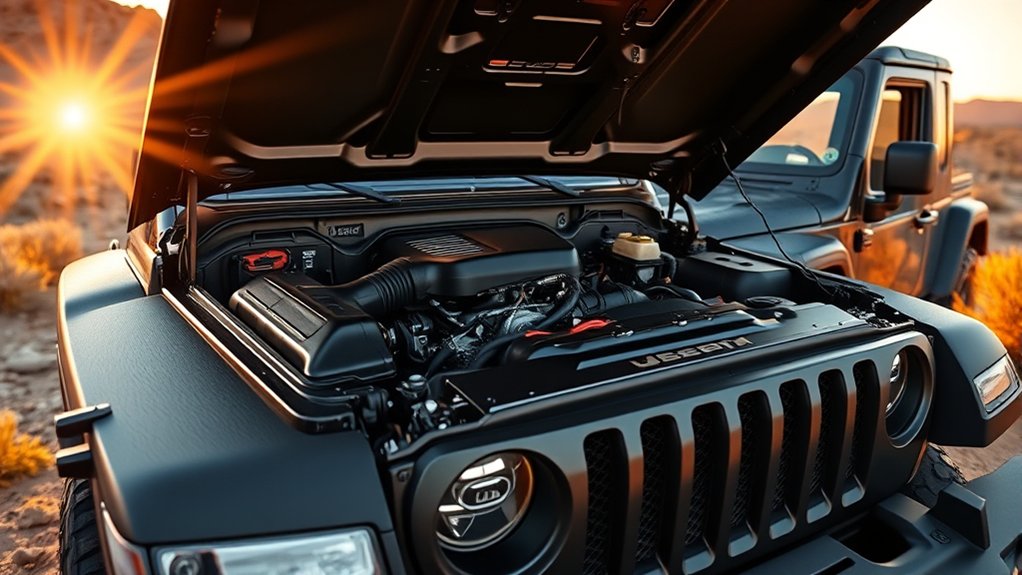
Although the Jeep Gladiator offers powerful engine options, it doesn’t come with a V8 engine from the factory. If you’re hoping to find a Gladiator with a V8 under the hood, you won’t.
Jeep has stuck to V6 and diesel engines for this model, focusing on a balance of power and efficiency. You might expect a V8 in a truck designed for rugged use, but Jeep has chosen to prioritize other features instead.
That said, if you’re set on a V8, you’ll have to contemplate aftermarket modifications or look at other trucks in the segment. For now, the Gladiator stays true to its current engine lineup without an official V8 option directly from the factory.
What Engines Are Available in the Jeep Gladiator?
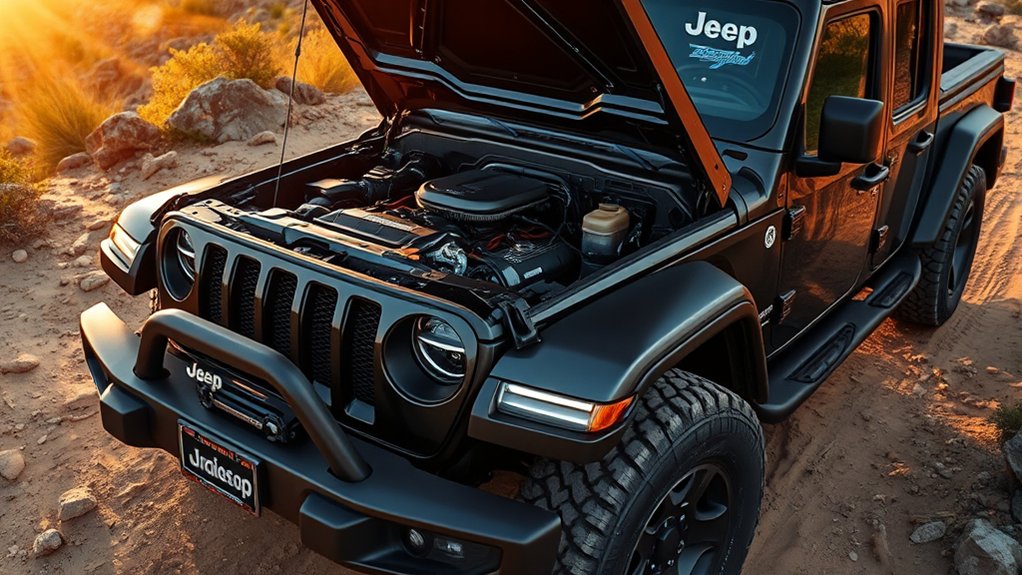
The Jeep Gladiator offers two main engine options that cater to different driving needs and preferences. You can choose between a naturally aspirated V6 and a turbocharged V6, each designed to balance power, efficiency, and capability. Both engines come paired with manual or automatic transmissions, giving you flexibility in driving style. Here’s a quick look at their key features:
| Engine Type | Horsepower | Torque (lb-ft) |
|---|---|---|
| 3.6L V6 Pentastar | 285 | 260 |
| 3.0L EcoDiesel V6 | 260 | 442 |
| Transmission Options | 6-speed manual | 8-speed automatic |
| Fuel Type | Gasoline | Diesel |
| Towing Capacity | Up to 7,650 lbs | Up to 7,650 lbs |
This variety lets you pick the Gladiator that fits your driving style.
How the Jeep Gladiator’s Turbocharged V6 Delivers Power
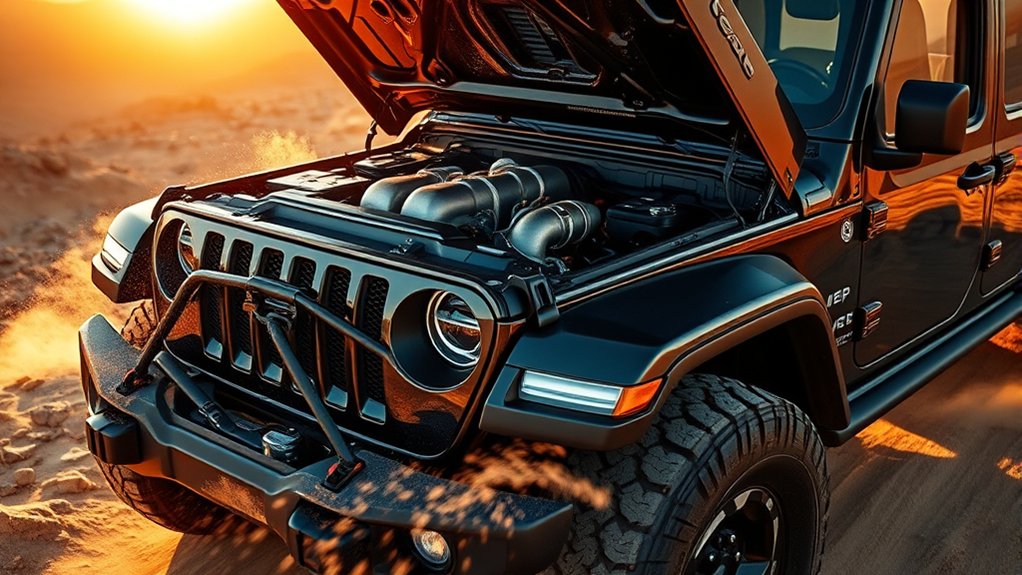
You’ll appreciate how the turbocharged V6 in the Jeep Gladiator blends strong performance with impressive efficiency. It delivers quick power when you need it without sacrificing fuel economy.
Let’s explore how this balance makes the Gladiator stand out.
Turbocharged V6 Performance
When you step on the accelerator, the Jeep Gladiator’s turbocharged V6 instantly responds with impressive power and torque, delivering a driving experience that balances strength and efficiency.
This 3.6-liter engine produces 285 horsepower and 260 lb-ft of torque, giving you plenty of muscle to tackle off-road trails or highway merges with confidence. The turbocharger boosts performance by forcing extra air into the combustion chambers, improving throttle response and maintaining power even at higher altitudes.
You’ll notice smooth acceleration and strong low-end torque, perfect for hauling or towing. Whether you’re climbing rocky paths or cruising city streets, the turbocharged V6 provides a dynamic, responsive ride that adapts effortlessly to your driving demands without hesitation or lag.
Power and Efficiency Balance
How does the Jeep Gladiator’s turbocharged V6 strike a balance between power and efficiency? It delivers strong performance without guzzling fuel, thanks to its modern engineering.
You get 285 horsepower and 260 lb-ft of torque, enough to handle tough trails and heavy loads. The turbocharger boosts power when you need it but doesn’t sacrifice fuel economy during everyday driving.
Plus, the engine features direct injection and variable valve timing, optimizing combustion and reducing waste. This means you can tackle off-road adventures confidently while still enjoying reasonable gas mileage on the road.
In short, the Gladiator’s V6 guarantees you don’t have to compromise power for efficiency—you get a capable, responsive engine that adapts to your driving demands.
Is the Gladiator’s V6 Enough for Towing and Heavy Duty?
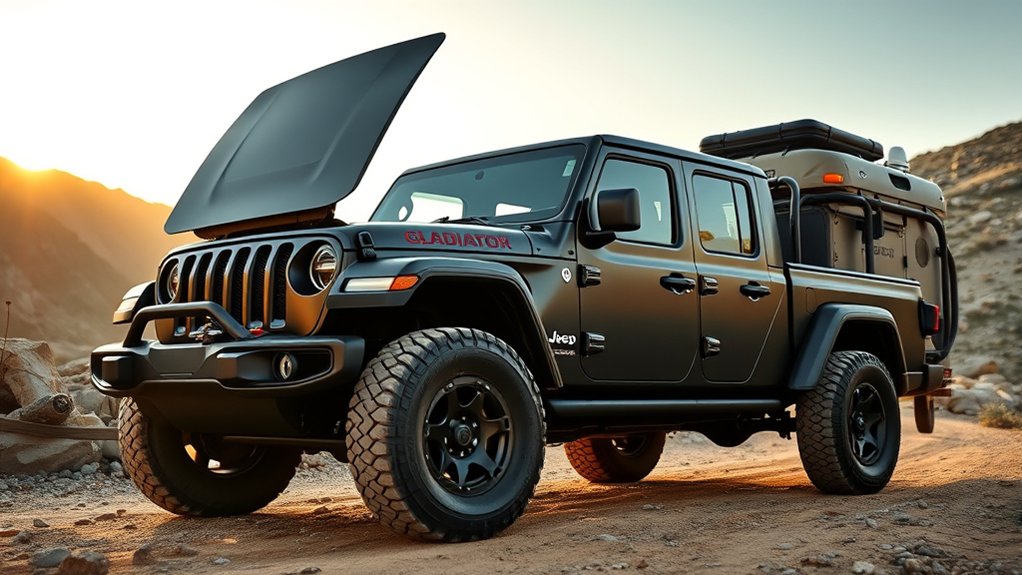
You might wonder if the Gladiator’s V6 can handle your towing needs and heavy-duty tasks. Its towing capacity is solid for most trailers, but you’ll want to take into account the weight and frequency of your loads.
Let’s see how it stacks up when the work gets tough.
V6 Towing Capacity
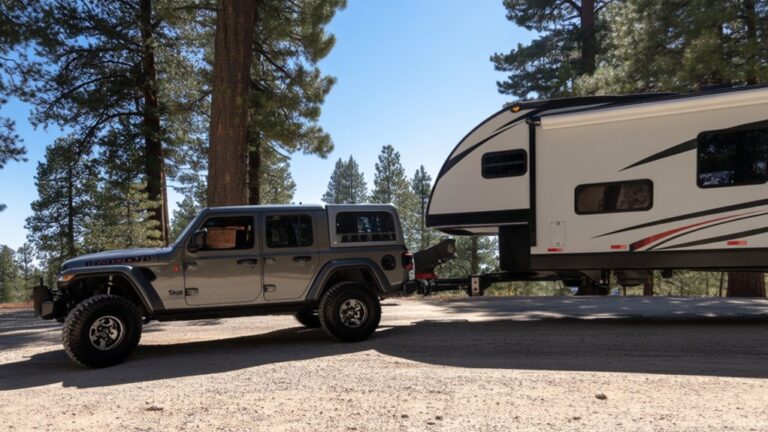
Wondering if the Gladiator’s V6 engine can handle towing and heavy-duty tasks? The 3.6-liter V6 delivers a solid towing capacity that suits most recreational needs. It can tow up to 7,650 pounds when properly equipped, making it capable for boats, trailers, and campers. While it’s not a V8 powerhouse, the V6 combines efficiency with strength, giving you reliable performance without sacrificing fuel economy.
| Feature | Specification |
|---|---|
| Engine | 3.6L V6 Pentastar |
| Maximum Towing | 7,650 lbs |
| Torque | 285 lb-ft |
| Recommended Use | Light to moderate towing |
This makes the V6 a practical choice if you don’t require extreme heavy-duty towing.
Heavy Duty Performance
While the Gladiator’s V6 engine offers respectable towing capabilities for light to moderate loads, it may fall short when tackling more demanding heavy-duty tasks. If you regularly haul heavy trailers or carry substantial payloads, the V6 might feel underpowered, especially on steep inclines or rough terrain.
You’ll notice the engine working harder, which could affect fuel efficiency and long-term durability. For serious heavy-duty performance, a V8 would provide the extra torque and horsepower needed to handle tougher jobs with ease.
Without a V8 option in the Gladiator lineup, you might want to contemplate aftermarket upgrades or different models if maximum towing and heavy-duty capability are priorities.
The V6 does well, but it’s not designed for the heaviest workloads.
How Fuel Economy Compares Between V6 and V8 Engines
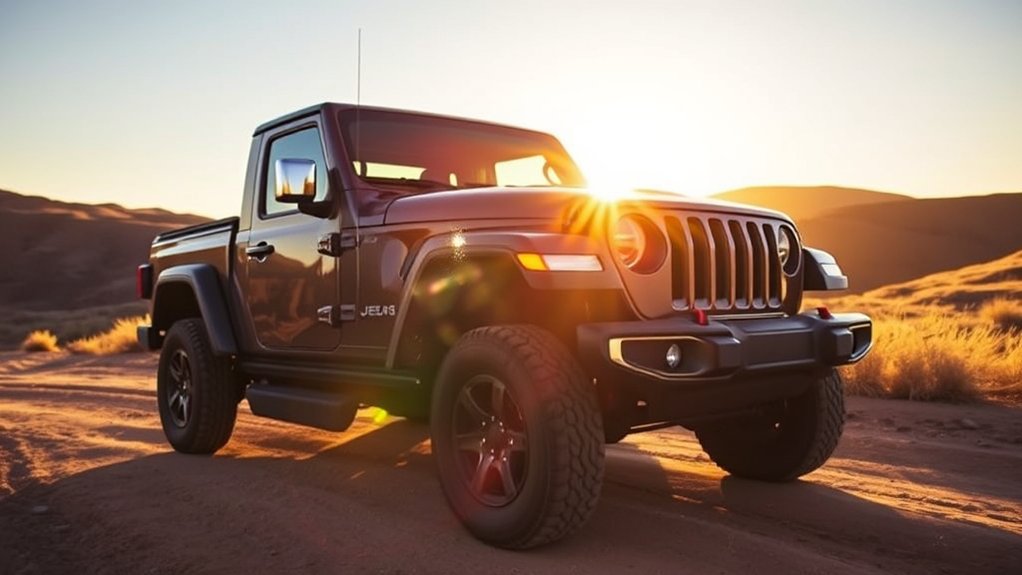
Although both engines power the Jeep Gladiator with capable performance, you’ll notice distinct differences in fuel economy between the V6 and V8 options.
The V6 engine, typically a 3.6-liter Pentastar, offers a balanced mix of power and efficiency, letting you cover more miles per gallon, especially in daily driving or light towing.
On the other hand, a V8 engine, known for its greater horsepower and torque, generally consumes more fuel due to its larger displacement and performance focus.
If you prioritize fuel savings and longer trips without frequent refueling, the V6 will suit you better.
However, if you need raw power and don’t mind sacrificing some fuel economy, a V8 can deliver.
In short, the V6 is more economical, while the V8 leans toward performance over efficiency.
Reasons Jeep Hasn’t Introduced a V8 in the Gladiator Yet
Even if you’re enthusiastic to see a V8 engine in the Jeep Gladiator, Jeep hasn’t introduced one yet due to a mix of strategic, regulatory, and market-driven reasons. Here’s why:
- Fuel Efficiency Standards: Jeep must meet strict emission and fuel economy regulations, making it challenging to justify a V8 that typically consumes more fuel.
- Market Demand: The current Gladiator’s V6 and diesel options satisfy most buyers, so Jeep prioritizes engines that balance power and efficiency.
- Cost and Complexity: Introducing a V8 would require redesigning engine bays, cooling systems, and drivetrain components, increasing production costs and complexity.
For now, Jeep focuses on optimizing existing engines to deliver performance and efficiency without the compromises a V8 might bring.
Can You Add a V8 to a Jeep Gladiator? (Aftermarket Swaps)
If you’re thinking about adding a V8 to your Jeep Gladiator, you’ll want to explore popular engine options like the Chevy LS or HEMI swaps.
Keep in mind, installation isn’t simple—it involves significant modifications and can get pricey.
Understanding these challenges upfront helps you decide if the upgrade is worth it.
Popular V8 Engine Options
Wondering whether you can add a V8 engine to your Jeep Gladiator? You definitely can, and several popular V8 options fit well with Gladiator swaps. Here are three engines to contemplate:
- LS3 V8 – A favorite from GM, the LS3 offers reliable power with around 430 horsepower, perfect for off-road and towing upgrades.
- Hemi 5.7L V8 – Chrysler’s renowned V8 delivers strong torque and solid performance, matching the Gladiator’s rugged character.
- Ford Coyote 5.0L V8 – Known for its smooth power delivery and aftermarket support, this engine can provide a unique swap option if you’re looking for something different.
Each of these engines brings distinct benefits, making your Gladiator more powerful and versatile without stock limitations.
Installation Challenges and Costs
While adding a V8 engine to your Jeep Gladiator can substantially boost performance, you’ll face several installation challenges and costs that require careful planning. You’ll need to contemplate modifications to the engine bay, transmission compatibility, wiring harnesses, and cooling systems. Labor costs can also add up quickly if you’re not doing the work yourself. Budgeting for these factors upfront helps avoid surprises.
| Challenge | Description | Estimated Cost |
|---|---|---|
| Engine Bay Modifications | Adjusting mounts and space | $1,000 – $3,000 |
| Transmission Upgrade | Matching to V8 power output | $1,500 – $4,000 |
| Wiring & Electronics | Custom harness and ECU programming | $800 – $2,500 |
| Cooling System | Upgraded radiator and fans | $500 – $1,200 |
| Labor | Professional installation and tuning | $2,000 – $5,000 |
How a V8 Engine Would Change the Gladiator’s Off-Road Skills
Though the Gladiator already excels off-road, a V8 engine would boost its power and torque, giving you more confidence on tough trails. You’d notice immediate improvements in three key areas:
- Climbing Ability: The extra torque helps you conquer steep inclines and rugged terrain with less strain, making tricky climbs smoother and safer.
- Towing and Hauling: You can pull heavier loads and carry more gear without sacrificing performance, which is essential for extended off-road adventures.
- Throttle Response: A V8’s quicker throttle lets you react faster to obstacles, improving control in technical sections where precision matters.
With these enhancements, you’d tackle challenging environments more effectively, pushing the Gladiator beyond its current limits while maintaining its legendary off-road capability.
Jeep Gladiator vs. V8 Competitors: How It Compares
When you compare the Jeep Gladiator with V8-powered rivals like the Ford Ranger Raptor and Toyota Tacoma TRD Pro, you’ll find distinct differences in power, capability, and overall driving experience.
The Gladiator sticks with a V6 and diesel options, offering solid torque but lacking the raw horsepower a V8 delivers. You’ll notice rivals with V8s tend to accelerate quicker and tow heavier loads, giving them an edge in muscle and hauling tasks.
However, the Gladiator shines in off-road versatility and customization, compensating for its power gap with superior terrain handling. If you prioritize straight-line power and towing capacity, V8 competitors might suit you better.
But if you value rugged off-road ability and Jeep’s signature style, the Gladiator holds its own despite not having a V8.
What Jeep Fans Say About the Lack of a V8 Engine
If you’re a Jeep fan, you’ve probably noticed the buzz about the Gladiator missing a V8 engine. Many expect that powerful roar and performance to match Jeep’s rugged tradition.
Let’s see how that expectation stacks up against what the Gladiator actually delivers.
Enthusiast Engine Expectations
Since Jeep fans often crave powerful engines, many have voiced their disappointment over the Gladiator’s lack of a V8 option. You might feel the same if you expect raw muscle and that classic rumble.
Enthusiasts often highlight three key expectations:
- Power and Torque: You want a V8 to provide more horsepower and towing capacity than the current V6 or diesel options.
- Sound and Feel: The distinct V8 growl and smooth power delivery create an emotional connection you feel is missing.
- Heritage and Identity: A V8 aligns with Jeep’s rugged legacy, and without it, some argue the Gladiator loses a bit of its soul.
If you’re an enthusiast, these points explain why the absence of a V8 feels like a missed opportunity.
Performance Versus Tradition
The absence of a V8 in the Gladiator doesn’t just spark disappointment over raw power—it stirs a debate about what Jeep represents. You’ll hear fans argue that Jeep’s legacy is rooted in rugged, capable vehicles that don’t necessarily need a massive engine to perform well off-road.
Many believe the Gladiator’s current V6 engine balances performance, fuel efficiency, and modern technology better than a traditional V8 would. However, if you crave the growl and muscle of a V8, you’ll find that missing.
Jeep enthusiasts often view this as a break from tradition, feeling the brand should offer a V8 to honor its heritage. Ultimately, you’re left deciding whether you prioritize raw power or Jeep’s evolving approach to performance.
Will Jeep Introduce a V8 Gladiator Model in the Future?
How likely is it that Jeep will introduce a V8 Gladiator model in the future? While Jeep hasn’t announced any official plans, several factors suggest it’s possible. You should consider:
- Market demand: Jeep knows many enthusiasts crave the power and sound of a V8, especially for towing and off-roading.
- Competitive pressure: Rival trucks often offer V8 engines, pushing Jeep to keep up in performance offerings.
- Regulatory challenges: Stricter emissions standards may slow or limit V8 availability, but technological advances could overcome this.
If Jeep decides to add a V8, it would likely target customers wanting more muscle without sacrificing the Gladiator’s rugged character.
You can stay tuned for updates, but for now, it remains a strong possibility rather than a confirmed plan.
How Your Engine Choice Changes the Gladiator’s Price and Value
Considering the potential addition of a V8 engine, it’s clear that your choice of powertrain markedly impacts the Gladiator’s price and overall value.
Opting for the current V6 or diesel engines keeps your initial cost lower, making the Gladiator more accessible while still offering solid performance and capability.
Choosing a V8, once available, would likely raise the price considerably, reflecting the increased power and towing capacity. However, that higher cost could translate into greater long-term value if you need the extra horsepower or plan to use the truck for heavy-duty tasks.
Your engine choice also influences fuel economy, maintenance costs, and resale value, so think about how you’ll use the Gladiator daily.
Ultimately, balancing price with performance needs ensures you get the best value for your investment.
Should You Wait for a V8 Gladiator or Buy the Current Model?
If you’re torn between waiting for a V8 Gladiator or buying the current model, it’s important to weigh your priorities carefully. The decision hinges on what matters most to you right now.
- Performance Needs: If you crave immediate power and torque, the V6 turbo offers plenty. But the V8 will deliver more grunt when it arrives.
- Budget Constraints: The current Gladiator is priced competitively, while a V8 version will likely come at a premium. So consider your financial limits.
- Timeline: Waiting means delaying your ownership and enjoyment. Whereas buying now gets you off-road ready without the wait.
Ultimately, assess how urgently you need the truck and whether the anticipated V8 benefits justify holding off on a capable current model.
Final Thoughts: Choosing the Right Engine for Your Jeep Gladiator
Deciding between the current Gladiator and a future V8 model comes down to what fits your needs right now.
If you want proven reliability, decent fuel economy, and solid off-road capability, the current V6 or turbo-four engines will serve you well. They’re efficient and capable for most daily drives and weekend adventures.
However, if you crave more power for towing heavy loads or plan to push your Gladiator harder, waiting for the V8 might be worth it. The V8 will offer stronger performance and a more thrilling drive but may come with higher fuel costs.
Ultimately, choose the engine that matches your lifestyle and priorities. Whether you pick the current model or wait, the Gladiator remains a versatile and rugged choice.
Frequently Asked Questions
What Safety Features Come Standard on the Jeep Gladiator?
You get standard safety features like blind-spot monitoring, rear cross-traffic alert, electronic stability control, multiple airbags, and a rearview camera. These help keep you safer on and off the road every time you drive.
How Spacious Is the Jeep Gladiator’s Interior?
You’ll find the Jeep Gladiator’s interior spacious enough for four adults, offering ample headroom and legroom. Its practical layout lets you store gear easily, making it comfortable for both daily drives and off-road adventures.
What Are the Available Trim Levels for the Gladiator?
Imagine customizing your Gladiator for weekend adventures; you’ll find trims like Sport, Overland, Rubicon, and Mojave. Each offers unique features, letting you tailor your ride from rugged off-roading to comfortable daily driving effortlessly.
Does the Jeep Gladiator Have Advanced Off-Road Technology?
Yes, the Jeep Gladiator has advanced off-road technology. You’ll get features like locking differentials, sway bar disconnect, and multiple 4×4 systems that help you conquer tough terrain with confidence and ease on your adventures.
What Warranty Coverage Does Jeep Offer on the Gladiator?
Jeep offers you a 3-year/36,000-mile basic warranty and a 5-year/60,000-mile powertrain warranty on the Gladiator. You’ll also get roadside assistance for 5 years, helping you stay covered on and off the road.
Conclusion
If you’re torn between power and practicality, the Gladiator’s turbo V6 is a trusty steed ready to tackle most trails and hauls. While a V8 roar might be a distant thunder on the horizon, the current model balances strength and efficiency like a well-tuned symphony. So, don’t wait for a future rumble—grab the wheel now and let the Gladiator’s heart drive your next adventure with confidence and style.