Does Jeep Renegade Have CVT Transmission and How to Check
The Jeep Renegade generally doesn’t come with a CVT transmission, focusing instead on durable 6-speed manuals and 9-speed automatics. If you want to confirm what transmission your Renegade has, check the VIN on the dashboard or door jamb and use an online decoder, or look at the window sticker under “Drivetrain” or “Transmission.” While CVTs are rare and often not ideal for rugged use, understanding your options helps you choose the best fit. More details on this can give you clearer insights.
Does the Jeep Renegade Come With a CVT Transmission?
Although many modern vehicles offer continuously variable transmissions (CVTs) for smoother rides and fuel efficiency, the Jeep Renegade doesn’t come with a CVT option. If you’re looking into a Renegade, you won’t find a CVT listed among its transmission choices.
Jeep has opted to equip the Renegade with more traditional transmission types that suit its off-road capability and driving style. This means you won’t experience the seamless, stepless acceleration CVTs provide, but you’ll get transmissions that match the vehicle’s rugged character.
What Types of Transmissions Are Available on Jeep Renegade Models?
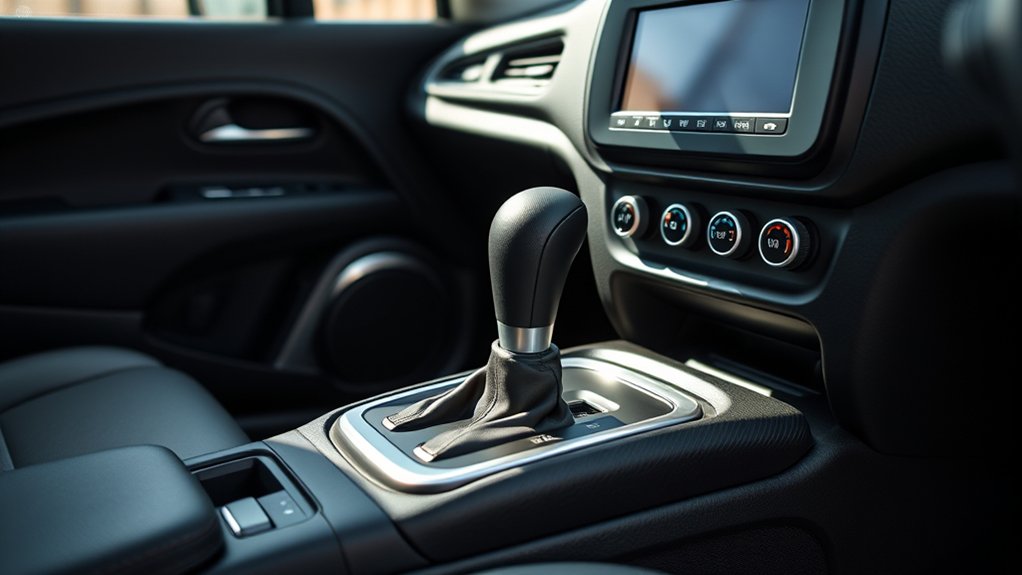
When you explore Jeep Renegade models, you’ll find a range of transmission options designed to balance performance and efficiency. Most Renegades come equipped with a 6-speed manual transmission or a 9-speed automatic transmission, depending on the trim and engine choice.
The 6-speed manual gives you more control and engagement, especially if you like a hands-on driving experience. On the other hand, the 9-speed automatic offers smooth shifting and adapts well to different driving conditions.
Significantly, Jeep Renegade models don’t feature a CVT transmission. Instead, they stick with traditional automatic and manual gearboxes, which work well with their small turbocharged and naturally aspirated engines.
Knowing these options helps you choose the right Renegade to fit your driving style.
How Does Transmission Type Affect Jeep Renegade Driving and Fuel Economy?
You’ll notice different Jeep Renegade transmissions change both how the vehicle drives and how much fuel it uses. Understanding the main transmission types helps you predict fuel efficiency and performance.
Let’s explore how these differences shape your driving experience and gas mileage.
Transmission Types Overview
Understanding how transmission types influence your Jeep Renegade’s performance and fuel economy can help you make smarter driving choices.
The Renegade typically comes with either a traditional automatic transmission, a manual, or a CVT (Continuously Variable Transmission), depending on the model and trim. Each type offers a distinct driving experience.
Manual transmissions give you more control over gear changes, which can be fun but requires more effort.
Automatics shift gears smoothly for convenience and ease, especially in stop-and-go traffic.
CVTs, on the other hand, don’t have fixed gears; they adjust seamlessly to keep the engine in its most suitable range. This results in smoother acceleration and can enhance fuel efficiency.
Knowing which transmission your Renegade has will help you understand how it responds on the road and what to expect in daily driving.
Impact on Fuel Efficiency
How does the type of transmission in your Jeep Renegade affect its fuel efficiency? CVT transmissions are designed to provide smoother, more efficient power delivery by continuously adjusting gear ratios. This means your engine runs at ideal RPMs more often, helping you get better gas mileage compared to traditional automatic transmissions.
If your Renegade has a CVT, you’ll likely notice improved fuel economy, especially during city driving and stop-and-go traffic. On the other hand, models with conventional automatic or manual transmissions may not optimize engine performance as effectively, potentially reducing fuel efficiency.
Driving Experience Differences
What sets the driving feel of a Jeep Renegade with a CVT apart from one with a traditional automatic or manual transmission? You’ll notice the CVT offers smoother, more consistent acceleration without the gear shifts you feel in other transmissions. This can make city driving and stop-and-go traffic more comfortable.
However, if you prefer a more connected, responsive feel, a manual or traditional automatic might suit you better, as they provide distinct shift points and more control.
Regarding fuel economy, the CVT often helps you get better mileage by keeping the engine at ideal RPMs. So, if you want a relaxed, efficient ride, the CVT’s your friend.
But if you enjoy a sportier, engaged drive, manual or automatic transmissions might be more satisfying.
Why the Jeep Renegade Doesn’t Use CVT Transmissions
Although continuously variable transmissions (CVTs) offer smooth acceleration and fuel efficiency, Jeep chose not to equip the Renegade with one because it prioritizes off-road capability and durability.
When you’re tackling rough terrain, you need a transmission that can handle sudden torque demands and harsh conditions without slipping or overheating. CVTs, while efficient, often struggle under these stresses.
Instead, Jeep uses traditional automatic or manual transmissions designed to withstand rugged use.
Here’s why Jeep avoids CVTs in the Renegade:
- CVTs have limited torque capacity for off-road power
- Traditional transmissions offer better control on uneven surfaces
- Durability under heavy loads is essential for Jeep’s target drivers
- Maintenance and repair costs for CVTs can be higher
- Drivers expect a more tactile, responsive feel during off-road driving
Pros and Cons of CVT vs. Jeep Renegade Transmissions
When comparing CVTs to the transmissions in the Jeep Renegade, you’ll find distinct advantages and drawbacks on both sides. CVTs offer smooth acceleration and improved fuel efficiency by continuously adjusting gear ratios, which benefits city driving and highway cruising.
However, they can feel less responsive and sometimes produce a droning noise under heavy acceleration. In contrast, the Jeep Renegade’s traditional automatic or manual transmissions deliver more tactile feedback and better performance in off-road or rugged conditions.
You’ll appreciate the durability and predictable shifting, especially when tackling uneven terrain. On the downside, these transmissions may sacrifice some fuel efficiency and smoothness compared to a CVT.
Ultimately, your choice depends on whether you prioritize driving feel and capability or fuel economy and smoothness.
How Transmission Choice Affects Jeep Renegade Maintenance and Repair Costs
Choosing between a CVT and a traditional transmission for your Jeep Renegade doesn’t just impact driving experience—it also influences how much you’ll spend on maintenance and repairs.
CVTs often require specialized fluid changes more frequently, which can increase routine service costs.
Traditional automatics tend to have higher repair costs if major components fail but usually have longer intervals between services.
Here’s how your choice affects expenses:
- CVTs need specific transmission fluid, which is pricier.
- Repair parts for CVTs can be more expensive and less common.
- Traditional transmissions may incur higher labor costs during repairs.
- CVTs generally have fewer mechanical parts, potentially lowering some repair risks.
- Resale value can be affected by the type of transmission due to maintenance perceptions.
Knowing these factors helps you budget and maintain your Renegade wisely.
How to Identify Your Jeep Renegade’s Transmission Type
If you want to understand your Jeep Renegade’s transmission better, you’ll need to know how to identify its type. Start by checking the gear shifter—CVTs often have a simple, smooth shift pattern without distinct gears, while traditional automatics show clear gear positions like P, R, N, D, and sometimes lower gears.
You can also look under the hood for transmission labels or tags; manufacturers often place these on the transmission housing. Another way is to pay attention to driving feel: CVTs provide seamless acceleration without noticeable gear shifts, unlike conventional automatics that shift gears in steps.
Finally, consult your owner’s manual, which specifies the transmission type for your model year and trim, helping you identify exactly what’s installed in your Jeep Renegade.
How to Use the VIN and Window Sticker to Check Transmission Details
Although it might seem technical, using your Jeep Renegade’s VIN and window sticker is a straightforward way to confirm its transmission details. The VIN is a unique 17-character code that holds key info about your vehicle, including its transmission type.
The window sticker, often found on the driver’s side window, lists factory-installed features.
Here’s how to use them effectively:
- Locate the VIN on your dashboard or driver’s side door jamb.
- Enter the VIN into an online decoder or Jeep’s official website.
- Check the decoded report for transmission codes or descriptions.
- Find the original window sticker if available, either physically or online.
- Look for transmission details under the “Drivetrain” or “Transmission” section.
This method guarantees you get accurate transmission info without guesswork.
Jeep Renegade Trims and Model Years: Transmission Differences
How do transmission options vary across Jeep Renegade trims and model years?
If you’re looking at older models, you’ll find that early Renegades mostly came with traditional automatic or manual transmissions, depending on the engine and trim.
From 2015 onward, Jeep introduced more variation, with some trims offering a 6-speed manual, a 9-speed automatic, or even a CVT in specific markets.
For example, the base Sport trim is often paired with a manual or 9-speed automatic, while higher trims like Limited leaned toward the 9-speed automatic.
In certain regions outside the U.S., you might encounter CVT-equipped Renegades, especially with smaller engines.
Key Transmission Considerations When Buying a Used Jeep Renegade
When buying a used Jeep Renegade, you’ll want to carefully assess the transmission type and condition, as these factors substantially impact driving experience and long-term reliability.
Start by confirming whether the vehicle has a CVT, traditional automatic, or manual transmission. Next, check for smooth shifting and listen for unusual noises during a test drive.
Also, review the service history to ensure timely transmission maintenance. Don’t forget to inspect for leaks or fluid discoloration under the vehicle.
Finally, consider how the transmission type aligns with your driving style and terrain needs.
- Identify the transmission model and type
- Test for smooth and responsive gear changes
- Review past transmission maintenance records
- Check for fluid leaks and condition
- Match transmission features to your daily driving demands
What to Expect From Jeep Renegade Transmissions in Terms of Reliability and Cost
Since the transmission plays a crucial role in your Jeep Renegade’s performance, understanding its reliability and potential costs is essential before making a purchase. Generally, Jeep Renegade transmissions, including the 9-speed automatic, show decent reliability but occasional issues can arise, especially if maintenance is neglected. Repair costs vary but can be significant if major work is needed. Here’s a quick overview to help you anticipate what you might face:
| Transmission Type | Reliability Rating | Estimated Repair Cost |
|---|---|---|
| 6-speed Manual | High | Low ($500 – $1,000) |
| 9-speed Automatic | Moderate | Moderate ($1,000 – $3,000) |
| CVT (rare) | Low to Moderate | High ($2,000 – $4,000) |
Regular maintenance keeps costs down and reliability up.
Frequently Asked Questions
What Engine Options Are Available for the Jeep Renegade?
You’ll find Jeep Renegade offers several engines, including a 1.3L turbocharged inline-4, a 2.4L inline-4, and a 2.0L turbo diesel in some markets. Check your model’s specs to know exactly which you have.
How Does the Jeep Renegade Perform Off-Road?
You’ll find the Jeep Renegade performs well off-road, especially in Trailhawk trim. It handles rough terrain with ease, thanks to its 4×4 system, good ground clearance, and off-road driving modes that boost your confidence.
What Safety Features Come Standard on the Jeep Renegade?
You get standard safety features like blind-spot monitoring, rear cross-traffic alert, electronic stability control, and multiple airbags. These help keep you protected whether you’re driving around town or tackling rough terrain in your Jeep Renegade.
How Does the Jeep Renegade’s Infotainment System Work?
Like using a rotary phone, you’ll find the Jeep Renegade’s infotainment system straightforward. You just tap the touchscreen or use voice commands to control navigation, music, and calls, keeping you connected without distracting your focus.
What Are the Warranty Terms for the Jeep Renegade?
You get a 3-year/36,000-mile basic warranty and a 5-year/60,000-mile powertrain warranty on your Jeep Renegade. Plus, there’s a 5-year/60,000-mile roadside assistance program to keep you covered on the road.
Conclusion
If you’re eyeing a Jeep Renegade, knowing its transmission options will save you from a world of confusion. The Renegade doesn’t come with a CVT, sticking instead to traditional automatics and manuals, which often deliver a more rugged drive. To get the full scoop, check the VIN or window sticker—don’t put all your eggs in one basket. This way, you’ll drive off confident, knowing exactly what’s under the hood.