Does a Jeep Renegade Have a Catalytic Converter?
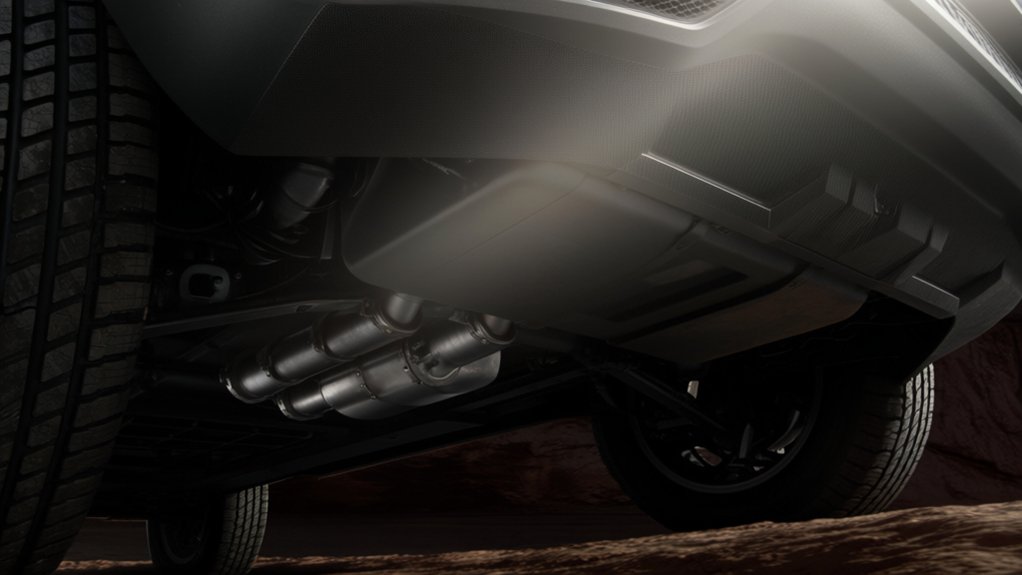
Yes, your Jeep Renegade definitely has a catalytic converter, which plays a key role in reducing harmful emissions like carbon monoxide and nitrogen oxides. It’s located along the exhaust system, usually near the engine, helping keep your vehicle environmentally friendly and compliant with emissions laws. If you notice performance issues or warning lights, it might need attention. Keep exploring to understand why it’s essential, how to spot problems, and what to do if it fails.
Does the Jeep Renegade Have a Catalytic Converter?
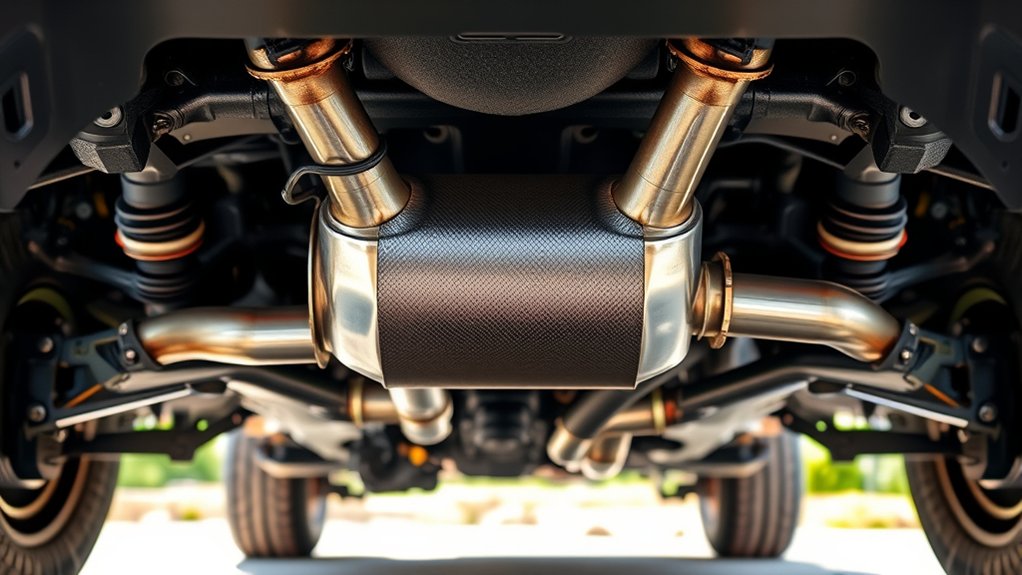
Although you might wonder about the emissions system in your Jeep Renegade, it definitely has a catalytic converter. This essential component helps reduce harmful gases your engine produces, converting toxic emissions like carbon monoxide and nitrogen oxides into less harmful substances before they exit the exhaust system.
Without it, your vehicle wouldn’t meet environmental regulations or pass emissions tests. The catalytic converter works continuously as you drive, playing a key role in keeping your Jeep environmentally friendly and compliant with legal standards.
If you’re concerned about performance or emissions, rest assured that the catalytic converter is there doing its job silently, ensuring your Jeep Renegade runs cleaner and safer for both you and the environment.
Where Is the Catalytic Converter Located on a Jeep Renegade?
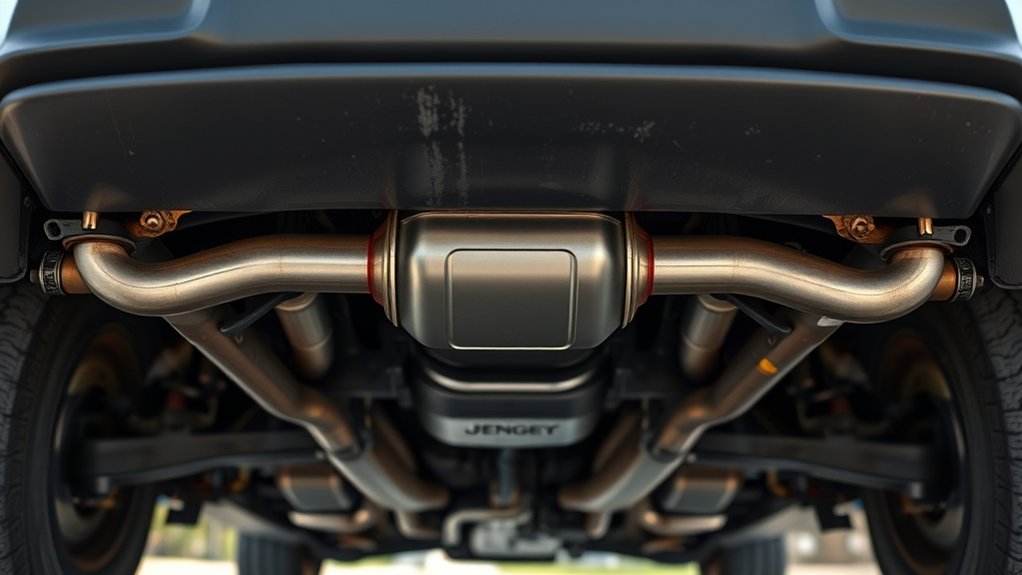
When you need to locate the catalytic converter on your Jeep Renegade, you’ll find it positioned along the exhaust system underneath the vehicle. Typically, it’s closer to the engine, between the exhaust manifold and the muffler, helping to reduce emissions effectively. Knowing its exact location helps if you plan on inspections or repairs.
| Location Area | Description | Access Tips |
|---|---|---|
| Front Section | Near the exhaust manifold | Use a lift or jack for access |
| Mid-Section | Between front and rear exhaust | Look for a honeycomb structure |
| Rear Section | Closer to the muffler | Often harder to reach |
| Under Vehicle | Along the exhaust pipe | Ensure vehicle is cooled down |
Why the Catalytic Converter Matters in the Jeep Renegade
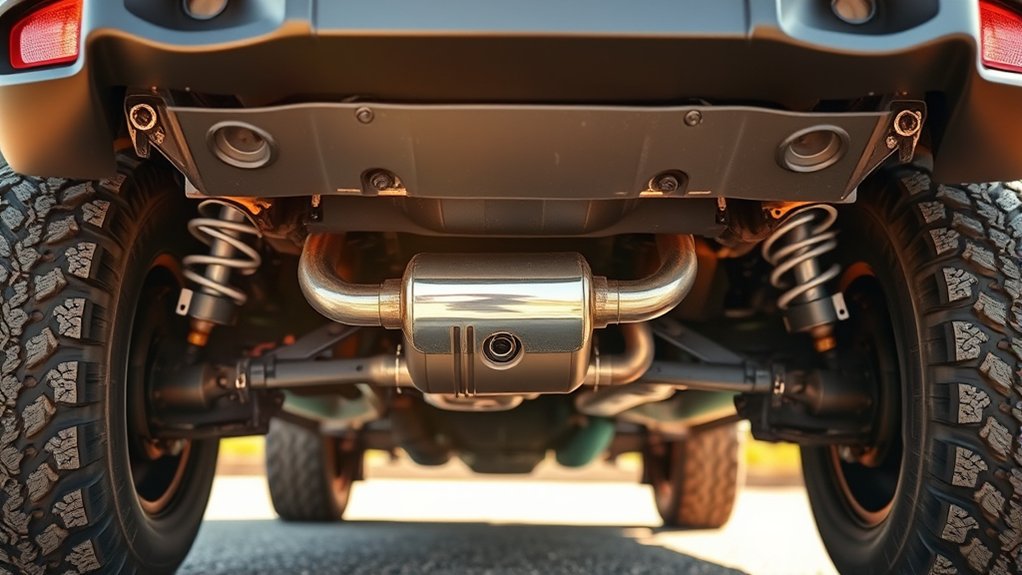
Because your Jeep Renegade relies on clean emissions to meet environmental standards, the catalytic converter plays a crucial role in reducing harmful pollutants from the exhaust. Without it, your vehicle would release toxic gases that contribute to air pollution and harm public health.
The catalytic converter helps guarantee your Renegade complies with legal requirements, preventing costly fines or failed inspections. It also supports your engine’s efficiency by managing emissions properly, which can protect other components from damage.
When this part is functioning well, you can enjoy peace of mind knowing your Jeep is environmentally responsible and road-legal. So, keeping the catalytic converter in good shape directly impacts your vehicle’s performance, legal standing, and your role in reducing pollution.
How the Jeep Renegade’s Catalytic Converter Reduces Emissions
You’ll find that the Jeep Renegade’s catalytic converter uses advanced emission control technology to cut harmful gases.
It triggers a chemical conversion process that transforms toxic pollutants into less harmful substances.
This system plays a key role in reducing the vehicle’s environmental impact.
Emission Control Technology
How does the Jeep Renegade’s catalytic converter effectively cut down harmful emissions? It uses advanced emission control technology designed to target pollutants before they exit the exhaust system.
You’ll find sensors that monitor exhaust gases, allowing the converter to adjust its operation in real time to maintain ideal performance. The converter’s honeycomb structure maximizes surface area, improving contact between harmful gases and the catalyst materials inside.
This setup ensures pollutants like carbon monoxide, nitrogen oxides, and hydrocarbons are markedly reduced. The system works seamlessly with the vehicle’s engine management to keep emissions low without compromising performance.
Chemical Conversion Process
The Jeep Renegade’s catalytic converter reduces harmful emissions through a precise chemical conversion process. When exhaust gases pass through it, harmful pollutants like carbon monoxide, nitrogen oxides, and hydrocarbons undergo chemical reactions on the converter’s catalyst surface, typically coated with platinum, palladium, and rhodium.
You’ll find that carbon monoxide converts into less harmful carbon dioxide, nitrogen oxides break down into nitrogen and oxygen, and hydrocarbons transform into water vapor and carbon dioxide. This process happens quickly and efficiently as the exhaust flows through a honeycomb structure inside the converter, maximizing the surface area for reactions.
Environmental Impact Reduction
Why does your Jeep Renegade’s catalytic converter matter for the environment? It plays a vital role in cutting down harmful emissions from your vehicle. By converting toxic gases like carbon monoxide, nitrogen oxides, and hydrocarbons into less harmful substances, it helps reduce air pollution.
This means you’re contributing less to smog and acid rain, improving air quality around you. Also, by lowering these emissions, your Renegade supports efforts to combat climate change.
Without a properly functioning catalytic converter, your Jeep would release more pollutants, harming both the environment and public health. So, maintaining this component not only keeps your vehicle compliant with emission standards but also helps protect the planet for future generations.
Signs Your Jeep Renegade’s Catalytic Converter Is Failing
When your Jeep Renegade’s catalytic converter starts to fail, you’ll notice several warning signs that shouldn’t be ignored. First, you might experience a drop in engine performance, such as sluggish acceleration or reduced power.
Your vehicle could also emit a rotten egg or sulfur smell, indicating trapped exhaust gases. Additionally, you may hear rattling noises from underneath, caused by broken internal components.
The “Check Engine” light often comes on if the converter isn’t working properly, so don’t overlook that indicator.
Poor fuel efficiency is another sign; if you suddenly need to fill up more often, the catalytic converter might be struggling.
Catching these symptoms early helps you avoid costly repairs and keeps your Jeep running smoothly.
What Causes Catalytic Converter Issues in the Jeep Renegade?
Noticing signs like poor engine performance or strange smells means your Jeep Renegade’s catalytic converter is under stress. Several issues can cause this stress, starting with engine misfires or running rich, which overload the converter with unburned fuel.
Contaminants like oil or coolant leaking into the exhaust can also damage it. Additionally, physical impacts from road debris or corrosion can harm the converter’s structure.
Using low-quality fuel or ignoring scheduled maintenance allows deposits to build up, reducing efficiency. Over time, these factors clog or overheat the catalytic converter, leading to failure.
Can You Drive a Jeep Renegade Without a Catalytic Converter?
Although your Jeep Renegade might still run without a catalytic converter, driving it this way comes with significant risks and legal issues.
Removing or bypassing the catalytic converter can cause your vehicle to emit harmful pollutants, which violates environmental regulations in many areas. You could face hefty fines or fail emissions tests, making it illegal to drive on public roads.
Additionally, without the converter, your engine may run inefficiently, leading to reduced performance and potential damage over time. Your check engine light will likely stay on, signaling problems that can affect diagnostics.
In short, while your Jeep might technically operate without this component, it’s neither safe nor legal to drive it without a catalytic converter installed. It’s best to keep it intact for compliance and proper vehicle function.
How Much Does It Cost to Replace a Catalytic Converter on a Jeep Renegade?
Replacing the catalytic converter on your Jeep Renegade can vary widely in cost depending on parts and labor.
You’ll want to contemplate both the price of the converter itself and the labor charges at your chosen shop.
Several factors like model year and location can also influence the total expense.
Price Range Overview
When your Jeep Renegade’s catalytic converter needs replacement, you can expect the cost to vary based on factors like part quality and labor rates. Generally, prices range widely, so it’s important to budget accordingly.
Here’s a quick price range overview:
- Aftermarket parts: Typically cost between $200 and $600, offering a more affordable option but varying in quality.
- OEM (Original Equipment Manufacturer) parts: Usually range from $500 to $1,200, providing guaranteed fit and performance.
- High-performance or specialty converters: Can cost upwards of $1,000, designed for enhanced efficiency or specific emissions standards.
Knowing these ranges helps you prepare financially and make informed decisions when replacing your catalytic converter.
Make sure to shop around and consider warranties for the best value.
Labor Versus Parts
Because both labor and parts contribute considerably to the total cost, understanding their individual prices can help you budget better for your Jeep Renegade’s catalytic converter replacement.
Typically, the part itself ranges from $300 to $1,200, depending on whether you choose an OEM or aftermarket converter.
Labor charges usually run between $100 and $300, influenced mainly by the mechanic’s hourly rate and the time required for installation.
Since replacing the catalytic converter involves removing and reinstalling exhaust components, expect labor to take one to two hours.
By separating these costs, you can decide if sourcing the part yourself or opting for a repair shop package suits your budget.
Knowing this breakdown puts you in control when planning your vehicle’s maintenance expenses.
Factors Influencing Cost
Although the cost of replacing a catalytic converter on your Jeep Renegade can vary widely, several key factors determine the final price. Understanding these can help you budget and make informed decisions.
First, the type of converter matters—OEM parts typically cost more than aftermarket options.
Second, your vehicle’s model year influences availability and price, with newer models often requiring pricier components.
Third, labor rates vary by location and shop expertise, affecting your total bill.
Here are the main factors influencing cost:
- Type of catalytic converter: OEM vs. aftermarket
- Model year and engine type: Affecting part compatibility
- Labor costs: Varying by region and mechanic experience
How to Choose the Right Catalytic Converter Replacement for Your Jeep Renegade
Selecting the right catalytic converter replacement for your Jeep Renegade requires understanding key factors like compatibility, emissions standards, and quality.
First, make sure the replacement fits your Renegade’s specific model year and engine type to avoid installation issues.
Next, check that the converter meets your local emissions regulations; this guarantees your vehicle stays street-legal and environmentally compliant.
Opt for converters made from high-quality materials like stainless steel and with efficient catalytic coatings to boost durability and performance.
You can choose between OEM parts for guaranteed fit and quality or high-grade aftermarket options that may offer cost savings.
Finally, consider warranty coverage—it protects your investment and reflects the manufacturer’s confidence in the product.
These steps will help you find a reliable, efficient replacement for your Jeep Renegade.
How to Maintain the Catalytic Converter in Your Jeep Renegade
You’ll want to regularly inspect your Jeep Renegade’s catalytic converter to catch any issues early.
Keeping it clean and following simple maintenance steps can extend its life.
Let’s explore some practical tips to help you maintain it effectively.
Regular Inspection Tips
Since your Jeep Renegade’s catalytic converter plays a crucial role in reducing harmful emissions, regular inspections are essential to keep it functioning properly. You should routinely check for any signs of damage or clogging to avoid costly repairs. Keep an eye on your vehicle’s performance, as a failing converter can cause poor acceleration or increased fuel consumption.
Here are some key inspection tips:
- Look for rattling noises when starting the engine, which may indicate loose components inside the converter.
- Monitor the check engine light; if it comes on, have the system scanned for related error codes.
- Inspect the exhaust system for visible rust, cracks, or discoloration near the converter area.
Regularly performing these checks will help maintain your Jeep Renegade’s catalytic converter efficiency.
Cleaning Methods Explained
Although catalytic converters are designed to be self-cleaning, deposits and contaminants can still build up over time, reducing their effectiveness. To clean your Jeep Renegade’s catalytic converter, you can use specialized fuel additives that help break down carbon deposits. Simply add these cleaners to your fuel tank as directed, and they’ll work during normal driving.
Another method involves professional cleaning, where a mechanic may remove the converter and clean it with pressurized air or chemicals. Avoid attempting harsh mechanical cleaning yourself, as it can damage the converter’s delicate components.
Also, running your engine at higher RPMs occasionally can help burn off minor deposits. Using these cleaning methods can restore your catalytic converter’s efficiency and improve your vehicle’s performance without costly replacements.
Preventative Maintenance Practices
To keep your Jeep Renegade’s catalytic converter functioning efficiently, regular preventative maintenance is essential. You’ll want to avoid issues that can lead to costly repairs or reduced performance.
Start by ensuring your engine runs smoothly because a misfiring engine can damage the converter. Also, use high-quality fuel to minimize contaminants that clog the system. Finally, keep an eye on your exhaust system for leaks or damage, which can affect the converter’s operation.
Here are three key maintenance tips:
- Regularly check and replace spark plugs to prevent incomplete combustion.
- Use fuel additives occasionally to clean the fuel system and catalytic converter.
- Schedule routine inspections to catch exhaust leaks or sensor malfunctions early.
Legal and Environmental Reasons to Keep Your Jeep Renegade’s Catalytic Converter Intact
When you keep your Jeep Renegade’s catalytic converter intact, you not only comply with legal requirements but also help protect the environment. Removing or tampering with this component is illegal in many places and can lead to hefty fines or failed emissions tests.
Your vehicle relies on the catalytic converter to reduce harmful pollutants like carbon monoxide, nitrogen oxides, and hydrocarbons. Without it, your Jeep releases markedly more toxic gases, contributing to air pollution and health risks.
By maintaining the converter, you guarantee cleaner air quality and contribute to efforts against climate change. Plus, staying legal avoids costly penalties and keeps your Jeep running smoothly.
Protect your investment and the planet by keeping your catalytic converter in place.
Frequently Asked Questions
What Is the Lifespan of a Catalytic Converter in a Jeep Renegade?
You can expect your Jeep Renegade’s catalytic converter to last around 70,000 to 100,000 miles. Regular maintenance and avoiding engine issues will help it perform well throughout its lifespan without premature failure.
Can a Catalytic Converter Affect Fuel Efficiency in a Jeep Renegade?
You’d think a catalytic converter’s impact on fuel efficiency is as tiny as an atom, but it actually helps your Jeep Renegade run cleaner and smoother. A clogged one can definitely drag your mileage down, so keep it healthy!
Are Aftermarket Catalytic Converters Compatible With the Jeep Renegade?
Yes, aftermarket catalytic converters are compatible with your Jeep Renegade, but you’ll want to choose one that meets emissions standards and fits correctly. Make sure it matches your engine type to avoid performance or legal issues.
How Long Does It Take to Replace a Catalytic Converter on a Jeep Renegade?
You might think replacing the catalytic converter takes forever, but it usually only takes about 1 to 2 hours. If you’re handy or have a good mechanic, the process is pretty straightforward and quick.
Does the Jeep Renegade’s Catalytic Converter Require Special Tools for Removal?
You don’t usually need special tools to remove the Jeep Renegade’s catalytic converter, but having a good socket set, penetrating oil, and a torque wrench helps. Rusted bolts might require extra care or tools.
Conclusion
You should know your Jeep Renegade definitely has a catalytic converter, essential for cutting harmful emissions. In fact, catalytic converters reduce up to 90% of toxic gases, helping your vehicle meet environmental standards. Keeping yours in good shape not only protects the environment but also saves you from costly repairs. Regular maintenance guarantees your Renegade runs clean and efficient—so don’t overlook this small yet powerful part of your SUV’s emission system.