Honda CR V Vs Jeep Compass: 10 Key Differences
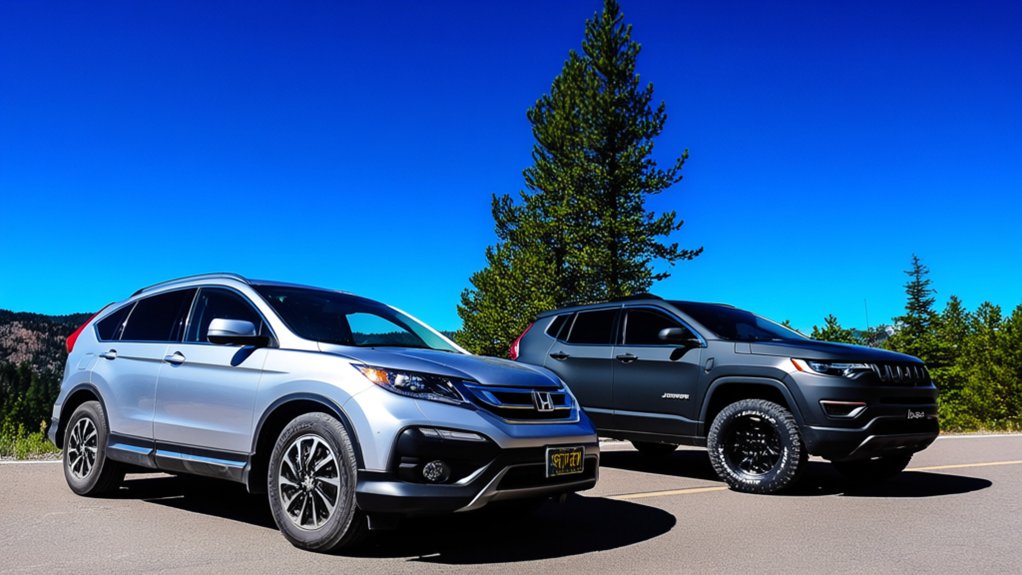
If you want a smoother daily driver with better fuel efficiency and more cargo space, the Honda CR-V’s turbocharged engine and hybrid option make it a smart choice. But if off-road capability matters, the Jeep Compass offers higher ground clearance, rugged traction systems, and tougher handling on rough terrain. You’ll find the CR-V is quieter and more spacious inside, while the Compass focuses on adventure-ready tech and style. Keep exploring to understand which SUV suits your needs best.
How to Choose Between the Honda CR-V and Jeep Compass Compact SUVs
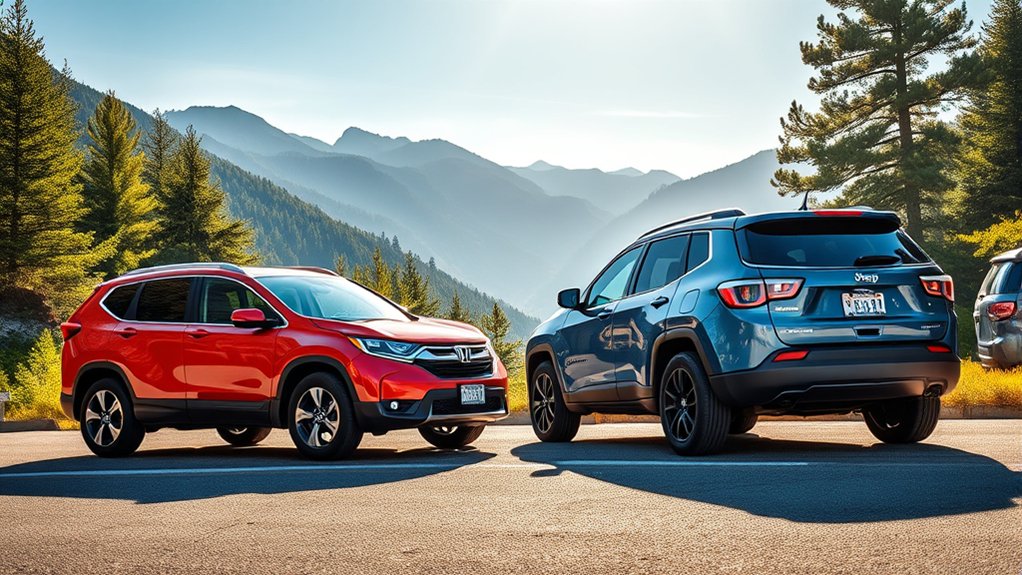
When deciding between the Honda CR-V and Jeep Compass, you’ll want to take into account what matters most to your driving experience. Start by considering your daily needs: do you prioritize spaciousness and comfort, or are you drawn to style and off-road capability?
The CR-V offers a roomy interior and practical storage, perfect for family trips or hauling gear. On the other hand, the Compass presents a rugged design that suits adventurous souls who occasionally tackle rough terrain.
Think about tech features, too—both SUVs come with user-friendly infotainment systems, but their layouts and connectivity options differ.
Ultimately, factor in budget and fuel efficiency. By weighing these elements, you can confidently pick the compact SUV that fits your lifestyle without guessing.
Performance: Honda CR-V vs Jeep Compass
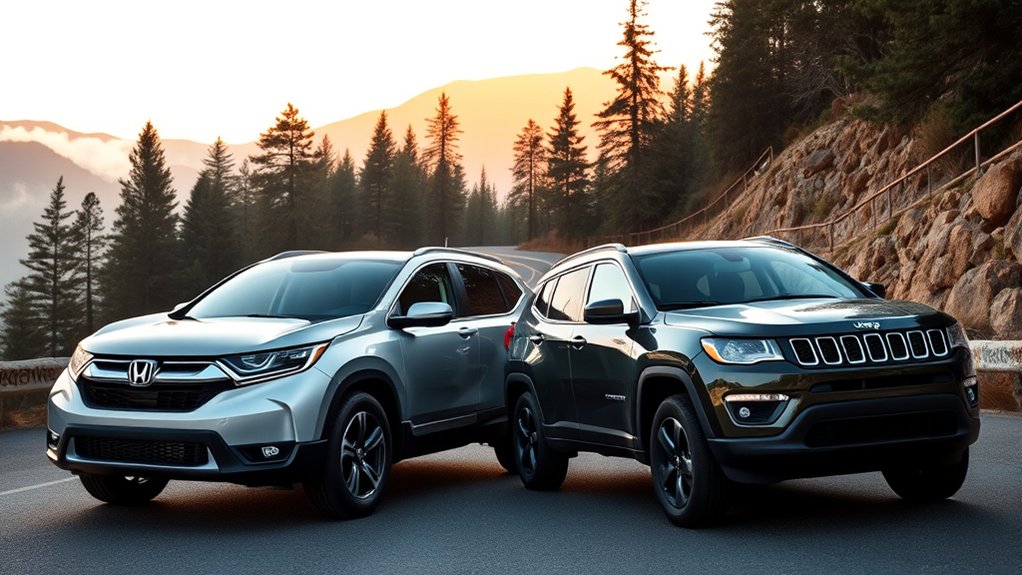
When comparing the Honda CR-V and Jeep Compass, you’ll want to look closely at engine power and fuel efficiency.
Both offer different strengths depending on your driving needs.
Let’s see how they stack up in these key performance areas.
Engine Power Comparison
How does the engine power of the Honda CR-V stack up against the Jeep Compass? When you compare them, the CR-V offers a turbocharged 1.5-liter four-cylinder engine producing 190 horsepower, providing a smooth and responsive drive.
On the other hand, the Jeep Compass comes with a 2.4-liter four-cylinder engine that delivers 180 horsepower. While the Compass’s engine has a slightly larger displacement, the CR-V’s turbocharged setup gives you a bit more power and better acceleration.
If you prioritize a peppier feel and quicker responsiveness, the CR-V edges out the Compass. However, both engines handle daily driving comfortably, so your choice might depend on whether you want a sportier engine or a traditional naturally aspirated one in your SUV.
Fuel Efficiency Ratings
While the Honda CR-V offers a bit more power under the hood compared to the Jeep Compass, fuel efficiency is another key factor to weigh in.
The CR-V shines with an EPA-estimated 28 mpg city and 34 mpg highway, helping you save at the pump on daily drives and road trips.
Meanwhile, the Jeep Compass delivers around 22 mpg city and 31 mpg highway, which is respectable but not as impressive as the CR-V’s numbers.
If you prioritize lower fuel costs and fewer fill-ups, the CR-V’s efficiency gives it a clear edge.
However, if you lean toward off-road capability and don’t mind slightly lower gas mileage, the Compass still holds appeal.
Your driving habits will determine which fuel rating suits you best.
Fuel Efficiency: Which Compact SUV Saves More?

Curious about which compact SUV will save you more at the pump? The Honda CR-V generally offers better fuel efficiency than the Jeep Compass, making it a more budget-friendly choice if you drive often. Here’s a quick comparison of their fuel economy:
| Model | MPG (City/Highway) |
|---|---|
| Honda CR-V | 28 / 34 |
| Jeep Compass | 22 / 31 |
| CR-V Hybrid | 40 / 35 |
| Compass 4×4 | 20 / 29 |
If you want to maximize savings, the CR-V Hybrid stands out with impressive mileage. The Compass, especially in 4×4 configuration, consumes more fuel, so it might cost you more over time. Your choice depends on how much you prioritize fuel economy versus other features.
Interior Space and Comfort Comparison
When you step inside both the Honda CR-V and Jeep Compass, you’ll notice distinct differences in interior space and comfort that could influence your daily driving experience.
The CR-V offers a more spacious cabin, giving you and your passengers extra legroom and headroom. The Jeep Compass, while cozy, delivers a snug feel that some might find appealing for city driving.
Here’s a quick look at their interior features:
- Honda CR-V: More rear legroom, larger cargo space, and adjustable rear seats for enhanced comfort.
- Jeep Compass: Slightly tighter space but supportive seats with a rugged feel.
Both provide quality materials, though the CR-V leans toward a softer touch. Noise insulation is better in the CR-V, making rides quieter and more relaxing.
Advanced Tech Features in CR-V and Compass
Although both the Honda CR-V and Jeep Compass prioritize user experience, their advanced tech features target different needs and preferences.
In the CR-V, you’ll find a user-friendly 7-inch touchscreen with Apple CarPlay and Android Auto integration, making connectivity seamless. It also offers a premium audio system option for an enhanced listening experience.
On the other hand, the Jeep Compass features an 8.4-inch touchscreen with a more rugged infotainment interface, appealing if you want off-road navigation and Jeep’s Uconnect system. You’ll appreciate its available GPS navigation and SiriusXM satellite radio.
Both vehicles provide multiple USB ports and Bluetooth connectivity, but the CR-V leans toward simplicity and ease, while the Compass emphasizes versatility and tech geared to adventure.
Your choice depends on whether you prioritize straightforward tech or more specialized features.
Safety Ratings and Driver Assistance Features
While both the Honda CR-V and Jeep Compass offer solid safety features, you’ll find differences in their ratings and driver assistance technologies that could influence your decision. The CR-V generally receives higher safety ratings from institutions like the IIHS and NHTSA, reflecting its strong crashworthiness.
Honda’s suite of driver aids, Honda Sensing®, comes standard across trims, providing overall tools to keep you safe.
Key safety and driver assistance highlights include:
- Honda CR-V offers adaptive cruise control, collision mitigation braking, and lane-keeping assist as standard.
- Jeep Compass includes blind-spot monitoring and rear cross-traffic alert but offers advanced features mainly on higher trims.
- CR-V’s stronger crash test ratings may give you added peace of mind.
- Both SUVs provide multiple airbags and stability control for basic protection.
These details help you weigh safety priorities effectively.
Off-Road Capability: Which SUV Handles Rough Terrain Better?
When you take the Honda CR-V and Jeep Compass off-road, their terrain adaptability becomes clear through their drivetrains and traction systems.
You’ll want to compare ground clearance and approach angles to see which handles rough terrain better.
Let’s break down how each SUV performs in these key areas.
Terrain Adaptability Comparison
If you plan to take your SUV off the beaten path, understanding how the Honda CR-V and Jeep Compass handle rough terrain is essential. The Jeep Compass is designed with rugged trails in mind, offering better ground clearance and approach angles.
The Honda CR-V, while capable, leans more toward comfort on mild off-road conditions.
Here’s how they compare in terrain adaptability:
- Jeep Compass provides superior clearance for rocky and uneven paths
- Honda CR-V focuses on smooth handling on dirt roads and light trails
- Jeep’s suspension absorbs shocks better on harsh terrain
- CR-V offers a more stable ride on gravel and softer surfaces
Choose based on the roughness you expect; Jeep excels on tougher trails, Honda suits lighter off-roading.
Drivetrain and Traction Systems
Understanding how the Honda CR-V and Jeep Compass handle rough terrain goes beyond ground clearance and suspension—it comes down to their drivetrain and traction systems.
The CR-V offers an Intelligent Variable Torque Management (i-VTM4) all-wheel-drive system, which adjusts power between the front and rear wheels for better grip on slippery surfaces. This suits light off-roading and improves stability on wet or uneven roads.
On the other hand, the Jeep Compass comes equipped with Jeep Active Drive 4×4 systems, including options like Selec-Terrain traction management, allowing you to tailor the drivetrain for snow, mud, sand, or rocks. This makes the Compass more capable in challenging off-road conditions.
Ground Clearance and Approach Angle
Although both the Honda CR-V and Jeep Compass offer capable drivetrains, their ground clearance and approach angles reveal key differences in off-road readiness. When you’re tackling rough terrain, these specs matter a lot.
The Jeep Compass generally boasts higher ground clearance, letting you clear obstacles with less risk of damage. Its steeper approach angle means it can handle sharper inclines without scraping the bumper.
On the other hand, the CR-V’s lower clearance suits paved roads better but limits rough terrain performance.
Here’s a quick comparison to help you decide:
- Jeep Compass ground clearance: around 8.2 inches
- Honda CR-V ground clearance: about 7.8 inches
- Jeep Compass approach angle: roughly 19.5 degrees
- Honda CR-V approach angle: near 17 degrees
If off-roading is a priority, the Jeep Compass takes the lead.
Cargo Space and Practicality: CR-V vs Compass
When you need a vehicle that adapts to your daily demands, cargo space and practicality become top priorities. The Honda CR-V offers a spacious 39.2 cubic feet of cargo space behind the rear seats, expanding to 75.8 cubic feet with the seats folded down. This lets you easily carry bulky items or groceries without hassle.
The Jeep Compass, meanwhile, provides a more modest 27.2 cubic feet behind the rear seats and 59.8 cubic feet with them folded, which might feel tight for larger loads.
Both SUVs offer flexible seating configurations and user-friendly storage compartments, but the CR-V’s larger space gives you an edge if you often haul gear or need room for passengers and cargo simultaneously.
Pricing and Value: Which Compact SUV Fits Your Budget?
If cargo space and practicality matter to you, it’s equally important to take into account how much you’ll spend on each SUV. The Honda CR-V generally comes with a slightly higher starting price but offers a strong value with its reliability and fuel efficiency.
The Jeep Compass might appeal if you want a rugged look and off-road capabilities, though it can get pricier with added features. Consider these points when budgeting:
- Honda CR-V’s base price is competitive, with excellent fuel economy.
- Jeep Compass offers various trims, often increasing the total cost.
- CR-V includes more standard tech and safety features at entry-level.
- Compass’s off-road packages add to the price but boost versatility.
Ultimately, pick the one that balances features and price to fit your needs.
Resale Value: Which Compact SUV Holds Its Worth Longer?
When you consider resale value, it’s key to look at depreciation rates and how market demand affects each model.
The Honda CR-V tends to hold its worth better over time compared to the Jeep Compass.
Understanding these factors can help you make a smarter investment in your next compact SUV.
Depreciation Rates Comparison
Although both the Honda CR-V and Jeep Compass offer appealing features, their depreciation rates reveal which model holds its value better over time. When you consider resale value, the CR-V typically outperforms the Compass, maintaining a stronger worth after several years. Here’s what you should know:
- Honda CR-V retains around 60-65% of its original value after 5 years
- Jeep Compass usually holds about 50-55% of its initial value in the same period
- CR-V’s consistent reliability and fuel efficiency contribute to slower depreciation
- Compass depreciation accelerates due to higher maintenance costs and market competition
If you want a compact SUV that depreciates less, the Honda CR-V is usually the smarter choice.
Market Demand Impact
Understanding depreciation rates is just one part of how resale values are shaped. Market demand plays a vital role in determining which compact SUV holds its worth longer.
When you consider the Honda CR-V, its consistent popularity and reputation for reliability keep demand strong, boosting resale prices.
On the other hand, the Jeep Compass attracts buyers looking for off-road capability and style, but its market appeal isn’t as broad, which can soften resale value.
If you want a vehicle that maintains value well, you’ll likely find the CR-V’s steady demand more favorable.
However, if you prioritize unique features, you might accept a steeper depreciation with the Compass.
Ultimately, understanding market trends helps you make smarter resale decisions.
Frequently Asked Questions
What Are the Warranty Differences Between the Honda CR-V and Jeep Compass?
You’ll get a 3-year/36,000-mile basic warranty with both, but Jeep offers a longer 5-year/60,000-mile powertrain warranty, while Honda’s powertrain coverage is 5 years/60,000 miles too, so they’re quite similar overall.
How Do Maintenance Costs Compare for the CR-V and Compass?
You’ll find the Honda CR-V generally has lower maintenance costs due to its reliability and widespread service network. The Jeep Compass may cost more over time because of pricier parts and less frequent dealer availability.
Which SUV Offers Better Towing Capacity?
When you hitch a trailer, the Jeep Compass symbolizes strength, towing up to 2,000 pounds, while the Honda CR-V gently pulls around 1,500 pounds. So, you’ll find Compass offers better towing capacity for your adventures.
Are There Significant Differences in Available Color Options?
Yes, you’ll notice significant color differences between the two. The Honda CR-V offers more neutral, classic shades, while the Jeep Compass provides bolder, adventurous colors, letting you pick a style that matches your personality perfectly.
How Do the Infotainment System Interfaces Differ Between the Two?
You’ll find the CR-V’s infotainment is more intuitive with a larger touchscreen and physical knobs, making controls easier. The Jeep Compass offers a stylish but sometimes less user-friendly interface, focusing more on customization than simplicity.
Conclusion
Choosing between the Honda CR-V and Jeep Compass is like picking your travel companion for an epic journey. The CR-V offers reliable comfort and efficiency, while the Compass promises adventurous off-road thrills. Think of it as deciding between steady roads and wild trails—both have their charm. Ultimately, your choice reflects not just a vehicle, but the story you want to tell on every drive. Which adventure will you write?