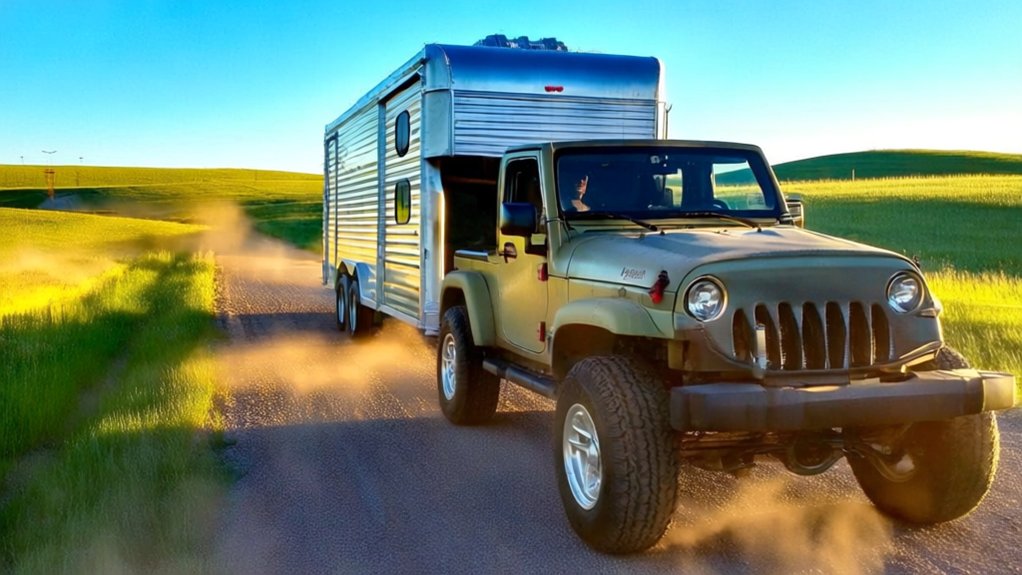
How to Tow a Horse Trailer With a Jeep Wrangler
To tow a horse trailer with your Jeep Wrangler, first check its towing capacity and pick a trailer that fits within those limits. Securely hitch the trailer using the right equipment, and guarantee tires and lights are in good shape. Drive carefully, maintaining slower speeds and wider turns, and use extended mirrors for better visibility. Plan your route to avoid tough spots and perform post-trip checks to keep everything in top condition. Following these steps sets you up for safe, confident towing.
Key Takeaways
- Verify your Jeep Wrangler’s towing capacity and select a horse trailer within those limits for safe towing performance.
- Use a properly rated hitch and secure safety chains correctly to ensure trailer stability and safety.
- Distribute the load evenly inside the trailer, securing horses and equipment to maintain balance and prevent shifting.
- Drive cautiously with gradual acceleration, increased following distance, and wider turns to prevent trailer sway and accidents.
- Enhance visibility using extended towing mirrors or backup cameras and plan routes avoiding narrow or difficult roads.
Check Your Jeep Wrangler’s Towing Capacity
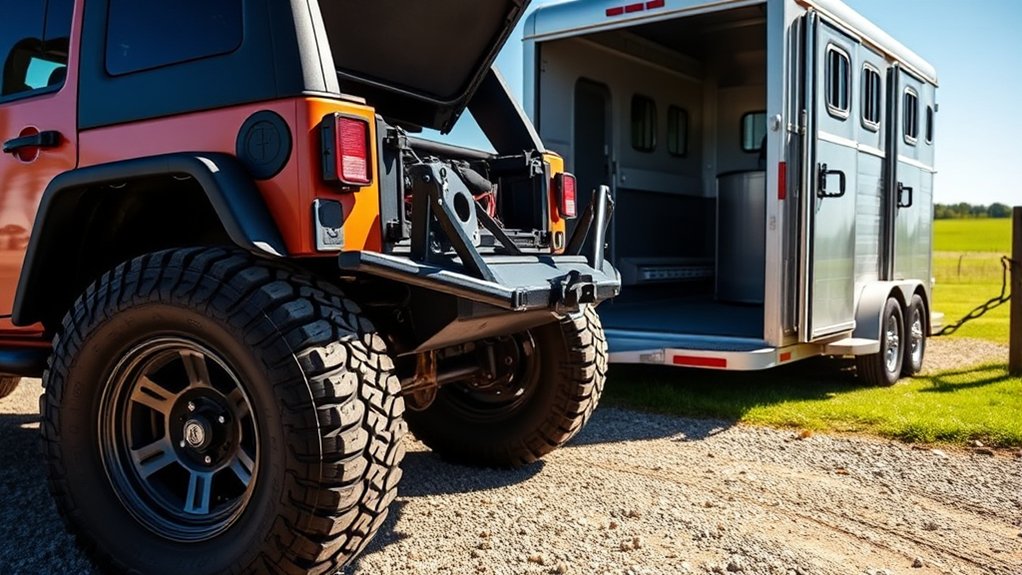
How much weight can your Jeep Wrangler safely tow? Before hooking up your horse trailer, you need to know your Wrangler’s exact towing capacity. Check your owner’s manual or the manufacturer’s website for the official numbers, as they vary by model and year.
Know your Jeep Wrangler’s towing capacity before hooking up your horse trailer to ensure safety.
Don’t guess or assume because exceeding this limit puts you and your horses at risk. Remember, the towing capacity includes the trailer’s weight plus the horses and gear inside.
Also, factor in the tongue weight—the downward pressure the trailer exerts on your hitch. Understanding these limits helps you avoid strain on your Jeep’s engine, transmission, and brakes.
Staying within your Wrangler’s towing capacity ensures a safer, more controlled drive when hauling your horse trailer.
Choose the Right Horse Trailer for Your Jeep
When choosing a horse trailer for your Jeep, make sure its weight stays within your vehicle’s towing limits.
You’ll also want to take into account the size of the trailer to ensure it fits your horses comfortably without overloading your Jeep.
Matching these factors keeps towing safe and stress-free.
Trailer Weight Compatibility
Why does trailer weight compatibility matter so much when choosing a horse trailer for your Jeep? Because towing a trailer that’s too heavy can strain your Jeep’s engine, brakes, and suspension, risking safety. You need to match your trailer’s weight to your Jeep’s towing capacity to guarantee smooth, safe towing.
Here’s a quick guide to help you understand weight limits:
| Jeep Wrangler Model | Max Towing Capacity (lbs) |
|---|---|
| 2-Door JK | 2,000 |
| 4-Door JK | 3,500 |
| JL Sport | 2,000 |
| JL Sahara | 3,500 |
| JL Rubicon | 3,500 |
Always check your Jeep’s manual for exact specs before hitching up!
Trailer Size Considerations
What size trailer fits best with your Jeep? Choosing the right horse trailer size guarantees safe and efficient towing.
First, consider the number of horses you plan to haul. A two-horse trailer is usually manageable for most Jeep Wranglers, while larger trailers could exceed your Jeep’s towing capacity.
Next, think about trailer length and width—longer trailers increase turning difficulty and require more braking power.
Keep your Jeep’s payload and hitch ratings in mind to avoid overloading. Don’t forget additional gear and supplies add weight, so factor that into your decision.
Ultimately, pick a trailer that balances your hauling needs with your Jeep’s capabilities. This keeps towing stable and protects both your vehicle and your horses during transport.
Properly Hitch a Horse Trailer to Your Jeep
To hitch your horse trailer properly, start by choosing the right hitch that matches your Jeep and trailer weight.
Make sure the hitch is securely locked in place before you move on.
Don’t forget to attach safety chains in a crisscross pattern to keep everything secure on the road.
Selecting The Right Hitch
Although hitching your horse trailer might seem straightforward, selecting the right hitch for your Jeep is essential to guarantee safety and stability on the road.
Start by checking your Jeep Wrangler’s towing capacity and match it with a hitch rated for that weight. Most horse trailers require a Class III or IV hitch, which provides the strength needed for heavy loads.
You’ll want a ball mount compatible with your trailer’s coupler size—commonly 2 or 2-5/16 inches.
Consider a weight-distributing hitch if your trailer is particularly heavy; it helps balance the load and improves handling.
Also, verify the hitch is securely installed on your Jeep’s frame, not just the bumper, for maximum stability.
Choosing the right hitch means safer towing and peace of mind.
Securing Safety Chains
Once you’ve selected the right hitch, securing the safety chains is essential for keeping your horse trailer firmly connected to your Jeep. Cross the chains under the trailer tongue to create a cradle that can catch it if the hitch fails. Attach the chains to the designated hooks on your Jeep’s hitch receiver, ensuring they’re not too loose or too tight. Avoid letting the chains drag on the ground to prevent damage. Double-check all connections before hitting the road.
| Step | Action | Tip |
|---|---|---|
| 1 | Cross safety chains | Creates a cradle |
| 2 | Attach to hitch hooks | Use designated points |
| 3 | Adjust chain length | Avoid slack or tightness |
| 4 | Check for ground contact | Prevent wear & damage |
| 5 | Inspect before driving | Confirm secure connection |
Inspect Tires and Lights Before Towing a Horse Trailer
Before you hit the road, you’ll want to carefully inspect the tires and lights on your horse trailer to make certain safe travel. Check each tire for proper inflation, tread depth, and any signs of damage like cracks or bulges. Underinflated or worn tires can cause blowouts or poor handling. Don’t forget the spare tire—make sure it’s in good condition and properly inflated.
Next, test all trailer lights, including brake lights, turn signals, and running lights. Have someone assist you by activating the vehicle’s signals while you observe the trailer’s lights. Replace any burnt-out bulbs or fix loose wiring immediately.
Performing these checks helps prevent accidents, keeps you visible to other drivers, and guarantees a smoother towing experience with your Jeep Wrangler.
Understand Trailer Braking Systems for Safe Towing
After ensuring your tires and lights are in top shape, you need to focus on how your trailer slows down. Trailer braking systems are essential for safe towing, especially with heavy horse trailers. You’ll encounter electric brakes, surge brakes, or even no brakes on light trailers. Electric brakes connect to your Jeep’s brake controller, giving you control and smoother stops. Surge brakes activate automatically when you brake, but they require regular maintenance. Knowing your trailer’s braking type helps you anticipate stopping distance and prevents accidents.
| Braking Type | Control Level | Maintenance |
|---|---|---|
| Electric | High | Moderate |
| Surge | Automatic | High |
| No Brakes | None | None |
| Jeep Wrangler | Brake Controller | Easy |
| Safety | Peace of Mind | Confidence |
Prepare Your Jeep’s Suspension for Towing
Although your Jeep Wrangler is built tough, towing a horse trailer puts extra strain on its suspension system. To handle this load safely, you should upgrade or reinforce your suspension before hitting the road.
Start by installing heavy-duty shocks or springs designed for towing to improve stability and reduce sway. Adding a weight distribution hitch can also help balance the trailer’s tongue weight, easing the burden on your suspension.
Don’t forget to check your tire pressure regularly, as proper inflation supports better handling under load. If your Jeep has adjustable air suspension, increase the pressure to compensate for the trailer’s weight.
Taking these steps guarantees your suspension can handle the extra stress, providing a smoother, safer towing experience every time you tow your horse trailer.
Load Your Horse Trailer Safely and Evenly
You need to distribute the weight inside your horse trailer evenly to maintain balance while towing. Securing the load properly will prevent shifting that could cause instability on the road.
Let’s look at how to pack your trailer safely for a smooth ride.
Distribute Weight Evenly
When loading your horse trailer, distributing the weight evenly is essential for safe towing and stable handling. Start by placing heavier items low and centered over the trailer’s axles to maintain balance.
Position your horses evenly, keeping their weight spread out rather than clustered on one side. Avoid placing too much weight toward the front or rear, as this can cause swaying or fishtailing.
Use the trailer’s design features, like partitions, to help keep weight balanced. Double-check your load after securing everything to make sure the trailer sits level when hitched to your Jeep Wrangler.
Taking these steps helps you maintain control on the road, reduces wear on your vehicle and trailer, and keeps your horses comfortable during transit.
Secure Horse Trailer Load
Balancing the weight in your horse trailer sets the foundation for a secure load. Once you’ve distributed the weight evenly, make certain each horse is comfortably restrained using appropriate dividers or partitions.
Secure all tack, feed, and equipment so nothing shifts during transit. Use strong, reliable tie-downs or straps to prevent movement, and double-check that all latches and doors are firmly closed.
Avoid overloading any one side, as uneven weight can cause instability. Regularly inspect your trailer’s floor and walls for wear or damage that could compromise safety.
Adjust Your Driving Habits When Towing a Trailer
Since towing a horse trailer adds extra weight and length to your vehicle, you’ll need to adjust your driving habits to maintain control and safety. Start by accelerating and braking more gradually to avoid sudden movements that could cause swaying.
Keep a greater following distance, giving yourself ample time to react to traffic changes.
When turning, take wider arcs to prevent the trailer from clipping curbs or other obstacles.
Stay mindful of your speed, especially on downhill slopes, as the extra weight increases stopping distance.
Avoid sharp lane changes and sharp turns.
Ultimately, be patient and allow extra time for maneuvers like merging or parking.
These adjustments help ensure a smooth, safe towing experience with your Jeep Wrangler.
Improve Visibility With Mirrors and Cameras
To tow a horse trailer safely, you’ll need to improve your visibility with the right mirrors and cameras. Your Jeep Wrangler’s standard mirrors often won’t give you a clear view of the trailer’s sides and rear. Upgrading guarantees you spot blind spots and avoid accidents.
- Install extended towing mirrors for a wider field of view.
- Attach clip-on mirrors if you need a temporary solution.
- Use a backup camera designed for trailers to see directly behind you.
- Consider wireless camera systems that transmit real-time footage to your dashboard.
Handle Turns, Stops, and Hills When Towing
When you tow a horse trailer, mastering how to handle turns, stops, and hills is essential for safety and control. Take wider turns to avoid clipping curbs or other vehicles, and slow down well in advance of stops to reduce strain on your Jeep’s brakes. When going uphill, maintain steady power without sudden acceleration. Downhill, use lower gears to help control speed and avoid overheating brakes.
| Maneuver | Key Tips |
|---|---|
| Turns | Take wide, slow turns |
| Stops | Brake early and gently |
| Uphill | Keep steady throttle |
| Downhill | Use low gear, avoid overbraking |
Following these tips keeps your towing smooth and safe on the road.
Plan Your Route for Towing a Horse Trailer
Although towing a horse trailer demands careful driving, planning your route is just as important to guarantee a smooth trip. Before you hit the road, map out your path to avoid tight turns, low bridges, and heavy traffic.
Careful route planning is essential to avoid tight turns, low bridges, and heavy traffic when towing a horse trailer.
Consider the terrain and road conditions to prevent unnecessary stress on your Jeep and trailer. Here are four key steps to plan effectively:
- Use GPS or apps designed for towing to identify safe routes.
- Avoid narrow roads and sharp curves that challenge maneuverability.
- Check for low clearance bridges or overpasses that your trailer can’t pass under.
- Plan rest stops where you can safely park and check on your horses.
Following these tips will help you tow confidently and keep your animals safe.
Maintain Your Jeep Wrangler and Horse Trailer After Each Tow
How often do you check your Jeep Wrangler and horse trailer after a trip? You should inspect both thoroughly to catch any wear or damage early.
Start by examining tires for cuts, punctures, or uneven wear, and make certain proper inflation. Check the trailer hitch and connections for signs of rust or looseness. Clean brake lights and signals to keep them visible.
After each tow, lubricate moving parts like hinges and couplers to prevent rust and guarantee smooth operation. Don’t forget to clean mud and debris off both vehicles to avoid corrosion.
Regular maintenance not only extends the life of your equipment but also keeps you safe on the road. Staying proactive helps you avoid costly repairs and unexpected breakdowns during your next journey.
Troubleshoot Common Towing Issues With Your Jeep Wrangler
If you notice unusual noises, handling issues, or warning lights while towing your horse trailer, you’ll want to address them promptly to avoid bigger problems. Start by checking these common trouble spots:
- Brakes – Ensure your trailer’s brakes are functioning and synced with your Jeep’s system. Faulty brakes cause poor stopping and safety risks.
- Tire Pressure – Low or uneven pressure can affect handling and cause tire damage. Check both Jeep and trailer tires before every trip.
- Hitch Connection – Inspect the hitch and safety chains for secure attachment. Loose connections lead to swaying or detachment.
- Electrical System – Verify all trailer lights and signals work properly. Wiring issues can trigger warning lights or unsafe driving conditions.
Address these issues quickly to keep your towing experience smooth and safe.
Frequently Asked Questions
What Are the Best Jeep Wrangler Models for Towing Horse Trailers?
You’ll want Jeep Wrangler models like the Rubicon, Sahara, or Sport with the 3.6L V6 engine since they offer the best towing capacity. They handle weight well and provide stability when hauling horse trailers.
Can I Tow a Horse Trailer Without a Trailer Brake Controller?
You absolutely can’t safely tow a horse trailer without a brake controller—it’s like expecting your brakes to stop a freight train with a feather. Don’t risk it; install one to control trailer brakes properly and keep everyone safe.
How Often Should I Replace Towing Hitch Components?
You should inspect towing hitch components every six months and replace them immediately if you notice rust, cracks, or wear. Regular checks prevent failures and keep your towing safe and secure on every trip.
Are There Specific Jeep Wrangler Accessories for Horse Trailer Towing?
Yes, you’ll find specific Jeep Wrangler accessories like heavy-duty hitch receivers, trailer brake controllers, and sway control devices designed for horse trailer towing. These help improve safety and stability while you’re on the road with your trailer.
What Insurance Coverage Is Needed When Towing a Horse Trailer?
You’ll need thorough auto insurance that covers towing, plus trailer insurance for damage or theft. Make sure your liability limits cover both your Jeep and horse trailer in case of accidents or injuries while towing.
Conclusion
Towing a horse trailer with your Jeep Wrangler can be as smooth as a gentle gallop if you follow the right steps. By knowing your Jeep’s limits, securing the trailer properly, and staying alert on the road, you’ll guarantee a safe and enjoyable journey for both you and your horse. Keep your gear in top shape, and you’ll be ready to hit the trail with confidence every time.