How You Get a HEMI Engine Installed in Your Jeep Wrangler
You get a HEMI engine installed in your Jeep Wrangler by choosing a compatible model like the JK or JL with enough space and a strong frame. Prepare by upgrading the transmission, cooling, electrical systems, and suspension to handle the extra power. Carefully mount the engine, connect all components, then test and fine-tune for peak performance. With the right parts and steps, your Jeep turns into a powerful off-road beast. Keep going to uncover detailed tips and upgrades.
Key Takeaways
- Choose a compatible Jeep Wrangler model like JK or JL for easier engine bay fitment and electrical system integration.
- Prepare by reinforcing the frame, drivetrain, and suspension to handle the HEMI’s increased power and torque.
- Drain all fluids safely and disconnect electrical components before removing the old engine to avoid contamination and damage.
- Install custom engine mounts, connect transmission, cooling, fuel, and exhaust systems, ensuring all connections are secure and aligned.
- Perform thorough testing, ECU tuning, and upgrade brakes and cooling systems to optimize performance and reliability post-installation.
Which Jeep Wrangler Models Can Handle a HEMI Swap?
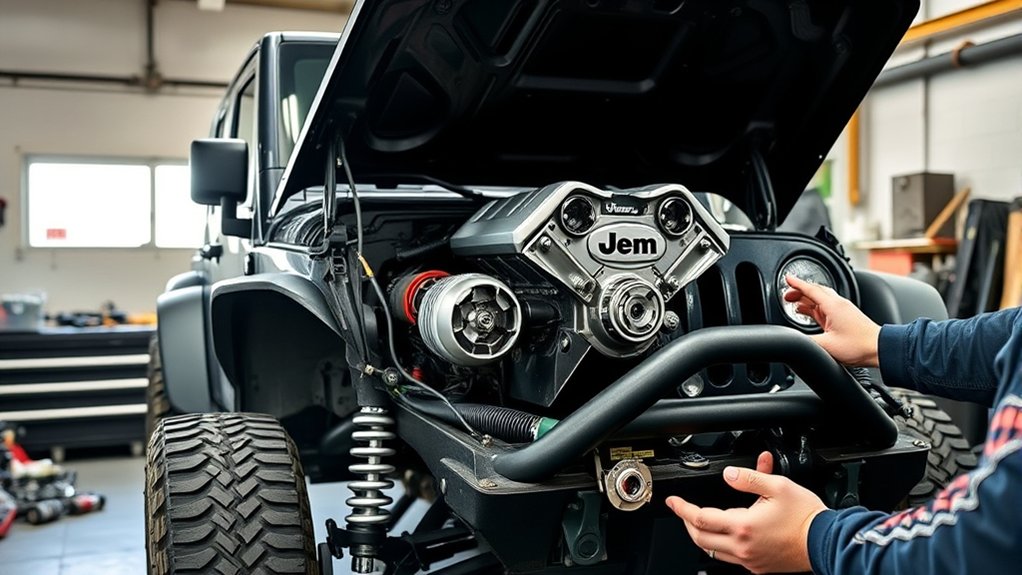
Although many Jeep Wrangler models can undergo a HEMI engine swap, not all are equally suited for the task. You’ll find that JK (2007-2018) and JL (2018-present) models are the most popular choices due to their larger engine bays and modern electrical systems. These Wranglers offer enough space to fit the HEMI’s size and weight, making installation smoother.
Earlier models like TJ and YJ can handle the swap, but you’ll face more challenges with wiring and mounting brackets. When considering your Wrangler, check the engine bay dimensions, transmission compatibility, and frame strength.
Also, your suspension and braking systems should be ready for the added power. Knowing which model you have helps you plan a successful, reliable HEMI swap without unnecessary headaches.
Why Upgrade Your Jeep Wrangler With a HEMI Engine?
Upgrading your Jeep Wrangler with a HEMI engine gives you a serious power and performance boost that transforms your driving experience.
You’ll notice improved acceleration and towing capacity, making tough trails feel easier.
Plus, the enhanced off-road capability lets you tackle more challenging terrain with confidence.
Power and Performance Boost
When you swap your Jeep Wrangler’s stock engine for a HEMI, you immediately release a new level of power and performance. You’ll notice how effortlessly your Jeep accelerates, making highway merges and overtaking smoother and safer.
The HEMI’s superior horsepower and torque give you more control and responsiveness, whether on the street or trail. Here’s what you gain:
- Increased horsepower for faster acceleration
- Higher torque for better towing and hauling
- Improved throttle response for quicker power delivery
- Enhanced engine durability under demanding conditions
Upgrading to a HEMI lets you push your Jeep harder without sacrificing reliability. You get a muscle car heart under your rugged Jeep’s hood, transforming your driving experience every time you hit the gas pedal.
Enhanced Off-Road Capability
How exactly does a HEMI engine enhance your Jeep Wrangler’s off-road capabilities? By delivering increased torque and horsepower, it powers you through tough terrains with ease. You’ll experience better throttle response, allowing precise control on rocky or muddy trails. The engine’s robust design ensures reliability under harsh conditions, so you won’t worry about overheating or stalling. Upgrading to a HEMI means your Wrangler can tackle steep inclines and deep mud without breaking a sweat.
| Off-Road Feature | HEMI Engine Benefit |
|---|---|
| Torque | Improved low-end power |
| Throttle Response | Enhanced control |
| Reliability | Durable under stress |
| Climbing Ability | Handles steep grades |
| Mud & Rock Traction | Maintains momentum |
Choosing the Right HEMI Engine for Your Wrangler
Selecting the right HEMI engine for your Jeep Wrangler depends on your performance goals, budget, and compatibility with your vehicle. You want an engine that meets your needs without causing unnecessary complications.
Start by considering these factors:
- Displacement and power output: Larger engines like the 6.4L deliver more horsepower but may require upgrades.
- Fuel efficiency: Smaller HEMI options balance power with better mileage.
- Transmission compatibility: Confirm your transmission can handle the engine’s torque.
- Installation complexity: Some engines demand more modifications, affecting time and cost.
Essential Parts You Need Beyond the HEMI Engine
Before you start your HEMI engine swap, you’ll need to address transmission compatibility to guarantee everything works smoothly.
Don’t forget to upgrade your cooling system to handle the increased power and heat. These parts are vital for a reliable and efficient setup.
Transmission Compatibility Requirements
While upgrading to a HEMI engine considerably boosts your Jeep Wrangler’s power, you’ll also need to make certain your transmission can handle the increased torque and horsepower. Not all stock transmissions are built for this kind of upgrade, so evaluating compatibility is critical.
Here’s what to focus on:
- Transmission Type: Opt for a heavy-duty automatic or manual transmission designed for high torque.
- Gear Ratios: Confirm gear ratios complement the HEMI’s power band for peak performance.
- Clutch or Torque Converter: Upgrade to a stronger clutch or torque converter to prevent slippage.
- Transmission Cooling: Consider additional cooling solutions to avoid overheating during intense use.
Checking these factors guarantees your drivetrain remains reliable and maximizes the HEMI engine’s potential in your Wrangler.
Upgraded Cooling System
Upgrading your transmission to handle the HEMI’s power is just one piece of the puzzle. You’ll also need an upgraded cooling system to keep that beast running smoothly.
The HEMI produces more heat than your stock engine, so relying on the existing radiator won’t suffice. Install a high-capacity aluminum radiator designed for heavy-duty cooling. Pair it with an electric fan or dual fans to boost airflow, especially during stop-and-go driving.
Don’t forget to upgrade your thermostat and coolant hoses to handle higher temperatures and pressure. A heavy-duty water pump ensures consistent coolant circulation under extreme conditions.
Finally, check your coolant type—using a high-performance antifreeze can protect your engine better. These upgrades prevent overheating and keep your HEMI performing reliably on every adventure.
Preparing Your Jeep Wrangler for a HEMI Swap
Although installing a HEMI engine is an exciting upgrade, you’ll need to prepare your Jeep Wrangler carefully to guarantee a smooth swap. Proper preparation minimizes complications and ensures your Jeep handles the new power effectively.
Start by evaluating your current setup and gathering necessary tools and parts.
Here’s what you should focus on:
- Clear workspace: Ensure ample room around your Jeep for maneuvering and engine access.
- Check frame and mounts: Verify your frame’s condition and prepare custom engine mounts for the HEMI.
- Upgrade drivetrain components: Reinforce transmission and axles to handle increased torque.
- Electrical system prep: Plan wiring modifications to support the HEMI’s sensors and ignition system.
Taking these steps sets a solid foundation before you begin the engine swap.
How to Safely Remove Your Old Engine
Before you remove your old engine, make sure to disconnect all electrical components carefully to avoid damage.
You’ll also need to drain all fluids properly to prevent spills and keep your workspace safe.
Taking these steps will set you up for a smooth engine removal.
Disconnect Electrical Components
Once you’ve prepped your workspace and verified the battery is disconnected, you’ll want to carefully label and disconnect all electrical components attached to the engine. This step is vital to avoid confusion during reassembly and prevent electrical shorts.
Start by identifying each connector and sensor, then use masking tape or tags to mark them clearly. Focus on these main components:
- Engine control module (ECM) connectors
- Fuel injector wiring harness
- Ignition coil connectors
- Ground wires and sensor plugs
Use appropriate tools to gently release clips without damaging wires or connectors. Take your time to guarantee everything is fully detached before moving on.
Proper labeling and disconnection will make reinstalling the HEMI engine smoother and safer.
Drain Fluids Properly
Since draining the fluids is a crucial step in removing your old engine, you’ll want to handle it carefully to avoid spills and environmental hazards. Begin by gathering proper containers and protective gear. Drain each fluid slowly, ensuring no cross-contamination. Dispose of fluids according to local regulations to protect the environment.
| Fluid Type | Drain Location | Disposal Method |
|---|---|---|
| Engine Oil | Oil pan drain plug | Recycle at a certified center |
| Coolant | Radiator drain valve | Dispose at hazardous waste facility |
| Transmission Fluid | Transmission pan drain plug | Take to an auto shop or recycling center |
| Brake Fluid | Brake fluid reservoir | Dispose of as hazardous waste |
Following these steps keeps your workspace clean and ensures safety during engine removal.
Installing the HEMI Engine and Connecting Systems
Although installing the HEMI engine requires careful attention, you’ll find the process manageable if you follow each step precisely. Start by carefully lowering the engine into the Jeep’s engine bay, aligning the motor mounts with the frame brackets.
Installing the HEMI engine is straightforward when you carefully align motor mounts with the frame brackets.
Securely bolt the engine mounts to keep everything stable during operation. Next, connect the essential systems to guarantee proper function:
- Attach the transmission to the engine, ensuring proper fit and alignment.
- Connect the cooling system hoses to prevent overheating.
- Link the fuel lines to deliver fuel efficiently.
- Hook up the exhaust system to manage emissions and noise.
Double-check each connection before proceeding to avoid issues later. With these steps, your HEMI engine will be firmly installed and ready for the next phase.
Electrical and ECU Upgrades for Your HEMI Swap
When upgrading to a HEMI engine, you’ll need to address the electrical system and ECU to guarantee compatibility and peak performance. The HEMI’s advanced fuel injection and ignition systems require a properly programmed ECU to manage engine functions effectively. You can either reflash your existing ECU with a HEMI-specific tune or install a standalone aftermarket ECU designed for this swap.
Wiring harness modifications are essential since the HEMI’s sensors and actuators differ from the stock engine’s. Make sure to upgrade wiring connectors and routes to prevent shorts or signal loss.
Additionally, consider an upgraded alternator and battery setup to handle increased power demands. Properly upgrading your electrical and ECU systems ensures smooth engine management, reliable starts, and maximum power delivery from your new HEMI swap.
Upgrading Transmission, Drivetrain, Suspension, and Brakes
Upgrading your Jeep Wrangler’s transmission, drivetrain, suspension, and brakes will help you handle the increased power and torque from your new HEMI engine. You’ll want to fortify these systems to maintain reliability and control.
Consider these key upgrades:
- Transmission: Swap to a heavy-duty transmission that can withstand more torque and provide smoother shifts.
- Drivetrain: Upgrade axles and driveshafts with stronger components to handle the extra power.
- Suspension: Install heavy-duty shocks and springs to support the added weight and improve off-road stability.
- Brakes: Upgrade to high-performance brake pads and rotors to ensure safe stopping power under increased load.
Testing and Tuning Your Jeep After the HEMI Installation
After installing your HEMI engine, you’ll want to thoroughly test and tune your Jeep to guarantee everything runs smoothly and performs at its best. Start by checking fluid levels and inspecting for leaks. Then, perform a road test to monitor engine responsiveness and transmission shifts. Use a diagnostic tool to adjust the ECU for ideal air-fuel mixture and ignition timing. Fine-tuning these settings improves fuel efficiency and power delivery.
| Test Type | Purpose | Tools Needed |
|---|---|---|
| Fluid Inspection | Ensure no leaks or issues | Visual inspection |
| Road Test | Check performance | Test drive |
| ECU Tuning | Maximize engine settings | Diagnostic scanner |
Regular testing and tuning keep your Jeep reliable and maximize the HEMI’s performance.
Common Challenges and Tips for a Successful HEMI Swap
Though installing a HEMI engine in your Jeep Wrangler can considerably boost power and performance, you’ll likely face several challenges along the way. You need to anticipate fitment issues since the HEMI is larger and heavier.
Electrical wiring often requires custom work to integrate the new engine management system. Cooling upgrades are essential to prevent overheating, and transmission compatibility must be addressed to handle the increased torque.
Here are some tips to help you succeed:
- Measure thoroughly before starting to avoid fitment surprises
- Use a professional-grade wiring harness or get expert help
- Upgrade your radiator and cooling fans for better heat management
- Choose a transmission rated for the HEMI’s power output
Planning ahead will save time and frustration during your swap.
Frequently Asked Questions
How Much Does a HEMI Engine Swap Typically Cost?
A HEMI engine swap typically costs between $7,000 and $15,000, depending on parts, labor, and modifications. You’ll want to budget extra for tuning and any unexpected issues that might pop up during the swap.
Can I Insure My Jeep After a HEMI Engine Swap?
Yes, you can insure your Jeep after a HEMI swap, but it’s not automatic. Insurers often require detailed inspections and documentation. You’ll want to shop around and be ready to explain the upgrade’s impact on value and risk.
How Will a HEMI Swap Affect My Jeep’s Fuel Economy?
A HEMI swap will likely lower your Jeep’s fuel economy because the engine is bigger and more powerful, so it burns more gas. You’ll enjoy more performance but expect to stop at the pump more often.
Are There Any Legal Restrictions for HEMI Engine Swaps?
When it comes to legal restrictions, you can’t just fly by the seat of your pants. You’ll need to check emissions laws and safety requirements in your state before swapping engines to stay street-legal and avoid fines.
How Long Does a Complete HEMI Engine Swap Usually Take?
A complete HEMI engine swap usually takes about one to two weeks, depending on your experience and parts availability. You’ll need time for wiring, custom mounts, and tuning to get everything running smoothly.
Conclusion
Swapping a HEMI engine into your Jeep Wrangler isn’t just about raw power—it transforms your driving experience. While it’s a complex project, tackling essential upgrades and careful tuning guarantees your Wrangler runs smoothly and reliably. Think the HEMI’s too big or complicated for your Jeep? With the right prep and parts, you’ll be surprised how well it fits. Ready to take on the challenge? Your Wrangler’s ultimate performance awaits.