How to Shift Into 4WD While Moving Your Jeep Wrangler
You can shift your Jeep Wrangler into 4WD while moving by easing off the throttle and smoothly engaging 4H at speeds up to 55 mph on traction-limited surfaces like mud or snow. Make sure your tires have good grip and that the terrain is stable to avoid drivetrain stress. Listen for a click and check your dashboard indicator to confirm engagement. If you want to handle shifting with confidence and troubleshoot common issues, there’s more to explore.
Key Takeaways
- Ease off the throttle and slow down to a low or moderate speed before shifting into 4WD while moving.
- Shift smoothly and firmly from 2H to 4H at speeds up to 55 mph for part-time 4WD systems.
- Confirm engagement by listening for a click or checking the dashboard 4WD indicator light.
- Avoid shifting into 4L while moving; stop or slow to under 5 mph before shifting to 4L.
- Ensure your Jeep’s 4WD system is well-maintained and tires have proper traction before shifting on the fly.
When to Shift Into 4WD While Driving Your Jeep Wrangler
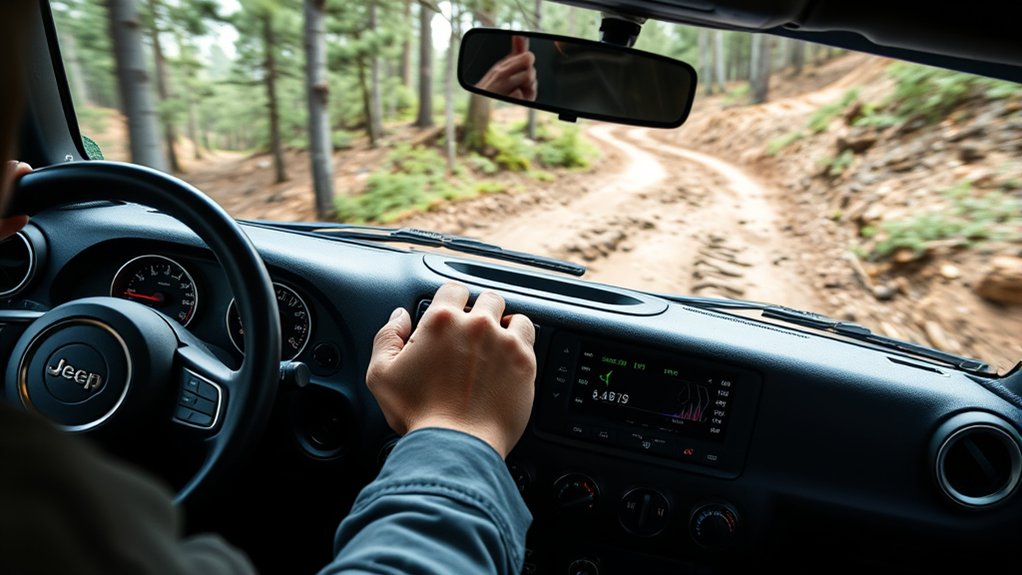
Although you can shift into 4WD while driving your Jeep Wrangler, you should do so only when conditions demand extra traction, such as on slippery or uneven terrain. If you’re cruising on dry pavement, 4WD isn’t necessary and can cause drivetrain binding.
Shift into 4WD only when extra traction is needed, avoiding dry pavement to prevent drivetrain binding.
When you hit mud, snow, loose gravel, or steep inclines, engaging 4WD improves stability and control. Pay attention to changes in road surface or weather that reduce tire grip.
You don’t need to stop to shift into 4WD in most Wranglers, but you should slow down to avoid strain. Remember, using 4WD on regular roads wastes fuel and accelerates wear.
Engage 4WD only when you need it to navigate challenging driving situations safely and efficiently.
Preparing Your Jeep for Safe 4WD Engagement While Driving
Before shifting into 4WD while driving, you should guarantee your Jeep Wrangler is properly prepared to handle the changeover smoothly.
First, check that your tires have adequate traction and pressure; uneven or low pressure can cause drivetrain stress.
Second, make sure your vehicle is on a stable surface or terrain where 4WD engagement will be effective and safe.
Third, confirm that your transfer case and 4WD system are well-maintained and free from mechanical issues to avoid damage during shifting.
By following these steps, you minimize the risk of drivetrain binding or excessive wear.
Preparing your Jeep this way helps facilitate a smooth transition into 4WD, keeping both you and your vehicle safe on the road or trail.
What Speeds Are Safe for Shifting Into 4WD in Your Wrangler?
Once your Jeep Wrangler is ready for 4WD engagement, knowing the right speed to shift becomes key to protecting your drivetrain. Generally, you can shift into 4WD at low to moderate speeds without causing damage, but each mode has its own ideal range. Avoid shifting at high speeds to prevent drivetrain stress.
| 4WD Mode | Safe Speed Range (mph) | Notes |
|---|---|---|
| 4H (4-High) | 0-55 | Use for on-road or light off-road |
| 4L (4-Low) | 0-5 | For slow, tough terrain |
| Neutral | Any | Disengages drive; no power transfer |
| 2H (2-High) | 0-65+ | Default for normal driving |
Stick to these speeds to keep your Wrangler running smoothly.
Step-by-Step Guide to Shifting Into 4WD While Driving
Shifting into 4WD while driving takes a bit of finesse to facilitate a smooth changeover and protect your Jeep’s drivetrain. Here’s how you do it:
- Ease off the throttle. Slow down slightly but don’t stop. This reduces stress on the drivetrain during the shift.
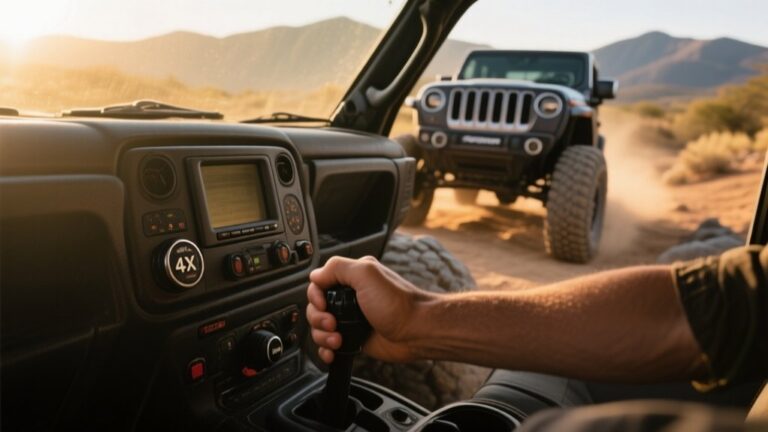
- Move the 4WD lever. Firmly but smoothly shift the lever from 2WD to 4WD. You’ll feel it engage without forcing it.
- Maintain steady speed. Keep your speed consistent as the system engages. Avoid sudden acceleration or braking.
How to Recognize When 4WD Is Fully Engaged
After you’ve smoothly moved the 4WD lever and maintained a steady speed, you’ll want to verify that your Jeep Wrangler’s 4WD system has fully engaged. Look for the 4WD indicator light on your dashboard—it usually illuminates when the system is active.
Listen closely for a subtle click or mechanical sound signaling the transfer case locking in. You may also notice a slight change in how the vehicle handles, such as improved traction and steadier movement.
If your Jeep has electronic engagement, the process is often quicker and confirmed by the light. Make sure to keep a steady pace during this time.
Recognizing these signs ensures you’re ready to tackle rough terrain with confidence and that your 4WD system is functioning properly.
Common Mistakes to Avoid When Shifting Into 4WD in Your Jeep
While engaging 4WD in your Jeep Wrangler can enhance off-road performance, you’ll want to steer clear of common mistakes that can damage your drivetrain or reduce system effectiveness. Avoid these pitfalls to keep your Jeep running smoothly:
- Shifting at high speeds: Don’t try to engage 4WD when driving too fast. It’s best to be below 55 mph to prevent driveline binding.
- Ignoring terrain conditions: Engaging 4WD on dry, paved roads can cause unnecessary wear and tear on your transfer case and tires.
- Forcing the lever: If the 4WD doesn’t engage smoothly, don’t force the shifter. Stop, ease off the throttle, and try again to avoid damaging components.
How to Shift Back to 2WD Safely While Driving
Although 4WD provides better traction in challenging conditions, you’ll want to switch back to 2WD once you’re on smoother terrain to preserve your Jeep’s drivetrain.
To do this safely, first reduce your speed to around 10-15 mph. Avoid abrupt acceleration or braking during the shift.
Then, shift the transfer case lever or knob from 4WD to 2WD firmly but smoothly. You don’t need to stop completely unless your owner’s manual specifies it.
After shifting, confirm the indicator light shows 2WD engaged. If you feel any unusual vibrations or noises, slow down and check the transfer case position.
Shifting back promptly when conditions improve helps reduce wear and improves fuel efficiency, keeping your Jeep running smoothly and ready for the next adventure.
Troubleshooting 4WD Engagement Problems While Driving
If your Jeep’s 4WD doesn’t engage smoothly, you’re not alone—it’s a common issue. You’ll want to recognize quick fixes that can get you back on track without stopping.
Let’s look at the most frequent problems and how to troubleshoot them while driving.
Common 4WD Engagement Issues
When you try shifting into 4WD on your Jeep Wrangler and it doesn’t engage smoothly, it can be frustrating and even concerning. Several common issues might be causing this problem:
- Low or Contaminated Transfer Case Fluid: If the fluid is dirty or low, the transfer case can struggle to engage properly.
- Worn or Damaged Shift Linkage: Misaligned or broken linkage can prevent the 4WD system from engaging when you shift.
- Faulty Front Axle Actuator: On models with electronic locking hubs, a malfunctioning actuator can stop the front wheels from locking in 4WD.
Knowing these common culprits helps you understand what might be going wrong, setting the stage for effective troubleshooting and repair.
Quick Fixes On-The-Go
Understanding common reasons why your Jeep Wrangler’s 4WD won’t engage sets you up to tackle problems quickly while on the trail.
If your 4WD sticks, first check if you’re at the right speed—generally under 55 mph is best. Try gently rocking the shift lever between 2WD and 4WD; sometimes it just needs a little nudge to engage.
Listen for the front differential engaging; no sound may mean an electrical issue with the actuator or a blown fuse.
If your Jeep has a manual hub system, make sure the hubs are locked.
Ultimately, don’t hesitate to pull over safely and inspect the linkage or cables for visible damage.
These quick checks can save you from getting stuck and keep your adventure moving.
How Your Jeep’s 4WD System Affects Shifting
Your Jeep’s 4WD system type plays a big role in how you shift while driving—manual and electronic setups work differently.
You’ll notice that electronic shifting is often quicker and easier, while manual requires more hands-on control.
Understanding these differences helps you maintain better vehicle performance on various terrains.
Types Of 4WD Systems
Because Jeep Wranglers come with different 4WD systems, knowing which one your vehicle has will help you shift smoothly while driving. Each system engages differently and requires specific shifting techniques to avoid damage and maximize performance.
Here are the three main types you’ll encounter:
- Part-Time 4WD – You manually shift between 2WD and 4WD modes, usually at low speeds or while stopped. Engaging on the fly needs caution to prevent drivetrain binding.
- Full-Time 4WD – This system powers all wheels constantly, allowing seamless shifting without driver input for different terrains.
- Automatic 4WD – Sensors detect wheel slip and automatically engage 4WD, letting you focus solely on driving without manual shifts.
Identify your system to shift confidently and keep your Jeep running smoothly.
Electronic Vs. Manual Shifting
Whether you prefer the tactile feedback of a manual lever or the convenience of electronic controls, the way your Jeep Wrangler shifts into 4WD directly impacts how smoothly and quickly you can respond to changing terrain.
With a manual shifter, you physically move the lever to engage 4WD, giving you direct control and immediate feedback. This hands-on approach can make it easier to feel confident during sudden shifts.
On the other hand, electronic shifting uses buttons or switches that activate the system with minimal effort, often allowing shifts at higher speeds without clutching or braking. Electronic systems typically prevent incorrect shifting, reducing wear and tear.
Understanding your Jeep’s system helps you shift appropriately, ensuring safer and more effective 4WD engagement when you need it most.
Impact On Vehicle Performance
Although shifting into 4WD might seem straightforward, the type of 4WD system in your Jeep Wrangler plays an essential role in how the vehicle performs and responds during the process. You’ll notice differences depending on whether your Jeep has part-time, full-time, or automatic 4WD systems.
Here’s how each affects shifting:
- Part-time 4WD: Requires you to stop or slow down for smooth engagement, preventing drivetrain damage.
- Full-time 4WD: Allows shifting on the fly with minimal performance impact, thanks to its center differential.
- Automatic 4WD: Adjusts power distribution seamlessly, so you barely notice when it shifts.
Understanding your system helps you shift efficiently while maintaining traction, control, and drivetrain health on all terrains.
Keep Your Jeep’s 4WD System in Top Shape
To keep your Jeep’s 4WD system functioning smoothly, you need to perform regular maintenance and inspections. Check the transfer case fluid and change it according to your owner’s manual to prevent wear and overheating.
Inspect the drivetrain components for damage or leaks, especially after off-road trips.
Keep an eye on your tires, as uneven wear can stress the 4WD system.
Engage the 4WD periodically, even if you don’t need it, to keep the parts lubricated and responsive.
Don’t overlook unusual noises or difficulty shifting into 4WD—address these issues promptly with a trusted mechanic.
Frequently Asked Questions
Can I Use 4WD on Dry Pavement Without Damaging My Jeep?
You shouldn’t use 4WD on dry pavement because it can cause drivetrain binding and damage. Save 4WD for slippery or off-road conditions where extra traction is needed. Stick to 2WD for normal dry road driving.
Does Shifting Into 4WD Reduce Fuel Efficiency?
You know what they say, “You don’t get something for nothing.” Using 4WD does reduce your fuel efficiency because it engages more drivetrain components, increasing resistance and fuel consumption, so use it only when necessary to save gas.
How Does Tire Size Affect 4WD Performance?
Tire size affects 4WD performance by changing your Jeep’s gearing and traction. Larger tires improve ground clearance but may strain the drivetrain and reduce fuel efficiency. Smaller tires offer better fuel economy but less off-road capability.
Will 4WD Help if My Jeep Is Stuck in Mud?
When your Jeep’s wheels sink like quicksand in mud, 4WD is your lifeline—it spreads power evenly, helping you claw out instead of spinning uselessly. So yes, it’ll definitely increase your chances of getting unstuck.
Can I Shift Into 4WD With Automatic Transmission Models?
Yes, you can shift into 4WD with automatic transmission models. Just make sure you’re driving at a low speed, usually under 25 mph, and follow your Jeep’s manual for specific steps to avoid damaging the drivetrain.
Conclusion
Shifting into 4WD while driving your Jeep Wrangler keeps you ready for tough terrain, guarantees better control, and protects your vehicle. Remember to shift at the right speed, follow the steps carefully, and watch for full engagement indicators. When it’s time to switch back, do it safely to maintain smooth handling. Stay attentive, maintain your system regularly, and troubleshoot issues promptly to keep your Jeep performing at its best every time you hit the road.