How to Fit 33-Inch Tires on a Stock Jeep Wrangler
You can fit 33-inch tires on your stock Jeep Wrangler by first measuring the clearance around your current tires, fenders, and suspension components to avoid rubbing. You might need to trim fender flares slightly for extra space and check if a mild suspension lift is necessary for better clearance and ride quality. Upgrading your brakes and balancing the new tires is essential for safety. Keep proper tire pressure and alignment for performance. Keep exploring to get all the details for a smooth upgrade.
Key Takeaways
- Measure current tire clearance to fenders and suspension to confirm 33-inch tires fit without major modifications.
- Trim stock fender flares carefully to prevent rubbing during turns and suspension travel.
- Consider a 1.5–2 inch suspension lift if clearance is minimal for better fit and off-road performance.
- Upgrade brakes and inspect components to handle increased tire size and weight safely.
- Recalibrate the speedometer and adjust tire pressure and alignment after installation for optimal performance.
Can You Fit 33-Inch Tires on a Stock Jeep Wrangler?
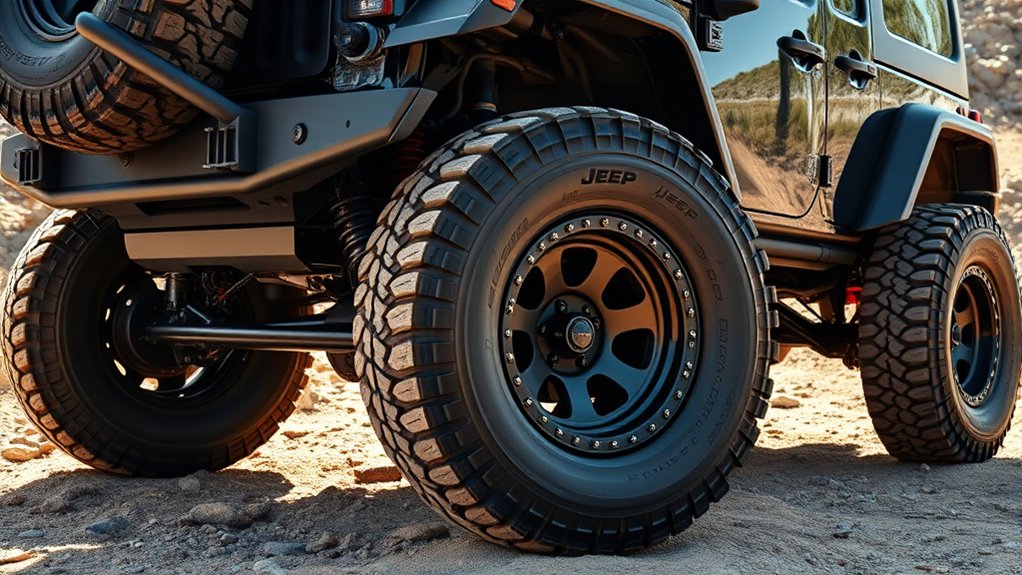
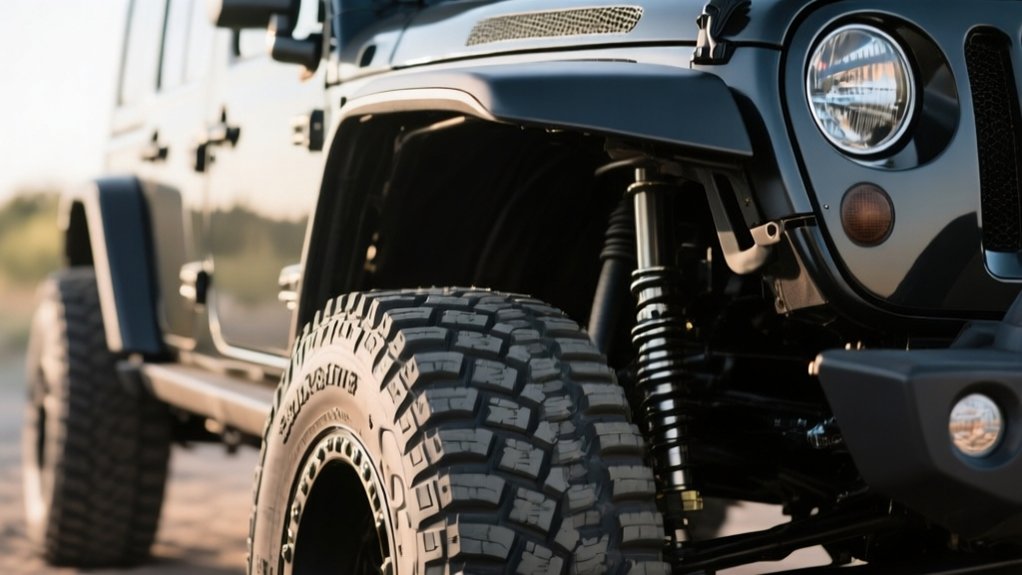
Wondering if you can fit 33-inch tires on a stock Jeep Wrangler? The good news is, you usually can. Most stock Jeep Wranglers, especially the JK and JL models, come with enough clearance to handle 33-inch tires without major modifications.
You might notice slight rubbing on the fenders or suspension components during sharp turns or off-road maneuvers, but it’s generally manageable. However, your experience can vary depending on the specific model year and trim.
Keep in mind, while the tires will fit physically, the extra size could affect your speedometer accuracy and fuel economy.
Choosing the Right 33-Inch Tires for Your Wrangler Model
Although fitting 33-inch tires on your Jeep Wrangler is possible, choosing the right tires is vital for performance and safety. You’ll want tires that match your Wrangler’s specific model and driving needs.
Consider all-terrain tires if you split time between highways and trails, or mud-terrain tires for more aggressive off-roading.
All-terrain tires suit mixed highway and trail driving, while mud-terrain tires excel in tough off-road conditions.
Look for tires with the correct load rating to handle your vehicle’s weight without compromising handling. Pay attention to the tire’s width and sidewall height too—these affect ride comfort and clearance.
Don’t forget to check manufacturer recommendations and user reviews to find reliable brands that fit your budget.
Picking the right 33-inch tires ensures you maintain traction, fuel efficiency, and overall driving confidence on and off the road.
How to Measure Clearance for 33-Inch Tires on Your Jeep
Before installing 33-inch tires on your Jeep, you need to accurately measure the clearance to guarantee they fit without rubbing or causing damage. Start by measuring the distance between your current tire and the fender, both at the top and sides.
Use a tape measure to check the gap between the tire and suspension components, like the control arms and shocks.
Don’t forget to measure the space in the wheel wells when the wheels are turned fully left and right, as this is where rubbing often occurs.
Also, measure the vertical clearance from the tire to the fender lip.
Record all these measurements and compare them to the dimensions of the 33-inch tires you plan to install.
This assures you know exactly how much room you have before making any changes.
Deciding If You Need a Suspension Lift for 33-Inch Tires
When you upgrade to 33-inch tires, you’ll need to assess whether your Jeep’s stock suspension can handle the extra size without causing rubbing or clearance issues. Start by checking your current ride height and wheel well space.
If there’s minimal clearance between your tires and suspension components or the inner fender, a suspension lift becomes necessary. A lift of 1.5 to 2 inches usually provides enough room for 33-inch tires without compromising handling or causing damage.
However, if your Jeep already has adequate clearance, you might get away without lifting. Keep in mind, a suspension lift not only prevents rubbing but also improves off-road capability and suspension travel.
Ultimately, weigh your Jeep’s current setup against your tire size to decide if lifting is the smarter move.
Adjusting Fender Flares for 33-Inch Tires
You’ll need to trim your fender flares carefully to fit 33-inch tires without rubbing.
Make sure to leave enough clearance for suspension travel and steering angles.
Proper adjustments will keep your Jeep looking sharp and running smoothly.
Fender Flare Trimming Tips
Although stock fender flares are designed to cover smaller tires, they often require trimming to accommodate 33-inch tires properly. Start by cleaning the flares and marking the areas where the tires rub or stick out too much.
Use painter’s tape to outline your cut lines; this helps keep cuts straight and protects the plastic from cracking. Use a rotary tool or a fine-toothed saw for precise trimming, cutting slowly to avoid damaging the flare.
After trimming, smooth the edges with sandpaper to prevent sharp spots. Test fit the tires often during the process to ensure you’re removing just enough material.
Ensuring Proper Tire Clearance
How much clearance do your 33-inch tires need to move freely without rubbing? You should aim for at least one inch of space between the tire and the fender flare when the suspension is fully compressed and the wheels are turned.
To ensure this, carefully trim or adjust your fender flares as needed. Start by measuring the current gap and marking areas where the tire contacts the flare during full articulation.
Use a cutting tool or heat gun to reshape the plastic flares, making sure not to remove too much material at once.
After adjustments, test by turning the wheels and compressing the suspension to confirm there’s no rubbing.
Proper clearance prevents damage and maintains your Wrangler’s off-road capability.
How Wheel Backspacing and Offset Affect 33-Inch Tire Fit
Wondering why backspacing and offset matter when fitting 33-inch tires on your stock Jeep Wrangler? These measurements determine how your wheels sit relative to the suspension and fenders, impacting clearance and handling. Backspacing is the distance from the mounting surface to the wheel’s inner edge, while offset is how far the mounting surface is from the wheel’s centerline. Choosing the right specs prevents tire rubbing and suspension interference.
| Term | Definition | Effect on 33-Inch Tires |
|---|---|---|
| Backspacing | Distance from mounting surface inward | Too much causes tire rub inside fender |
| Offset | Distance from wheel centerline | Low offset pushes tires outward, increasing clearance |
| Proper Fit | Balanced backspacing & offset | Ensures tire clearance and avoids suspension contact |
How to Regear Your Jeep’s Axles for 33-Inch Tires
To keep your Jeep running smoothly with 33-inch tires, you’ll need to regear your axles with the right gear ratio. Selecting the correct ratio guarantees your engine doesn’t strain and maintains proper power delivery.
Let’s go over the basic steps involved in installing new gears so you know what to expect.
Gear Ratio Selection
Since upgrading to 33-inch tires changes your Jeep Wrangler’s effective gearing, you’ll need to regear your axles to maintain ideal performance and fuel efficiency. Choosing the right gear ratio balances power, fuel economy, and drivability. Generally, going with a ratio close to stock gearing ensures your engine won’t strain.
Here’s a quick guide:
| Tire Size | Recommended Gear Ratio | Notes |
|---|---|---|
| 31-inch | 3.73 | Stock or slight upgrade |
| 33-inch | 4.10 | Ideal for 33-inch tires |
| 35-inch | 4.56 | For larger tires |
| 37-inch | 4.88 | Heavy off-road builds |
For 33-inch tires, 4.10 gears restore your Jeep’s torque and keep highway cruising smooth without sacrificing fuel economy too much.
Installation Process Overview
Although regearing your Jeep’s axles may seem intimidating, following a clear installation process will make fitting 33-inch tires much smoother.
First, you’ll need to lift the Jeep and securely support it on jack stands. Next, remove the wheels, brake calipers, and rotors to access the axles.
Drain the differential fluid, then unbolt and remove the differential cover. Carefully extract the ring and pinion gears, noting their orientation.
Clean all components thoroughly before installing your new gear set, guaranteeing proper tooth contact and backlash.
Reassemble the differential with a new gasket and refill with fresh gear oil.
Finally, reinstall brakes and wheels, then lower your Jeep.
Test drive to confirm smooth operation and correct gear engagement. Taking your time during each step ensures a successful regearing.
Checking and Upgrading Brakes for Larger Tires
How will your Jeep handle the extra weight and size of 33-inch tires when it comes to stopping power? Larger tires add rotational mass, meaning your stock brakes may struggle to slow down effectively. To guarantee safety, you need to check and potentially upgrade your braking system.
Larger 33-inch tires increase rotational mass, so upgrading your Jeep’s brakes is crucial for safe stopping power.
Here’s what you should focus on:
- Inspect your brake pads and rotors for wear; larger tires demand more stopping force.
- Upgrade to heavy-duty brake pads designed for off-road or larger tire setups.
- Consider installing larger or vented rotors to improve heat dissipation and braking efficiency.
- Check your brake lines and fluid—upgraded lines and fresh fluid improve responsiveness.
How to Balance and Mount 33-Inch Tires Safely
Before you hit the road with your new 33-inch tires, you’ll want to guarantee they’re balanced and mounted correctly to avoid vibrations and premature wear.
Start by cleaning the wheel and rim surfaces thoroughly to ensure a proper seal. When mounting, use a reliable tire mounting machine or visit a professional to prevent damage to the tire bead.
After mounting, balance each tire and wheel assembly precisely using a wheel balancer. Proper balancing distributes weight evenly, reducing vibrations and improving ride quality.
Don’t forget to double-check that the lug nuts are torqued to the manufacturer’s specifications.
Taking these steps assures your larger tires perform safely and smoothly, protecting your Jeep’s suspension and enhancing your driving experience.
Maintaining Performance and Fuel Economy With 33-Inch Tires
Once your 33-inch tires are properly balanced and mounted, focusing on maintaining your Jeep’s performance and fuel economy becomes key. Larger tires can affect handling and gas mileage, but you can minimize these effects with some smart steps.
- Keep Tire Pressure Suitable – Check and maintain the recommended tire pressure regularly to reduce rolling resistance.
- Adjust Your Driving Style – Avoid rapid acceleration and hard braking to improve fuel efficiency.
- Align and Rotate Tires Often – Proper alignment and rotation prevent uneven wear and keep your Jeep running smoothly.
- Upgrade Gear Ratios if Needed – Consider adjusting your differential gears to help maintain power and efficiency with bigger tires.
Following these tips helps you enjoy the benefits of 33-inch tires without sacrificing too much performance or mpg.
Troubleshooting Common Issues After Installing 33-Inch Tires
Although upgrading to 33-inch tires can enhance your Jeep Wrangler’s look and capability, you might encounter some common issues after installation. You may notice rubbing, inaccurate speedometer readings, or changes in handling. Addressing these quickly guarantees safety and performance.
| Issue | Solution |
|---|---|
| Tire rubbing | Trim fender liners or install spacers |
| Speedometer error | Recalibrate or use a speedometer tuner |
| Handling changes | Adjust alignment and tire pressure |
| Increased vibration | Balance tires and check suspension |
If rubbing persists, consider a lift kit. For handling, ensure proper tire pressure and alignment. Keeping an eye on these factors helps you enjoy your new tires without compromising your Jeep’s reliability.
Frequently Asked Questions
What Tools Are Essential for Installing 33-Inch Tires on a Jeep?
You’ll need a lug wrench, jack, jack stands, torque wrench, and an impact wrench if possible. Don’t forget a tire pressure gauge and breaker bar to loosen tight lug nuts safely before swapping your 33-inch tires.
Can 33-Inch Tires Affect My Jeep’s Warranty?
Yes, 33-inch tires can affect your Jeep’s warranty if they cause damage or issues. Manufacturers might deny claims related to suspension, drivetrain, or ABS problems linked to the tire upgrade. Always check your warranty terms carefully.
How Often Should I Rotate 33-Inch Tires on My Wrangler?
You should rotate your 33-inch tires every 5,000 to 7,000 miles to guarantee even wear. Regular rotation helps maintain traction, extends tire life, and improves your Wrangler’s overall performance on and off-road.
Are 33-Inch Tires Suitable for Daily City Driving?
City cruising with 33-inch tires can cause cautious concerns. You’ll notice a rougher ride, reduced fuel efficiency, and trickier traction in tight turns. Still, if you’re careful and maintain them, they’ll manage daily drives just fine.
What Is the Average Cost of Upgrading to 33-Inch Tires?
You’ll usually spend around $800 to $1,200 for a set of 33-inch tires, including mounting and balancing. Prices vary based on brand and tire type, so shop around to find deals that fit your budget.
Conclusion
Fitting 33-inch tires on your stock Jeep Wrangler is totally doable with the right prep. Did you know that 33-inch tires can improve your off-road traction by up to 20%? Just make sure to measure clearance, consider a suspension lift if needed, and adjust your fender flares. Don’t forget to check your brakes and balance those tires properly. With these steps, you’ll enjoy better performance without sacrificing safety or fuel economy.